
Effective provider credentialing strategies focus on preparation, accurate provider data, clear workflow ownership, disciplined payer follow-up, expiration tracking, and separate management of credentialing, contracting, enrollment, and effective dates. These steps can reduce preventable internal delays, but no strategy can guarantee how quickly a payer or credentialing organization will make a decision.
Provider credentialing becomes difficult when practices treat it as a single application instead of an ongoing administrative process.
A provider file may involve licensing, credentialing, CAQH information, payer enrollment, contracting, group affiliation, location setup, recredentialing, and renewal activity. Each part has different requirements and may be controlled by a different organization.
The strongest credentialing strategy is therefore not simply “submit earlier.” It is to create a system that makes missing information, outstanding tasks, payer requests, and upcoming deadlines visible before they become problems.
Why Do Provider Credentialing Delays Happen?
Credentialing delays can result from internal issues, external processing, or both.
Internal causes may include:
- Incomplete provider information
- Missing documents
- Expired credentials
- Unanswered payer requests
- Incorrect application data
- Unclear responsibility for follow-up
- Failure to distinguish credentialing from enrollment
External causes may include:
- Primary source verification
- Payer processing queues
- Credentialing committee schedules
- Network availability
- Contracting review
- Licensing-board processing
- Medicare or Medicaid review
A good credentialing strategy should minimize problems the practice can control while accurately tracking the ones it cannot.
1. Start With the Right Provider Data
Before submitting applications, build a complete provider record.
Depending on the provider and payer, this may include:
- Legal and professional name
- Type 1 NPI
- Specialty and taxonomy
- Professional licenses
- Education and training
- Work history
- Board certification when applicable
- DEA registration when applicable
- Professional liability coverage
- Practice locations
- CAQH information
Practices should maintain a clear provider credentialing document checklist rather than rebuilding the file for each payer.
2. Do Not Use One Status for the Entire Credentialing Process
A common operational mistake is labeling everything simply as “credentialing pending.”
Instead, track separate milestones such as:
| Milestone | What It Means |
|---|---|
| Application preparation | Required information is being collected or reviewed |
| Submitted | Payer or organization has received the application |
| Credentialing review | Provider qualifications are being evaluated |
| Contracting | Participation terms are being established where applicable |
| Enrollment | Provider or organization is being established in the payer system |
| Affiliation | Provider is being linked to the appropriate group or location |
| Effective | Payer has confirmed the applicable participation date |
This prevents a practice from assuming that credentialing approval automatically means billing is ready.
3. Prepare Before You Submit
The best time to identify missing information is before the payer does.
Review each application for:
- Unanswered questions
- Work-history gaps requiring explanation
- Expired documents
- Incorrect practice locations
- Incomplete ownership information
- Missing signatures or attestations
- Outdated professional liability information
Do not submit incomplete information simply to “get the clock started” unless the payer specifically permits it.
Our guide to credentialing application red flags covers common submission problems in more detail.
4. Maintain CAQH Provider Data Carefully
Many commercial health plans use provider information maintained through the CAQH Provider Data Portal, now under DataSpring branding.
Practices should monitor:
- Provider demographics
- Practice locations
- Professional licenses
- Work history
- Professional liability coverage
- DEA information where applicable
- Required attestations
- Organization authorizations
A complete CAQH profile does not mean the payer has completed credentialing or enrollment.
For more detail, see our CAQH Provider Data Portal guide.
5. Assign Clear Responsibility for Every Application
Credentialing work often stalls because several people assume someone else is managing the next step.
Every application should have:
- An assigned owner
- A current status
- A last-action date
- A next-action date
- Outstanding requirements
- A documented payer reference number where available
When responsibility changes, another team member should be able to review the record and understand the full application history without searching through multiple email threads.
6. Build a Structured Follow-Up Process
Submitting the application is not the end of the workflow.
Payers and credentialing organizations may request:
- Additional documentation
- Clarification
- Updated licenses
- Corrected applications
- Ownership information
- Missing attestations
A follow-up record should include:
- Date contacted
- Method of contact
- Representative or department
- Reference or case number
- Current status
- Outstanding issue
- Next follow-up date
Follow-up helps identify unresolved cases. It does not guarantee that the payer will accelerate its review.
Our credentialing follow-up process guide provides a structured workflow for managing these cases.
7. Track Provider Credentials Before They Expire
Credentialing is not finished when the initial application is approved.
Practices may need to monitor:
- Professional license expiration
- Professional liability policy dates
- DEA registration where applicable
- Board certification where applicable
- CAQH attestation requirements
- Recredentialing
- Medicare or Medicaid revalidation
These items do not all renew on the same schedule.
A central expiration tracker should identify the provider, credential, issuing organization, expiration date, responsible staff member, and renewal status.
8. Treat Recredentialing as Its Own Workflow
Recredentialing should not be treated as a last-minute extension of initial credentialing.
NCQA credentialing standards address periodic recredentialing as well as ongoing monitoring of practitioner sanctions, complaints, and quality issues between formal review cycles. For practical monitoring steps, use our credentialing quality audit checklist.
Practices should:
- Track known recredentialing cycles
- Respond to payer requests promptly
- Maintain current supporting documents
- Confirm final participation status
See our provider recredentialing process guide for the ongoing maintenance workflow.
9. Use Technology to Manage Work, Not to Assume Approval
Credentialing platforms can help teams organize:
- Provider profiles
- Documents
- Expiration dates
- Applications
- Follow-ups
- Assignments
- Renewals
Automation can also generate reminders or flag missing information.
However, the platform should not automatically treat a payer application as approved simply because a deadline passed or no new response was received.
True payer integrations and automated status retrieval vary by platform and payer.
Our credentialing platforms guide explains what practices should evaluate before selecting technology.
10. Centralize Credentialing for Multi-Provider Organizations
As an organization adds providers and locations, separate spreadsheets and individual inboxes become harder to manage.
A centralized credentialing model can provide one operational view of:
- Providers
- Facilities
- Payers
- Applications
- Documents
- Follow-up activity
- Effective dates
- Renewals
This can reduce duplicate internal work while still recognizing that each payer or government program may require its own external process.
See our guide to centralized credentialing for multi-provider practices.
11. Coordinate Credentialing With Billing
Credentialing teams and billing teams should exchange information before claims problems appear.
The credentialing team should communicate:
- Provider effective dates
- Network product participation
- Group affiliations
- Location additions
- Terminations
- Enrollment changes
Billing teams should report patterns such as:
- Provider-not-found denials
- Claims processing as out-of-network
- Location-related denials
- Unexpected provider enrollment edits
Not every claim denial is a credentialing problem, but repeated provider-status denials can expose enrollment or affiliation issues that the credentialing team needs to investigate.
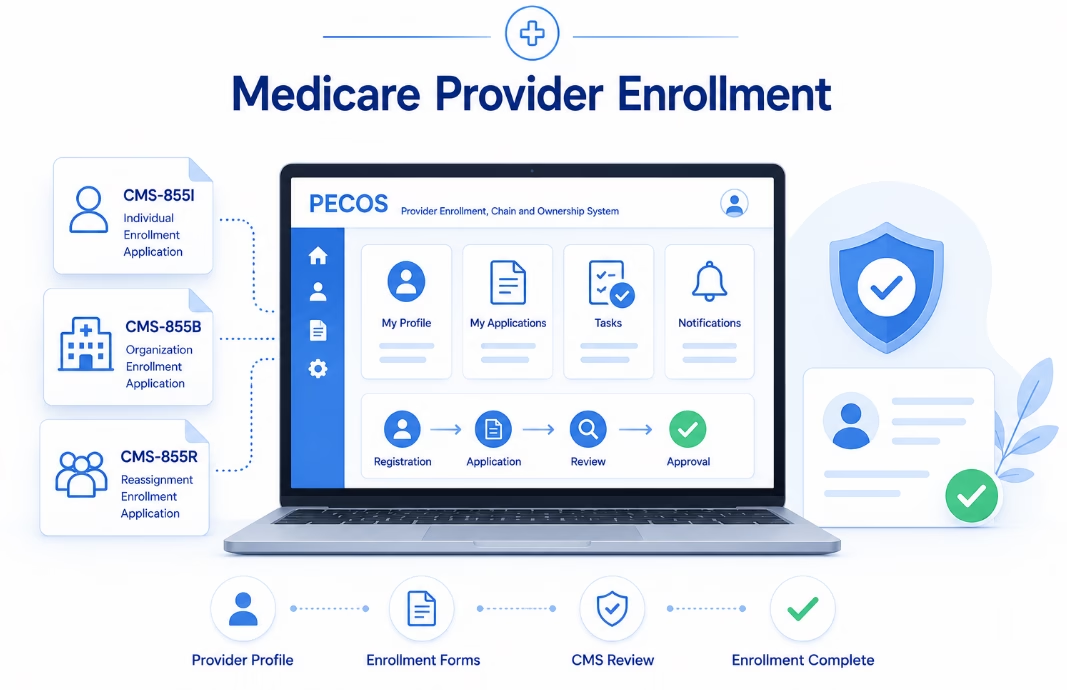
12. Handle Medicare Enrollment Separately
Medicare enrollment should not be managed as though it were simply another commercial payer credentialing application.
CMS uses PECOS as its online Medicare enrollment management system.
CMS currently directs eligible providers and suppliers to:
- Obtain an NPI.
- Complete the applicable Medicare enrollment application.
- Submit required documentation.
- Work with the applicable Medicare Administrative Contractor during processing.
PECOS is also used for enrollment updates and revalidation.
A credentialing system can track Medicare work internally, but CMS and its contractors remain responsible for Medicare enrollment processing.
13. Audit the Credentialing Workflow, Not Just Provider Files
A credentialing audit should examine both provider records and the process used to manage them.
Review:
- Missing documentation
- Expired credentials
- Applications without recent activity
- Cases with no assigned owner
- Overdue follow-ups
- Unconfirmed effective dates
- Unresolved payer requests
The goal is to identify operational weakness before it affects provider onboarding or enrollment status.
14. Do Not Rely on “Good Payer Relationships” as a Credentialing Strategy
Professional communication with payer representatives is valuable, especially when clarification or escalation is needed.
However, credentialing decisions should be based on the payer’s requirements and the provider’s qualifications rather than assumptions that a strong relationship will produce faster approval.
When communicating with a payer, focus on obtaining clear information:
- What is the current status?
- Is anything missing?
- What department owns the next step?
- Is credentialing complete?
- Is contracting complete?
- Has enrollment been loaded?
- What is the confirmed effective date?
How Should You Measure Credentialing Performance?
A strong credentialing program should measure what the organization can actually influence.
Useful operational metrics may include:
- Percentage of applications submitted complete
- Number of cases awaiting internal information
- Number of overdue follow-ups
- Number of credentials expiring soon
- Average time from internal file readiness to submission
- Applications without an assigned owner
- Applications awaiting payer action
- Confirmed effective dates received
Be careful with a single “credentialing turnaround time” metric because external payer processing may account for much of the total elapsed time.
Provider Credentialing Strategy Checklist
| Strategy | What to Confirm |
|---|---|
| Provider data | Core demographic and professional information is complete and current |
| Documents | Required documents are available, current, and tied to the correct provider |
| Application QA | Missing information and obvious discrepancies are resolved before submission |
| Ownership | Every case has a responsible staff member |
| Follow-up | Last contact, current status, and next action are documented |
| Milestones | Credentialing, contracting, enrollment, affiliation, and effective date are tracked separately |
| Renewals | Licenses, policies, registrations, recredentialing, and revalidation are monitored |
| Billing communication | Billing receives accurate participation and effective-date information |
| Audit | Pending and overdue work is reviewed regularly |
Frequently Asked Questions
How long does provider credentialing take?
There is no universal timeline. Processing depends on the payer or organization, provider type, application completeness, verification requirements, network availability, contracting, and other factors.
Does following up more often make credentialing faster?
Follow-up can identify missing information and stalled applications, but it cannot guarantee faster payer review. The goal is to prevent avoidable inactivity and understand what action is required next.
Can credentialing software speed up the process?
Software can improve internal organization, reminders, document management, and tracking. It does not control external payer processing or guarantee approval.
Does outsourcing credentialing guarantee faster approvals?
No. An experienced outside team may improve application preparation and administrative follow-up, but credentialing and network decisions remain with the applicable payer or organization.
Does credentialing approval mean the provider can bill?
Not necessarily. Contracting, enrollment, group affiliation, location setup, and a confirmed effective date may still need to be completed.
Is recredentialing the same as license renewal?
No. Professional license renewal is managed by the applicable licensing authority. Recredentialing is an organization’s periodic reevaluation of the provider’s qualifications.
Is Medicare credentialing handled through CAQH?
No. Medicare enrollment is managed through CMS enrollment processes, primarily PECOS for online applications. CAQH does not replace Medicare enrollment.
Build a Credentialing Process That Prevents Avoidable Problems
The strongest provider credentialing strategies focus on areas the practice can control: accurate information, complete documentation, clear ownership, disciplined follow-up, renewal tracking, and separation of credentialing from contracting and enrollment.
Technology and outside support can make those workflows easier to manage, but they do not replace payer review or guarantee an approval date.
eClinicAssist supports healthcare organizations with provider credentialing, payer enrollment, CAQH management, provider documentation, contracting coordination, application follow-up, effective-date tracking, renewals, and related administrative workflows.
Contact eClinicAssist to discuss credentialing and payer enrollment support for your providers.
This article provides general administrative information and is not legal, contractual, billing, accreditation, or compliance advice. Credentialing and enrollment requirements vary by payer, provider type, state, network, organization, and government program. Verify current requirements with the applicable payer, licensing authority, healthcare organization, or government program.