
Practice owners should not wait until a provider’s first day to start the credentialing process.
In most cases, the strongest approach is to begin credentialing before hiring is fully operational, or during late-stage hiring, and then submit payer applications once the employment relationship, start date, practice locations, tax structure, group affiliation, and required authorizations are sufficiently confirmed.
That distinction is important.
The real question is usually not simply credentialing before hiring vs after hiring.
A better question is:
Which credentialing tasks can safely begin before the provider officially starts, and which tasks require finalized employment or payer-specific information?
For growing medical practices, getting this timing right can reduce onboarding delays, prevent billing problems, and help a newly hired provider become productive sooner.
Key Takeaways
- Do not wait until a provider’s first working day to begin credentialing preparation.
- Start collecting and validating provider credentials during late-stage recruitment or immediately after an offer is accepted.
- A signed offer or employment agreement is often a strong operational trigger for the credentialing process.
- Do not submit estimated employment dates, locations, tax information, affiliations, or other inaccurate payer information simply to get an application started.
- CAQH, NPPES, Medicare enrollment, commercial payer credentialing, contracting, and payer enrollment are related, but they are not the same thing.
- Approval from one payer does not mean the provider is ready to see patients under every insurance plan.
- Never assume claims can automatically be billed retroactively after credentialing is completed.
- Credentialing readiness should be considered during provider onboarding, not discovered by the billing department after the provider starts seeing patients.
Should Credentialing Start Before or After Hiring?
For most practices, provider credentialing preparation should begin before the provider’s first day of employment.
However, that does not mean every payer application should be submitted before the employment relationship is finalized.
A better strategy is to separate the process into two stages.
| Before the Provider Starts | After Required Details Are Confirmed |
|---|---|
| Collect credentials | Submit payer applications |
| Review professional licenses | Complete payer enrollment |
| Verify NPI information | Add provider to applicable group contracts |
| Review CAQH profile | Complete Medicare reassignment when applicable |
| Verify malpractice information | Confirm payer effective dates |
| Review work history | Complete payer-specific follow-up |
| Identify missing documents | Resolve payer development requests |
| Build priority payer list | Confirm billing readiness |
| Identify possible network issues | Update payer directories and systems |
This staged approach is generally safer than either extreme.
Waiting until Day 1 creates unnecessary delays.
Submitting applications too early, before the provider’s employment, locations, group affiliation, or tax information are confirmed, can create a different set of problems.
Why Waiting Until After Hiring Can Be Costly
Consider a common scenario.
A medical practice spends weeks recruiting a physician, nurse practitioner, physician assistant, therapist, or specialist.
The provider accepts the position.
A start date is scheduled.
Marketing begins.
Patients are placed on the calendar.
Payroll starts.
Then someone asks:
Has credentialing been started?
If the answer is no, the practice may suddenly have a provider who is clinically ready to work but does not yet have the payer participation needed to support the expected insurance revenue.
Credentialing does not happen instantly.
Payer processing times can vary significantly, and applications may require additional documents, corrections, contracting, enrollment, or follow-up before the provider becomes fully operational.
Your practice cannot control every payer’s turnaround time.
You can control when your internal preparation begins.
What Credentialing Tasks Can Start Before the Provider’s First Day?
Quite a lot.
The earliest stage of credentialing is largely about collecting information, validating provider data, identifying problems, and preparing for payer enrollment.
Once a candidate becomes a serious finalist, and especially once the provider accepts a written offer, the credentialing team can begin building the provider’s file.
1. Collect the Provider’s Core Credentials
Depending on the provider type and payer requirements, the credentialing file may include:
- National Provider Identifier (NPI)
- State professional license
- DEA or controlled-substance registration, when applicable
- Board certification
- Education and postgraduate training
- Work history
- Hospital affiliations
- Professional liability insurance
- Government identification
- W-9 information, where applicable
- Specialty information
- Taxonomy
- Disclosure information
- Credentialing contact information
- CAQH access or authorization
Starting early can identify expired documents, missing information, or inconsistencies before they become payer problems.
2. Review the Provider’s CAQH Profile
For many commercial payers, the provider’s CAQH information is an important part of the credentialing process.
Review the profile for:
- Current practice information
- Professional licenses
- Malpractice coverage
- Work-history gaps
- Education
- Hospital affiliations
- Specialty
- Supporting documents
- Attestation status
One important point:
A complete CAQH profile does not mean the provider has been approved by a payer.
CAQH provides professional information to authorized organizations. Individual payers still determine their own credentialing, enrollment, contracting, and participation status.
3. Review NPPES and Other Provider Records
Credentialing teams should compare the provider’s information across relevant systems.
Look for inconsistencies involving:
- Legal name
- NPI
- Taxonomy
- Practice address
- Mailing address
- Specialty
- Individual versus organizational information
A minor mismatch may not look serious during hiring, but it can result in additional payer requests or delays after applications are submitted.
4. Determine Which Payers Matter Most
Not every provider needs to be submitted to every payer at the same time.
Prioritize credentialing according to the practice’s actual patient population and revenue needs.
A typical priority list may include:
- Medicare
- Medicaid and applicable Medicaid managed care plans
- High-volume commercial payers
- Medicare Advantage plans
- Smaller commercial networks
This helps the credentialing team focus resources on the insurance plans most important to the provider’s expected schedule.
5. Check Payer Network Availability
Credentialing does not automatically guarantee network participation.
A provider can be fully qualified and still encounter a payer network that is closed, restricted, or not currently accepting additional providers in that specialty or geographic area.
Credentialing and contracting are also separate processes.
This is why network availability should sometimes be investigated before a practice builds revenue expectations around a new provider.
When Should Formal Payer Credentialing Begin?
For many practices, the strongest operational trigger is when:
The provider has accepted the position, the relationship is documented, and the information required for payer applications is sufficiently finalized.
At that point, the credentialing process can move from preparation into submission.
Ideally, the practice should know the provider’s:
- Expected start date
- Practice entity
- Tax ID
- Billing NPI
- Individual provider NPI
- Practice location or locations
- Specialty
- Taxonomy
- Rendering arrangement
- Group affiliation
- Employment relationship
- Contact information
- Malpractice arrangement
- Priority payer list
Requirements can vary by payer.
The goal is not to delay applications unnecessarily. It is to avoid submitting information that is incomplete, estimated, or likely to change.
Prepare early. Submit accurately.
Can You Bill Retroactively While Credentialing Is Pending?
This is one of the most dangerous assumptions practices can make during provider onboarding.
The provider begins seeing patients.
Credentialing is still pending.
The practice assumes:
Once credentialing is approved, we’ll just bill everything retroactively.
That is not a safe general strategy.
Effective-date and retrospective billing rules can vary depending on:
- Payer
- Healthcare program
- State
- Provider type
- Network
- Contract
- Enrollment transaction
Medicare has specific rules governing effective dates and retrospective billing under qualifying circumstances.
Commercial payer rules may be different.
Services performed before the provider’s participation effective date may, depending on the payer and contract, be treated as out-of-network or may not be payable under the anticipated arrangement.
The safer rule is simple:
Never schedule or bill patients based only on the assumption that a future credentialing approval will solve the problem retroactively.
Verify the provider’s actual effective date and payer-specific billing rules first.
Credentialing Before Hiring vs After Hiring: A Better Workflow
The strongest credentialing process is not simply “before” or “after.”
It is a staged provider onboarding workflow.
Phase 1: Candidate Becomes a Serious Finalist
Perform a high-level credentialing readiness review.
Confirm:
- Provider type
- Specialty
- Active licenses
- States of practice
- NPI
- CAQH status
- Expected payer needs
- Obvious credentialing barriers
You do not necessarily need to launch payer applications at this stage.
The goal is to identify problems before they surprise the practice.
Phase 2: Offer Is Accepted
An accepted offer should trigger the full credentialing file.
Begin:
- Collecting documents
- Reviewing provider data
- Correcting inconsistencies
- Identifying payer requirements
- Preparing applications
- Establishing the priority payer list
For many practices, this is the most valuable period in the entire provider onboarding timeline.
Recruiting is essentially complete, but the provider may not have started payroll yet.
Use that time.
Phase 3: Employment and Practice Details Are Confirmed
Once payer-required information is accurate and finalized, begin the applicable payer submissions.
Track every payer independently.
A useful credentialing tracker might include:
| Payer | Status | Submitted | Last Follow-Up | Effective Date |
|---|---|---|---|---|
| Medicare | Submitted | Aug. 12 | Aug. 26 | Pending |
| Commercial Plan A | Credentialing | Aug. 15 | Sept. 1 | Pending |
| Commercial Plan B | Contracting | Aug. 18 | Sept. 3 | Pending |
| Medicaid Plan | Documents Requested | Aug. 20 | Sept. 4 | Pending |
Avoid using one generic status such as “credentialing“
A provider may simultaneously be:
- Approved by one payer
- Under credentialing review with another
- Waiting for contracting with a third
- Missing documents for a fourth
Each payer should be tracked separately.
Phase 4: Before the First Patient Is Scheduled
Before treating the provider as fully ready, verify the actual payer status.
Ask:
- Has credentialing been approved?
- Has payer enrollment been completed?
- Has contracting been finalized where required?
- What is the participation effective date?
- Is the provider correctly loaded in the payer system?
- Is the correct service location associated with the provider?
- Is the provider linked to the correct group or billing entity?
- Can payer eligibility systems recognize the provider correctly?
- Has the billing team been notified?
This is the difference between being credentialed and being operationally ready to bill.
A Provider Credentialing Example
Consider a primary care practice hiring a new nurse practitioner.
The NP accepts an offer on August 1 and is expected to start on November 1.
Practice A Waits Until the Start Date
November 1 arrives.
The provider starts payroll.
The schedule opens.
Only then does the practice begin requesting:
- CAQH access
- Malpractice information
- Work history
- Professional licenses
- Payer applications
- Enrollment documents
The provider is clinically ready to work.
The payer infrastructure is not.
Practice B Starts Credentialing During Onboarding
Practice B opens the credentialing file as soon as the offer is accepted.
During the first week, the credentialing team:
- Verifies the NPI
- Reviews CAQH
- Collects licenses
- Confirms malpractice coverage
- Reviews work history
- Identifies payer requirements
- Checks provider information across systems
- Creates a priority payer list
Once employment, group, location, and tax information are confirmed, payer-specific applications begin.
By November 1, some payers may be approved while others remain pending.
That does not mean the credentialing process failed.
It means the practice knows exactly where every payer stands and can build the provider’s schedule around verified participation instead of assumptions.
Practice B did not make the insurance companies process applications faster.
It simply used the time between hiring and the provider’s start date instead of wasting it.
Should Credentialing Affect the Hiring Decision?
Sometimes.
Credentialing should not determine whether a qualified healthcare professional deserves to be hired.
But administrative readiness should be part of workforce and financial planning.
Before setting expectations around a provider’s start date, consider:
- Is the provider licensed in the required state?
- Is the license current and unrestricted?
- Does the provider’s specialty align with the practice’s payer contracts?
- Is the CAQH profile current?
- Are there unexplained work-history gaps?
- Is appropriate malpractice coverage available?
- Will additional state licensing be required?
- Are important payer networks accepting new providers?
- Will Medicare or Medicaid enrollment be required?
- Is a new service location involved?
- Does the provider need to be linked to an existing group contract?
A provider may still be an excellent hire even when credentialing requires additional work.
The key is knowing about those requirements before the start date becomes a financial commitment.
What Should Be Included in a Credentialing-Ready Hiring Packet?
A strong healthcare provider onboarding process connects HR and credentialing instead of treating them as completely separate functions.
Once the provider accepts the position, trigger a standardized credentialing packet.
Provider Identity
Collect the required:
- Legal name
- NPI
- Contact information
- Authorized identification information
- Other information required for enrollment activities
Professional Credentials
Collect:
- Professional licenses
- Board certification
- DEA or other registrations, when applicable
- Education
- Training
- Malpractice information
- Hospital affiliations
- Work history
Practice Assignment
Document the intended:
- Group
- Facility
- Practice location
- Specialty
- Tax structure
- Billing arrangement
- Expected start date
System Access and Authorization
Determine whether access or authorization is needed for:
- CAQH
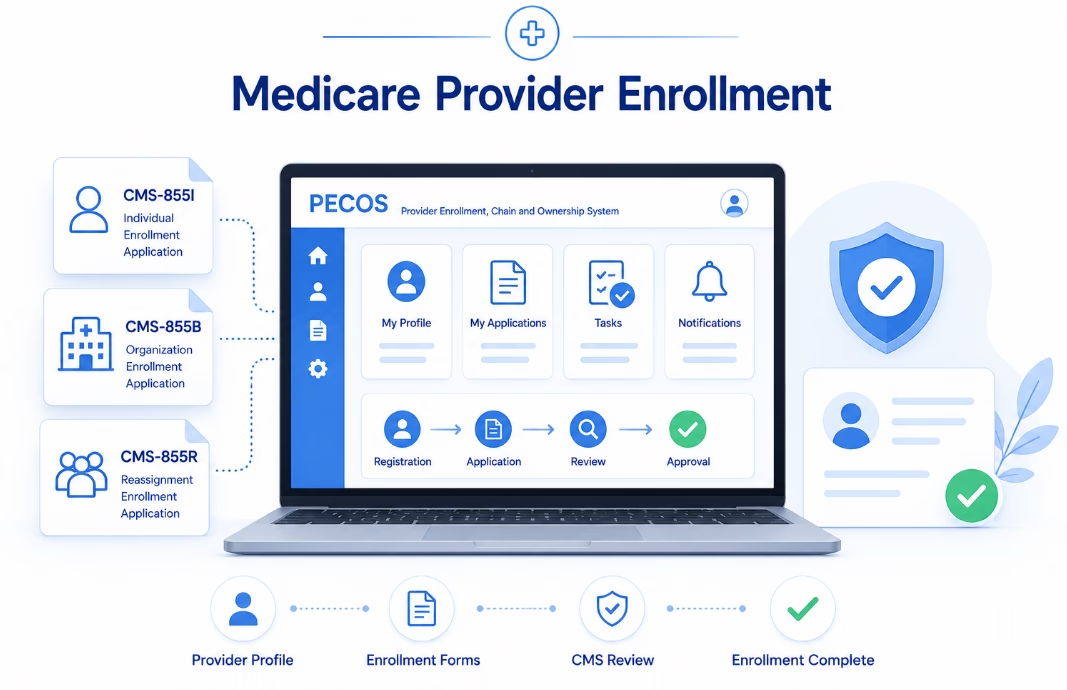
- PECOS
- Commercial payer portals
- State Medicaid systems
- Other enrollment platforms
Credentialing Follow-Up Ownership
Every payer application should have:
- Responsible owner
- Submission date
- Confirmation or reference number
- Current status
- Last follow-up date
- Next follow-up date
- Outstanding requirement
- Approval date
- Effective date
This transforms credentialing from a collection of paperwork into a managed operational workflow.
How Can Practices Reduce the Gap Between Hiring and Revenue?
Focus on the portion of the credentialing timeline your practice can actually control.
You cannot force a payer to review an application sooner.
You can prevent a completed application from sitting in your own office for three weeks before anyone submits it.
Start Credentialing Preparation Earlier
Begin a credentialing readiness review during late-stage recruitment and move into full preparation once an offer is accepted.
Use a Standard Credentialing Checklist
Do not rebuild the onboarding process every time a provider joins the practice.
Create a standardized document checklist for physicians, NPs, PAs, therapists, and other provider types.
Keep Provider Data Consistent
Compare information across:
- NPPES
- PECOS, when applicable
- CAQH
- Payer records
- Internal credentialing records
Resolve inconsistencies before applications are submitted whenever possible.
Track the Payer Application, Not Just the Provider
A note that says:
Dr. Smith is being credentialed
provides very little operational information.
A better status is:
Dr. Smith → Commercial Payer → credentialing review → last follow-up Sept. 10 → additional document requested → response submitted Sept. 11
That tells management what is actually happening.
Separate Credentialing, Contracting, Enrollment, and Effective Dates
These milestones are not interchangeable.
An application can be submitted without being approved.
Credentialing can be completed while contracting is still pending.
A contract can be signed while payer enrollment is still being loaded.
An approval notice may also carry a specific effective date.
Track each milestone independently.
Credentialing Is Part of Workforce Planning
Practice owners often treat hiring and credentialing as two separate processes.
They should be connected.
A better workflow looks like:
Recruit → Evaluate → Offer → Credentialing Readiness → Provider Onboarding → Payer Enrollment → Approval → Effective Date → Scheduling → Billing
Provider credentialing sits directly between workforce planning and revenue cycle management.
When credentialing begins too late:
- Provider scheduling becomes more difficult.
- Front-desk staff may not know which patients can safely be scheduled.
- Eligibility results may create confusion.
- Billing teams may receive claims that cannot yet be submitted correctly.
- Practice owners may carry payroll while expected payer revenue is delayed.
- Credentialing staff are pressured to solve a timeline problem that could have been prevented.
Starting earlier does not eliminate every payer delay.
It can eliminate many self-created delays.
Frequently Asked Questions About Credentialing Before Hiring
Can you start credentialing a provider before they are hired?
Yes, credentialing preparation can often begin before the provider’s first working day, particularly once the provider has accepted an offer and authorized the necessary process.
Formal payer submissions should follow payer requirements and use accurate information concerning employment, group affiliation, locations, tax structure, and other required details.
How early should provider credentialing begin?
There is no single timeline that applies to every payer.
The practical goal is to begin as early as reasonably possible once the provider relationship is sufficiently established.
Practices should avoid waiting until the provider’s first day to begin collecting documents and identifying payer requirements.
Does a completed CAQH profile mean a provider is credentialed?
No.
CAQH makes provider information available to authorized organizations. Each payer still determines its own credentialing, enrollment, contracting, and participation status.
Can a provider see patients while credentialing is pending?
It depends on the payer, contract, provider type, state requirements, network rules, and billing arrangement.
Practices should verify the provider’s actual payer participation and effective date before assuming services can be billed as in-network.
Will insurance pay claims retroactively after credentialing?
Not necessarily.
Retroactive billing and effective-date rules vary by payer and healthcare program.
Never rely on assumed retroactive approval when deciding whether to schedule insured patients.
Is credentialing the same as payer enrollment?
No.
Credentialing generally involves verifying the provider’s professional qualifications.
Contracting establishes the terms of network participation.
Enrollment connects the provider with the payer’s administrative and claims systems.
Completing one stage does not automatically mean the others are complete. This distinction is also emphasized in the original article. Credentialing Before Hiring vs …
Should credentialing be completed before setting a provider start date?
Not necessarily.
Waiting for every payer to approve the provider before establishing a start date may be impractical.
A better approach is to assess credentialing readiness early, begin payer processes as soon as permitted, and understand which payer approvals are expected to be active by the provider’s start date.
Turn Provider Hiring Into Provider Readiness
Credentialing before hiring does not mean rushing payer applications before the facts are known.
It means refusing to wait until a provider’s first day to discover what credentialing work still needs to be completed.
Strong practices connect:
Recruiting, provider credentialing, payer enrollment, onboarding, scheduling, and billing into one coordinated workflow.
Start collecting credentials early.
Resolve data inconsistencies before payer submissions.
Begin enrollment as soon as the provider relationship and required information are sufficiently confirmed.
Track each payer separately.
Most importantly, verify the provider’s effective date and billing readiness before treating the provider as fully in-network.
Need Help Managing Provider Credentialing?
Claims Med helps medical practices manage provider credentialing, payer enrollment, document collection, application follow-up, recredentialing, and ongoing credentialing requirements.
If you are preparing to hire a physician, nurse practitioner, physician assistant, therapist, or other healthcare provider, starting credentialing early can help prevent avoidable onboarding and revenue delays.
Contact eClinicAssist to discuss your provider credentialing needs.