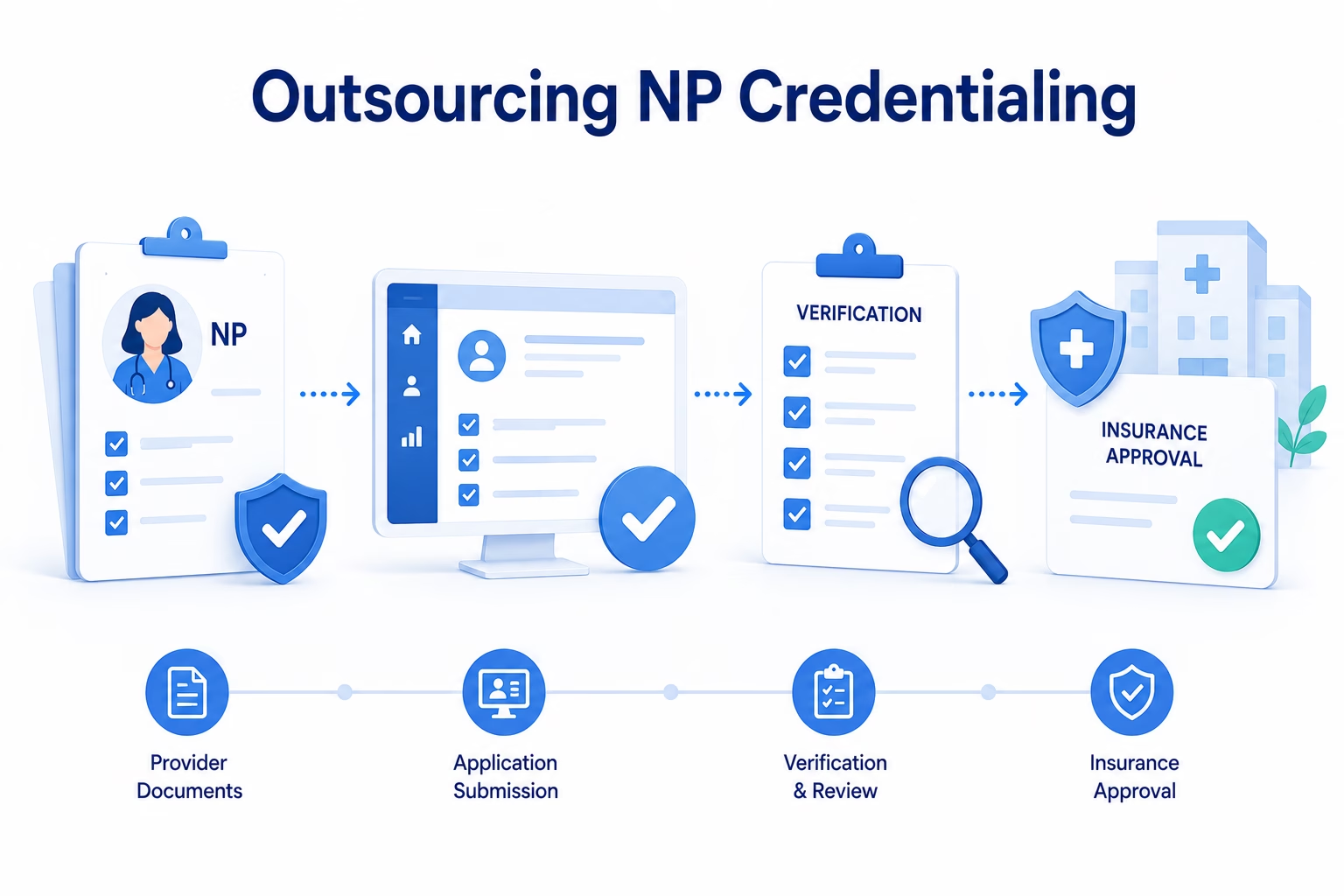

Outsourcing provider credentialing can make financial and operational sense when payer applications, follow-ups, recredentialing, and provider data maintenance are consuming staff time or delaying onboarding. However, outsourcing is not automatically cheaper or faster. The right decision depends on your workload, internal resources, payer complexity, growth plans, and the level of visibility you need.
A practice comparing a $200 credentialing invoice with “doing it ourselves for free” is comparing the wrong numbers.
Internal credentialing has costs too. Staff time, management oversight, payer follow-up, training, missed deadlines, rework, document management, provider interruptions, revalidation tracking, and delayed payer readiness can all affect the true cost of managing credentialing internally.
At the same time, hiring an outside credentialing company does not guarantee payer approval, eliminate payer processing times, or transfer every compliance responsibility away from the practice.
So, should you outsource provider credentialing?
For many healthcare practices, the answer may be yes. For others, a strong internal credentialing team or hybrid model may provide better value.
The key is understanding what credentialing is actually costing your organization and what you expect outsourcing to improve.
Key Takeaways
- Outsourcing can be especially valuable when credentialing competes with billing, collections, scheduling, HR, provider onboarding, or other operational responsibilities.
- Publicly advertised credentialing prices vary significantly, depending on the provider, payer, state, specialty, volume, and service scope.
- Credentialing ROI should consider internal labor, management time, rework, onboarding delays, technology, and ongoing maintenance, not just the vendor invoice.
- An outsourced credentialing company cannot force a payer to approve an application faster.
- Outsourcing can reduce preventable internal delays caused by incomplete documents, inconsistent information, missed follow-ups, and forgotten deadlines.
- Practices should understand the difference between credentialing, payer enrollment, contracting, recredentialing, and EDI/EFT/ERA enrollment.
- Larger organizations may benefit from a hybrid approach in which internal leadership retains strategic control while an outside team manages execution.
- Effective credentialing outsourcing should increase visibility and control rather than simply produce more submitted applications.
What Does It Mean to Outsource Provider Credentialing?
To outsource provider credentialing means assigning some or all credentialing and payer enrollment responsibilities to an outside organization rather than having practice employees manage every step internally.
The scope can vary considerably.
One credentialing company may only prepare and submit payer applications. Another may manage a broader credentialing lifecycle that includes:
- Provider document collection
- CAQH profile maintenance
- Commercial payer enrollment
- Medicare enrollment
- Medicaid enrollment
- Payer follow-up
- Recredentialing
- Expiring document tracking
- Demographic changes
- Provider and location updates
- Application status reporting
- Effective date confirmation
- EFT, ERA, or EDI enrollment when included in scope
This difference is important when comparing credentialing companies.
A low-cost application submission service and a full-service credentialing management program are not necessarily comparable simply because both are described as “credentialing.”
Healthcare practices should determine exactly what services are included before comparing prices.
How Much Does Outsourced Provider Credentialing Cost in 2026?
There is no universal price for outsourced provider credentialing.
Costs can depend on:
- Number of providers
- Number of payers
- Specialty
- State
- Organization type
- Existing payer participation
- Medicare or Medicaid requirements
- Number of locations
- Application complexity
- Level of ongoing management
- Recredentialing and maintenance requirements
Publicly advertised 2026 pricing shows considerable variation.
Some credentialing companies advertise approximately $100 to $300 per provider-payer application, while others publish ranges closer to $200 to $500 per application. Broader provider credentialing packages may cost several thousand dollars depending on the payer panel and service scope.
These figures are useful for general budgeting, but they are vendor-published market examples. They should not be treated as an official or standardized credentialing fee schedule.
Common Credentialing Pricing Models
| Pricing Model | How It Works | Often Fits |
|---|---|---|
| Per payer/application | Fee for each provider-to-payer application | Solo providers, new practices, occasional enrollments |
| Per provider | Fixed fee covering an agreed payer panel | Practices with predictable onboarding volume |
| Monthly management | Recurring fee for credentialing management and maintenance | Multi-provider or growing practices |
| Project/package | One price for a defined credentialing project | New practices, acquisitions, or expansion |
| Hybrid pricing | Base management fee plus transaction fees | Groups with changing credentialing volume |
The lowest quote is not always the lowest-cost option.
Before comparing proposals, determine whether the price includes CAQH maintenance, Medicare, Medicaid, commercial payers, recredentialing, payer follow-up, demographic changes, new locations, provider reassignments, EFT/ERA/EDI setup, contracting support, appeals, and effective-date confirmation.
A low base price can become expensive if most of the work your practice needs is billed separately.
Is In-House Provider Credentialing Really Cheaper?
Sometimes it is.
However, having an existing office manager or administrator does not make credentialing free.
Imagine an office manager who already handles scheduling, staffing, patient issues, billing escalations, vendor relationships, compliance responsibilities, and provider onboarding.
Adding credentialing to that workload does not remove the other responsibilities.
Something else receives less attention.
That opportunity cost is often overlooked because it does not appear as a separate credentialing expense on the practice’s financial statements.
Credentialing is also not a one-time activity.
Provider information must be maintained. Licenses expire. Malpractice policies renew. Payers request updated information. Medicare enrollment records require ongoing maintenance and periodic revalidation.
The true internal cost therefore extends far beyond completing an initial application.
It includes maintaining a system that continues to work months and years after a provider becomes participating.
How Should You Calculate Provider Credentialing ROI?
Credentialing ROI should not be calculated simply as:
Outsourcing fee vs. employee salary
A more useful framework is:
Credentialing ROI Formula
Credentialing ROI =
Internal labor avoided
- Management time avoided
- Rework avoided
- Financial value of preventable delays reduced
− Outsourcing cost
Divided by outsourcing cost × 100
Not every practice needs to assign an exact dollar amount to every component.
The value of this calculation is that it forces management to identify where credentialing is actually consuming resources.
A Simple Credentialing ROI Example
Consider a four-provider practice that is hiring two additional clinicians.
Assume the practice expects approximately 20 provider-payer enrollment transactions during onboarding.
For illustration, suppose each transaction requires an average of five staff hours when application preparation, documentation, portal work, payer calls, corrections, follow-ups, and status tracking are combined.
That equals:
20 transactions × 5 hours = 100 staff hours
If the fully loaded administrative labor cost is approximately $35 per hour:
100 hours × $35 = $3,500
Now assume an outsourced credentialing service charges $150 per transaction:
20 transactions × $150 = $3,000
Based only on labor, outsourcing appears to save about $500.
That alone may not represent a significant ROI.
But the calculation changes if outsourcing also returns 100 hours to an office manager who can focus on patient operations, staffing, collections, billing issues, or other higher-value responsibilities.
The value may increase further if stronger tracking prevents a missing document, forgotten payer request, expired credential, or application from remaining untouched for several weeks.
The reverse can also be true.
If your existing credentialing specialist has available capacity, strong payer knowledge, reliable systems, and only a few applications each year, outsourcing may increase costs without creating enough additional value.
Credentialing ROI should therefore be calculated for the individual practice.
Can Outsourcing Provider Credentialing Make the Process Faster?
It can make the parts controlled by your practice faster.
It cannot control the payer.
A credentialing company can help ensure that documentation is collected early, applications are complete, payer requests are answered, follow-ups occur consistently, and outstanding requirements are visible.
Those improvements can reduce unnecessary internal delays.
Once a complete application enters a payer’s review process, however, the credentialing company generally cannot control committee schedules, payer processing queues, network availability, or final participation decisions.
This distinction is important.
A responsible credentialing company should be able to promise consistent process management.
It should not promise guaranteed payer approval within an arbitrary number of days.
When Does Outsourcing Provider Credentialing Make the Most Sense?
1. Your Practice Is Growing
Adding providers, facilities, specialties, or states can multiply credentialing work quickly.
One new provider enrolling with eight payers may create eight separate payer workflows before Medicare, Medicaid, reassignment, location changes, and electronic transaction enrollments are considered.
As an organization grows, informal spreadsheets and memory-based follow-up become increasingly difficult to manage.
2. Credentialing Is a Side Job for Your Office Manager
This is one of the strongest signs that outsourcing may deserve consideration.
Credentialing requires consistent follow-up and attention to detail.
If the responsible employee is constantly interrupted by patients, staffing issues, scheduling, billing questions, and daily operations, credentialing tasks can remain “in process” for far too long.
3. Providers Start Before Payer Enrollment Is Ready
This often indicates a provider onboarding problem rather than simply a credentialing problem.
Credentialing should begin early enough in the hiring process to allow documentation, applications, payer follow-up, and enrollment activities to move forward before the provider is expected to begin billing participating payers.
For a deeper look at planning ahead, see Provider Credentialing Timeline: What Every Practice Should Know.
4. Nobody Can Clearly Explain Each Application’s Status
Ask one question:
Where does each provider stand with each payer?
“In credentialing” is not a sufficient answer.
A useful credentialing status should show:
- Payer
- Submission date
- Current stage
- Outstanding requirements
- Last follow-up
- Next follow-up
- Effective date when available
Without that level of visibility, management cannot tell whether a delay belongs to the practice, the credentialing company, or the payer.
5. Recredentialing and Expiring Documents Are Managed Reactively
Initial enrollment usually receives attention because a new provider is waiting to participate.
Ongoing maintenance is easier to overlook.
Licenses expire. Malpractice policies renew. CAQH information needs updating. Medicare enrollment requires maintenance. Payers request new information.
A strong credentialing operation should identify these requirements before they become urgent.
When Is Keeping Credentialing In-House Better?
Outsourcing provider credentialing is not automatically the best choice.
A large medical group with experienced credentialing staff, mature workflows, specialized technology, documented SOPs, strong reporting, and enough ongoing work to fully utilize its team may have little reason to outsource the core credentialing function.
Keeping credentialing internal can also make sense when an organization requires close coordination between credentialing, medical staff services, privileging, legal, contracting, recruitment, and complex organizational structures.
The more useful question is not simply:
Should credentialing be internal or outsourced?
Instead ask:
Which model gives our organization the best combination of accuracy, visibility, accountability, continuity, and cost control?
For some organizations, the answer is a hybrid model.
Internal leadership retains payer strategy, contracts, provider relationships, policy decisions, and escalation authority.
An outside credentialing team manages applications, submissions, follow-ups, provider data maintenance, recredentialing, and reporting.
That structure can preserve organizational control while reducing the amount of transactional work performed internally.
What Should You Outsource and What Should Stay Under Practice Control?
Even when using full-service credentialing support, healthcare practices should retain control of important business decisions and account access.
An external credentialing company may manage:
- Provider document collection
- Application preparation
- Payer portals
- Payer follow-up
- CAQH maintenance
- Medicare enrollment transactions
- Roster updates
- Recredentialing tracking
- Demographic changes
- Application reporting
Practice leadership should generally retain control over employment decisions, payer strategy, contract acceptance, banking authorization, legal attestations, ownership disclosures, organizational representations, and access governance.
This becomes particularly important with Medicare enrollment.
A credentialing partner may assist your organization with enrollment and PECOS-related processes, but the provider or organization should still understand what information is being submitted in its name.
What Should You Ask Before Hiring a Credentialing Company?
Before selecting a credentialing partner, evaluate the company with the same discipline you would use when selecting a billing or revenue cycle partner.
Ask:
- What exactly is included? Determine whether the scope includes payer enrollment, CAQH, Medicare, Medicaid, commercial payers, recredentialing, EFT/ERA/EDI, contracting support, demographic changes, and new locations.
- Who controls payer and portal access? Your organization should not become dependent on credentials that disappear when the vendor relationship ends.
- How is progress reported? Look for provider-level and payer-level tracking rather than vague weekly updates.
- How frequently are applications followed up? Follow-up should reflect payer-specific requirements rather than an unrealistic promise to contact every payer every day.
- How are missing documents escalated? Outstanding licenses, malpractice certificates, ownership documents, signatures, and other requirements need clear escalation procedures.
- What happens after approval? Confirm whether the service includes verifying the effective date and completing any agreed downstream enrollment tasks.
- What happens if the relationship ends? Your practice should retain access to credentialing records, payer correspondence, confirmation letters, application history, effective dates, and outstanding requirements.
A cheaper credentialing vendor can create additional work if the service lacks visibility, documentation, and accountability.
Credentialing Company vs. CVO: Are They the Same?
Not necessarily.
A practice-side credentialing service may prepare payer applications, maintain provider information, manage enrollments, follow up with payers, and coordinate administrative credentialing workflows.
A Credentials Verification Organization (CVO) performs credential verification functions, including verification of practitioner credentials through appropriate primary or recognized sources.
The distinction matters because the term “credentialing company” is used broadly.
Before evaluating certifications, services, or compliance claims, understand exactly what the organization is being contracted to perform.
Best Practices for Outsourcing Provider Credentialing
Successful credentialing outsourcing should operate as an ongoing operational partnership rather than a simple task handoff.
Start with an accurate provider roster and clearly define the payers, locations, providers, and services included in the engagement. Provide complete credentialing documentation as early as possible and establish who has authority to sign or approve different transactions.
Require application-level tracking rather than general status updates. Establish clear escalation procedures for missing information and delayed payer responses.
Your credentialing system should be able to answer three questions at any time:
What has been completed?
What is blocking progress?
What needs to happen next?
Maintaining a standardized provider credentialing file can also reduce repeated document requests and inconsistent information.
For additional guidance, see Provider Credentialing Documents: Complete Guide.
Practices should also periodically review credentialing information for accuracy, completeness, and expired documents. See Credentialing Quality Audits for Healthcare Practices for a framework for recurring review.
How Do You Know If Credentialing Outsourcing Is Working?
Do not evaluate a credentialing company based on how busy its staff appears.
Measure outcomes.
Useful credentialing KPIs can include application submission turnaround time, applications returned for corrections, outstanding applications by payer, age of pending applications, response time to payer requests, provider start date compared with payer effective date, upcoming revalidations, expired documents, and the percentage of applications with confirmed effective dates.
These measurements also help management separate two very different problems.
If a payer takes 90 days to review a complete application, that is primarily a payer processing issue.
If an application waits internally for three weeks because a required document was never uploaded, that is an operational issue.
Good credentialing reporting should make the difference visible.
Frequently Asked Questions About Outsourcing Provider Credentialing
Is outsourcing provider credentialing worth it for a small practice?
It can be. Small practices may not have enough credentialing volume to justify hiring a full-time credentialing specialist, but assigning payer enrollment to an office manager can take time away from scheduling, billing, staffing, and daily operations.
The decision should be based on credentialing workload, internal capacity, payer complexity, and the scope of the outsourced service rather than practice size alone.
How much does outsourced provider credentialing cost?
Publicly advertised 2026 credentialing prices commonly range around $100 to $300 per provider-payer application, although some companies publish rates of approximately $200 to $500 or package pricing in the thousands for broader payer panels.
Actual pricing varies considerably by provider count, payer count, specialty, location, volume, and service scope.
Will outsourcing guarantee faster payer approval?
No.
A credentialing service can improve document readiness, application accuracy, tracking, follow-up, and response time to payer requests. It cannot control payer processing times, committee schedules, network participation decisions, or guarantee approval.
Can a credentialing company manage Medicare enrollment?
Many provider credentialing companies assist with Medicare enrollment and PECOS-related transactions.
The provider or organization remains responsible for supplying accurate information, providing appropriate authorization, and maintaining its Medicare enrollment information.
Should we outsource credentialing or hire an employee?
Compare annual credentialing volume, employee costs, management time, training, software, backup coverage, payer expertise, and the cost of preventable onboarding delays.
A high-volume organization may have enough work to support an internal credentialing department. Smaller practices, rapidly growing organizations, or practices without specialized credentialing staff may find outsourcing or a hybrid model more practical.
What is the biggest risk when outsourcing credentialing?
One of the biggest operational risks is losing visibility and control.
Avoid arrangements where a vendor controls all payer access, provides vague status updates, or cannot provide a complete history of applications, payer correspondence, outstanding requirements, and effective dates.
Can we outsource credentialing but keep payer contracting in-house?
Yes.
Credentialing administration and payer contracting do not have to be managed by the same party. Many organizations outsource the administrative credentialing workflow while retaining internal authority over payer strategy, negotiations, and contract acceptance.
The service agreement should clearly define where credentialing responsibilities end and contracting authority begins.
Make the Credentialing Decision Based on Control, Not Just Cost
The decision to outsource provider credentialing should not depend only on whether an outside company’s invoice appears cheaper than an employee.
Look at the entire operating model.
Consider how many providers you are onboarding, how many payer relationships must be maintained, who currently manages follow-up, whether leadership can see application status clearly, how recredentialing and expiring documents are tracked, and what other responsibilities your staff is giving up to keep credentialing moving.
Outsourcing works best when it creates more control, not less.
That means cleaner provider data, more consistent applications, scheduled payer follow-up, clear status reporting, earlier escalation, documented effective dates, and a more reliable path from provider onboarding to payer readiness.
eClinicAssist helps healthcare practices manage provider credentialing, payer enrollment, credentialing documentation, follow-ups, recredentialing, and ongoing credentialing workflows through a structured system. If your team is spending too much time chasing applications and payer updates, contact eClinicAssist to discuss a credentialing workflow built around your providers, payer mix, and growth plans.
Disclaimer
This article is intended for general educational and operational purposes and does not constitute legal, regulatory, financial, contracting, or reimbursement advice. Credentialing requirements, payer processes, pricing, effective-date rules, and enrollment obligations vary by payer, provider type, state, organization, and service scope. Pricing examples referenced in this article are publicly published market examples and should not be treated as guaranteed industry rates. Verify applicable requirements and obtain organization-specific pricing before making credentialing or financial decisions.