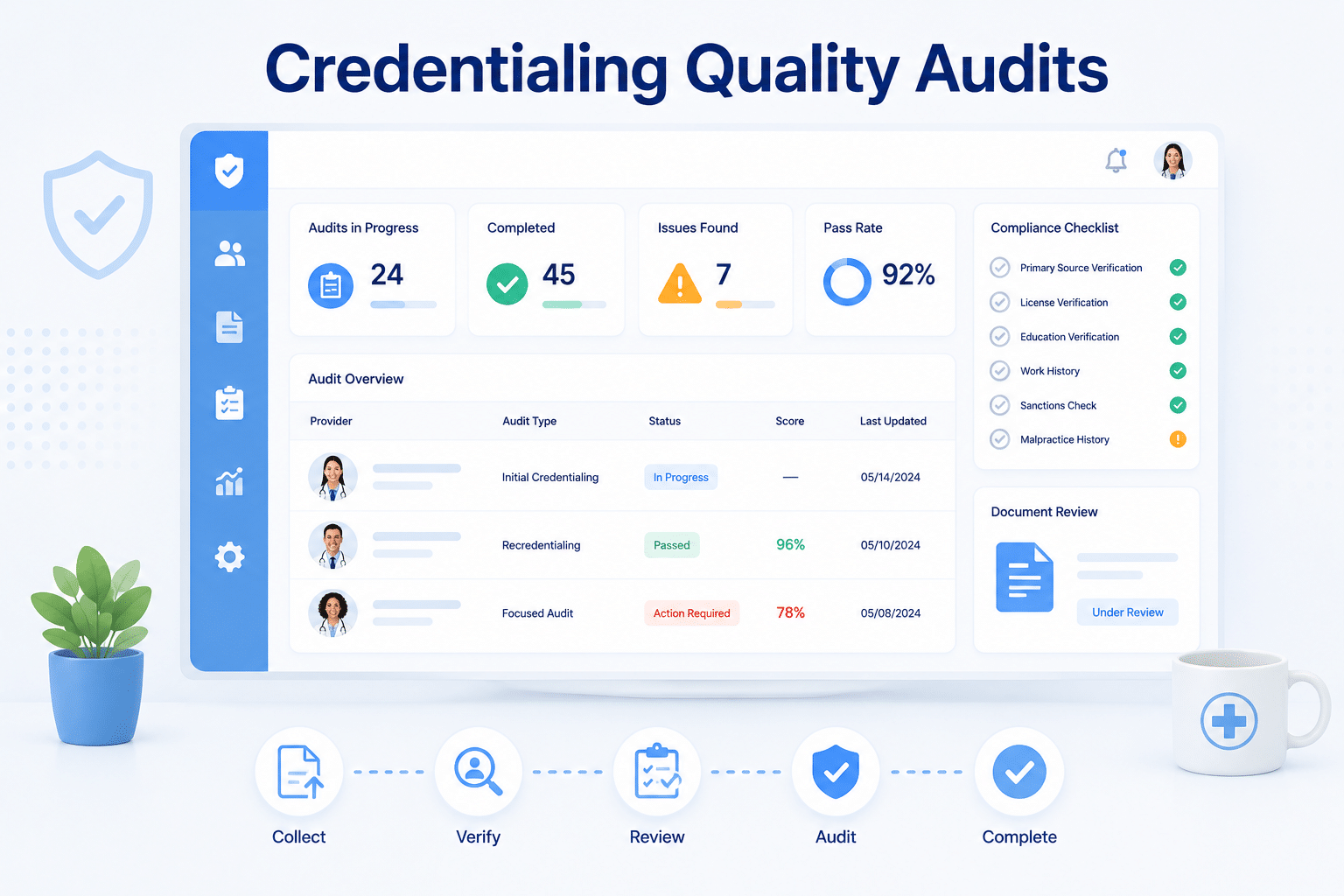
Credentialing quality audits are essential for maintaining accurate provider data, reducing compliance risks, and protecting healthcare revenue. In modern healthcare operations, credentialing quality audits help practices identify errors before they lead to claim denials, payer delays, or failed compliance reviews.
For practice managers, credentialing teams, and healthcare administrators, maintaining accurate credentialing files is no longer optional. Payers, CMS, NCQA, and commercial insurers now expect healthcare organizations to maintain audit-ready records at all times. As a result, practices that rely on outdated or incomplete processes face growing operational and financial risk.
Why Credentialing Quality Audits Matter More Than Ever
Healthcare credentialing has changed significantly in recent years. Regulatory expectations are stricter, payer verification timelines are tighter, and provider data accuracy has become critical for reimbursement.
A missing document or outdated license no longer causes a small delay. Instead, it can disrupt provider enrollment, interrupt medical billing workflows, and create serious revenue cycle management problems.
According to industry data, inconsistencies across payer directories remain one of the leading causes of preventable claim denials. In addition, inaccurate provider data may expose practices to compliance violations under regulations such as the No Surprises Act.
Because of this, healthcare organizations are shifting toward continuous credential monitoring instead of periodic file reviews.
Understanding the Role of Credentialing Quality Audits
Credentialing quality audits are detailed reviews of provider files, verification records, and compliance documentation. Their purpose is to confirm that all provider information is accurate, active, and aligned across systems.
Unlike basic checklist reviews, audits focus on validating information directly from primary sources. This includes verifying licenses with state boards, confirming DEA registrations, reviewing malpractice coverage, and checking exclusion databases.
A strong audit process helps practices:
- Prevent payer enrollment delays
- Reduce claim denials
- Improve healthcare compliance
- Maintain audit readiness
- Protect provider reimbursement timelines
Most importantly, it creates confidence that provider files are complete before payers or regulators identify issues.
Credentialing Checklists and Audit Workflows
Credentialing checklists and audits work together but serve different purposes.
Checklists help teams gather required documents and ensure onboarding requirements are complete. Audits, however, verify the quality and accuracy of that information.
For example:
- A checklist confirms a provider license exists
- An audit confirms the license is active and unrestricted
This distinction is critical for preventing downstream issues in billing and compliance.
Practices that maintain organized provider credentialing documents often experience fewer enrollment delays and faster payer approvals.
Core Areas Every Credentialing Quality Audit Should Review
A complete audit process should evaluate multiple credentialing categories.
Provider Identification and Enrollment Data
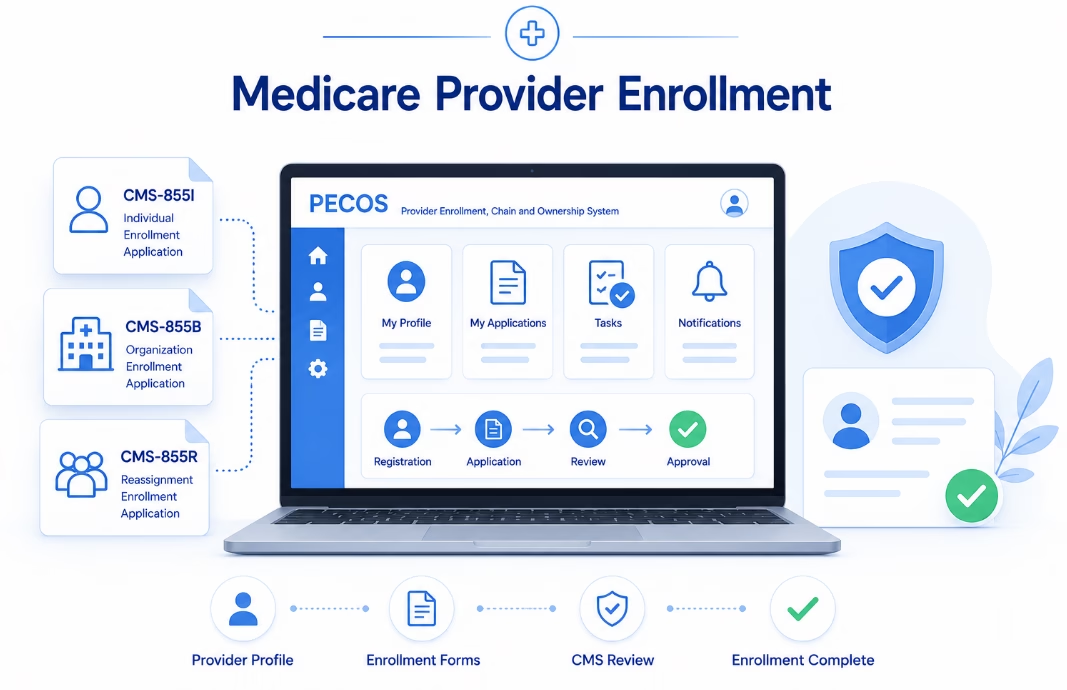
Every audit should verify that provider names, NPIs, CAQH profiles, and tax identification information match across all systems. Even small discrepancies can trigger payer delays or claim rejections.
Licenses and Certifications
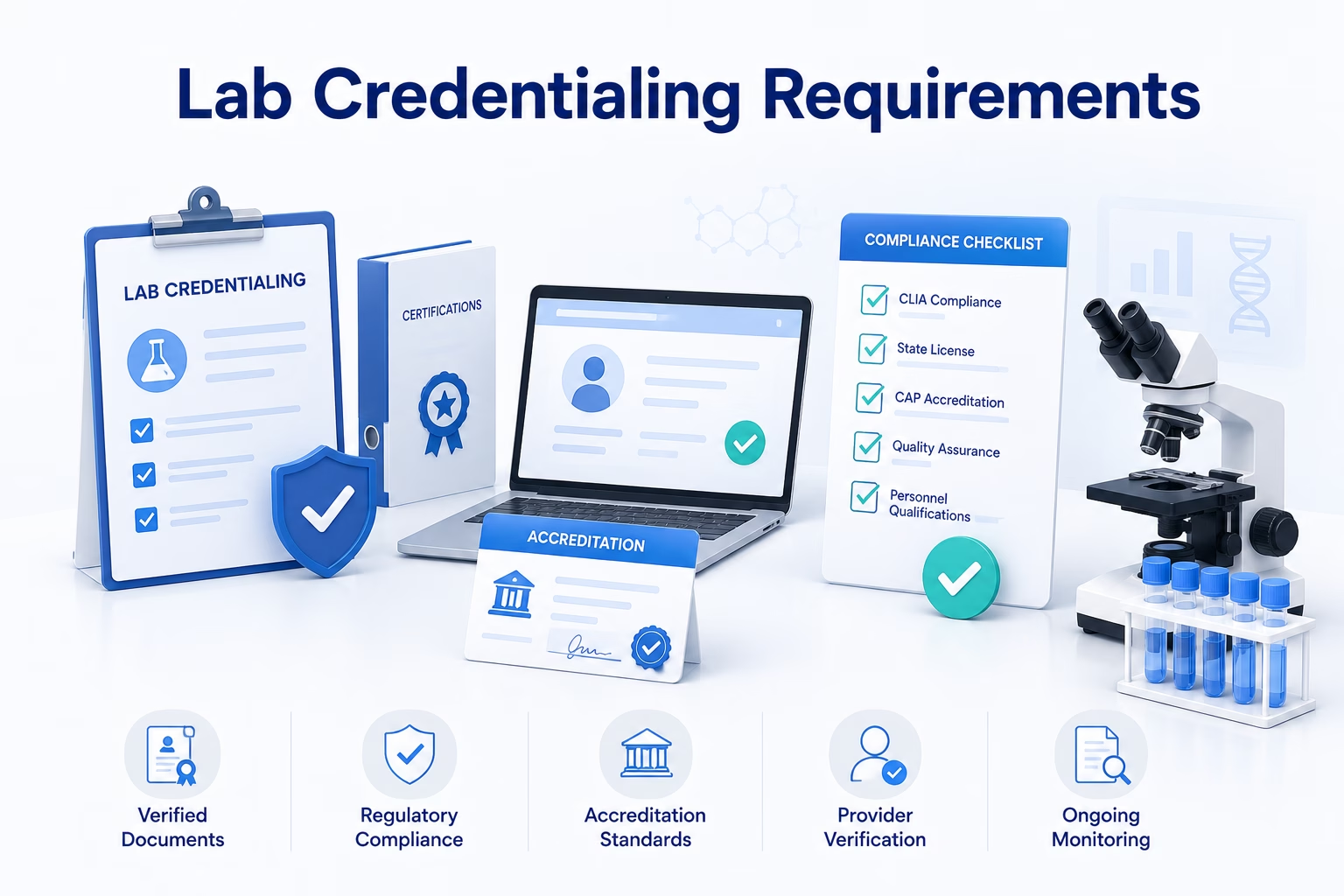
Auditors should confirm that state licenses, DEA registrations, board certifications, and controlled substance permits remain active and current.
Expired documents remain one of the most common reasons for credentialing failures.
Professional History and Education
Work history gaps, incomplete training records, or missing education verification often slow enrollment approvals. Therefore, audit teams should review these areas carefully before payer submission.
Compliance and Exclusion Screening
Credentialing quality audits should also include OIG, SAM.gov, and NPDB screenings to confirm providers are eligible to participate in federal healthcare programs.
Missing exclusion checks create serious compliance exposure for healthcare organizations.
How Credentialing Quality Audits Protect Revenue
Financial risk is one of the biggest reasons practices invest in stronger credentialing oversight.
When provider information is inaccurate, claims may reject because payer systems cannot properly link the provider to the enrollment file. These credentialing link issues delay reimbursement and create additional work for billing teams.
In addition, delayed onboarding affects provider productivity. A provider who cannot bill represents lost revenue every single day.
Practices that also implement strategies to reduce payer enrollment delays improve both operational efficiency and cash flow stability.
The Growing Role of AI in Credentialing Audits
Healthcare organizations are increasingly using AI-powered credentialing tools to improve audit accuracy and reduce manual workload.
Modern systems can:
- Automate primary source verification
- Detect mismatched provider data
- Flag high-risk credentialing files
- Monitor expiration dates automatically
- Generate compliance tracking reports
As a result, practices can identify risks earlier and maintain more consistent audit readiness.
However, automation still requires human oversight. Strong credentialing operations combine technology with experienced review processes.
Best Practices for Internal Credentialing Quality Audits
Healthcare practices should perform internal audits regularly rather than waiting for payer or accreditation reviews.
An effective process includes:
- Selecting random provider files quarterly
- Reviewing documents against NCQA or CMS standards
- Verifying data directly from primary sources
- Documenting all findings clearly
- Correcting issues across every payer system immediately
This proactive approach reduces errors before they impact enrollment or billing.
Keep Your Credentialing Process Audit-Ready
Credentialing quality audits are no longer just administrative reviews. They are essential tools for protecting compliance, reducing payer delays, and maintaining steady healthcare revenue.
Practices that monitor provider data continuously are better prepared for audits, faster payer approvals, and fewer billing disruptions. More importantly, they create stronger operational systems that support long-term growth.
If your organization is struggling with credentialing accuracy, audit preparation, or enrollment delays, eClinicAssist helps healthcare practices streamline credentialing workflows, improve compliance, and maintain audit-ready provider files.