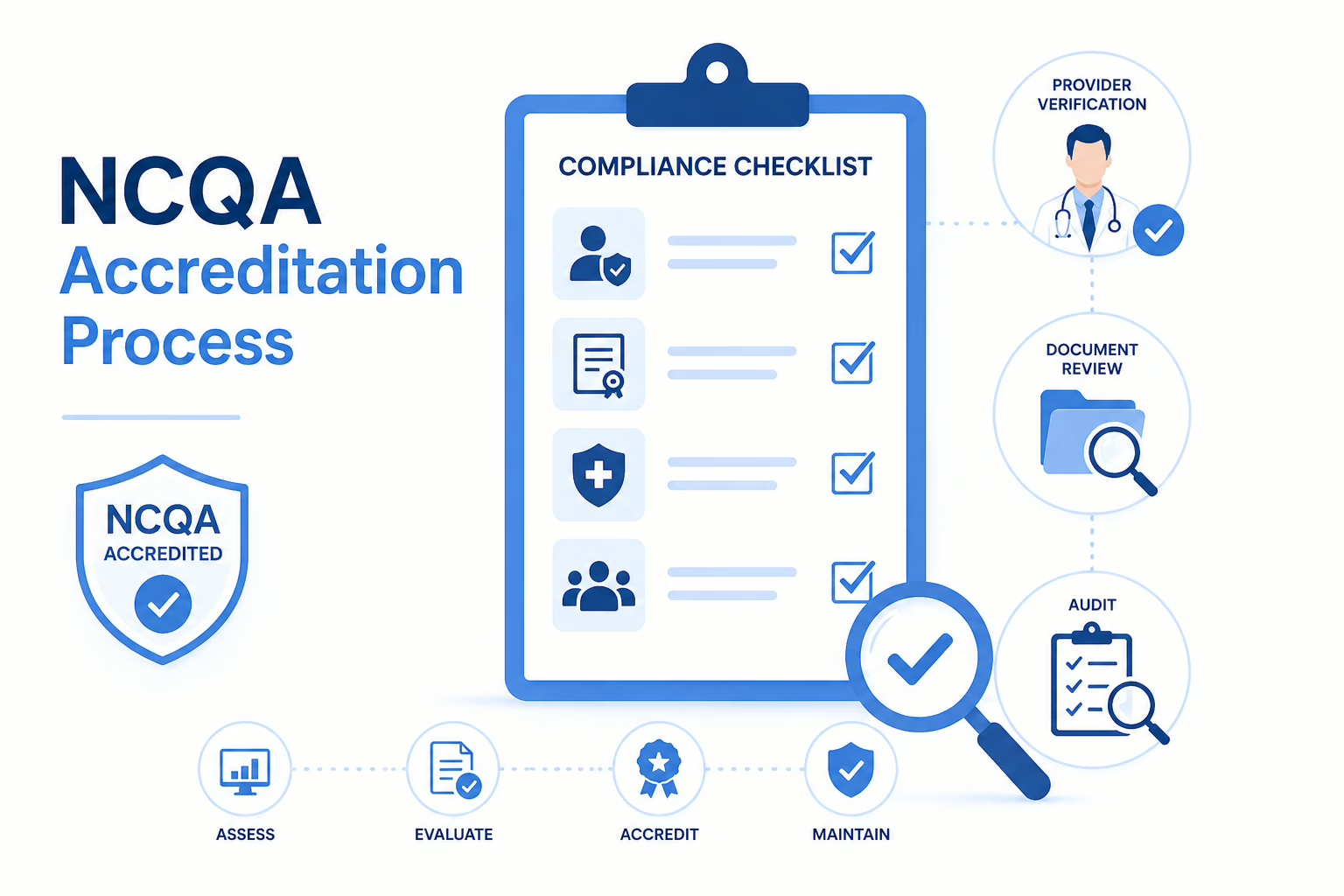
The NCQA accreditation process depends on the specific NCQA program. For Credentialing Accreditation, eligible organizations generally review the standards, assess readiness, submit an application, align operations with NCQA requirements, complete the Survey Tool and any required file review, receive a preliminary report, and then receive a final accreditation decision.
One important point is often missed: NCQA does not offer only one type of accreditation.
The National Committee for Quality Assurance operates multiple accreditation and certification programs covering different healthcare functions. Organizations considering NCQA should first determine which program applies to their actual operations.
For credentialing organizations, that may mean NCQA Credentialing Accreditation or, in some cases, Credentialing Certification.
What Is NCQA Accreditation?
NCQA is an independent healthcare quality organization that develops standards and evaluates healthcare organizations against those standards.
Its programs cover areas such as:
- Health plans
- Credentialing
- Provider networks
- Utilization management
- Population health
- Other healthcare quality functions
Because the standards differ by program, organizations should not assume that requirements for Health Plan Accreditation are the same as requirements for Credentialing Accreditation.
What Is NCQA Credentialing Accreditation?
NCQA Credentialing Accreditation evaluates organizations that provide full-scope credentialing services.
NCQA currently describes full-scope credentialing as including functions such as:
- Verification of practitioner credentials
- Credentialing and recredentialing review
- A designated credentialing committee
- Monitoring practitioner sanctions
- Monitoring complaints and quality issues
The program is intended to evaluate how an organization performs credentialing operations, not simply whether it owns credentialing software or maintains provider documents.
For background on the underlying process, see our provider credentialing process guide.
Who Is Eligible for NCQA Credentialing Accreditation?
Not every medical practice or credentialing department automatically qualifies.
NCQA currently states that organizations pursuing Credentialing Accreditation must meet program eligibility criteria.
Among the current requirements, eligible organizations:
- Must perform credentialing functions directly or through a contractual arrangement
- Must perform credentialing activities for at least 50% of the applicable practitioner network
- Must satisfy NCQA’s other program-specific eligibility requirements
NCQA also distinguishes Credentialing Accreditation from accreditation programs intended for health plans and managed behavioral healthcare organizations.
Organizations should confirm eligibility with NCQA before investing heavily in accreditation preparation.
Does a Medical Practice Need NCQA Credentialing Accreditation?
Usually, this is not something every physician office or outpatient practice should automatically pursue.
A practice that simply manages credentialing and payer enrollment for its own physicians may have very different needs from an organization providing full-scope credentialing services across a practitioner network or for outside clients.
The decision should begin with questions such as:
- What credentialing functions does the organization actually perform?
- Does it make credentialing recommendations or decisions?
- Does it credential providers for clients?
- How much of the practitioner network does it credential?
- Does another NCQA program apply instead?
Eligibility should be confirmed directly with NCQA.
NCQA Credentialing Accreditation vs Credentialing Certification
This distinction is important.
| Program | Primary Scope |
|---|---|
| Credentialing Accreditation | Evaluates organizations providing full-scope credentialing services, including verification and credentialing/recredentialing review |
| Credentialing Certification | Evaluates organizations that perform credential verification functions through primary or recognized sources |
An organization that only performs credential verification should not assume it needs the same program as an organization making full credentialing recommendations.
What Does NCQA Evaluate in Credentialing Accreditation?
Current NCQA Credentialing Accreditation requirements cover several major operational areas.
Internal Quality Improvement
The organization should have a structured process for evaluating and improving its credentialing operations.
Quality improvement is broader than correcting individual application errors. It involves evaluating whether the credentialing system itself is functioning effectively.
Client Agreements and Collaboration
Organizations performing credentialing services for clients need clear agreements defining responsibilities and collaboration.
Protection of Credentialing Information
Credentialing files contain sensitive professional and personal information.
Organizations need controls appropriate to the credentialing information they maintain and the responsibilities defined by NCQA standards.
Credential Verification
NCQA standards address verification through:
- Primary sources
- Recognized sources
- Contracted agents of primary sources where permitted
See our primary source verification guide for more detail.
Credentialing Review
Full-scope Credentialing Accreditation includes a designated credentialing committee that reviews practitioner credentials and makes credentialing recommendations.
Ongoing Monitoring
Credentialing does not stop after initial approval.
NCQA’s standards include monitoring sanctions, complaints, and quality issues between formal recredentialing cycles.
What Is the NCQA Accreditation Process?
NCQA currently outlines a structured process for organizations pursuing Credentialing Accreditation.
Step 1: Confirm Eligibility and Discuss the Program With NCQA
NCQA recommends beginning with an overview discussion with a program expert.
This helps the organization understand:
- Eligibility
- Evaluation areas
- Program benefits
- The application process
NCQA currently recommends beginning this discussion well before the desired survey start date.
Step 2: Purchase the Current Standards and Survey Tool
Organizations need the applicable NCQA Standards and Guidelines and Survey Tool for the program year being pursued.
The standards should be treated as the authoritative requirements for preparation.
Do not rely solely on old accreditation checklists, blog posts, or previous survey experience because NCQA issues updates and clarifications to its standards.
Step 3: Conduct a Gap Analysis
Compare the organization’s current credentialing operations with the applicable NCQA requirements.
A gap analysis may examine:
- Credentialing policies
- Verification procedures
- Committee structure
- Recredentialing processes
- Ongoing monitoring
- Client agreements
- Information protection
- Quality improvement
- Delegated activities where applicable
The objective is to identify where the organization’s actual operating process differs from what the standards require.
Step 4: Submit the NCQA Application
Once the organization decides to pursue accreditation and satisfies the applicable application requirements, it submits the formal application through NCQA.
The organization should ensure that the scope of the application accurately reflects the credentialing services being evaluated.
Step 5: Align Operations With NCQA Requirements
Preparation should involve more than rewriting policies.
Operational workflows need to demonstrate that the organization actually follows the processes described in its policies.
This can require coordination among:
- Credentialing staff
- Credentialing committee leadership
- Compliance personnel
- Quality improvement teams
- Information security personnel
- Management
Step 6: Prepare the Survey Tool
The NCQA Survey Tool contains the standards and supports preparation for the accreditation review.
Before submission, organizations should verify that required evidence is:
- Current
- Complete
- Consistent with actual operations
- Mapped to the appropriate requirement
NCQA states that an Accreditation Services Coordinator contacts organizations before survey submission to review the process and answer procedural questions.
Step 7: Submit the Survey
The assigned survey start date marks the official beginning of the formal survey process.
The organization submits its completed Survey Tool according to NCQA instructions.
Step 8: Complete an Onsite File Review if Required
NCQA states that Credentialing Accreditation may include an onsite file review when required by the program.
The exact review should therefore be confirmed for the organization’s specific accreditation cycle rather than assuming every survey will be entirely virtual or entirely onsite.
Step 9: Review the Preliminary Report
NCQA provides the organization with a preliminary report after evaluation.
According to NCQA’s current process, the organization has a defined period to review that report and may provide comments and additional documentation according to NCQA procedures.
Step 10: Receive the Final Accreditation Decision
The full evaluation information is submitted for final review.
NCQA’s Review Oversight Committee considers the available information and determines the final score and accreditation status.
How Long Does NCQA Credentialing Accreditation Take?
NCQA currently states that the typical evaluation timeframe for Credentialing Accreditation is approximately 12 months from application submission to decision.
That is a planning estimate, not a guaranteed completion period.
The actual timeframe can depend on:
- Organizational readiness
- Existing alignment with NCQA requirements
- Survey preparation
- Required file review
- Documentation quality
- Issues identified during evaluation
Organizations already operating close to NCQA requirements may require less preparation than organizations building credentialing processes from the beginning.
How Quickly Does NCQA Issue a Decision After the Survey?
NCQA currently states that Credentialing Accreditation status is determined within 30 days after an onsite file review, when one is required, or within 90 days after survey submission.
The organization first receives a preliminary report and an opportunity to respond before the final accreditation determination.
What Should Organizations Prepare Before Applying?
A strong preparation process should review both policies and evidence that the policies are actually being followed.
Areas to assess include:
- Credentialing policies and procedures
- Provider application workflows
- Credential verification methodology
- Credentialing committee documentation
- Recredentialing procedures
- Sanctions and complaint monitoring
- Quality improvement activities
- Client agreements
- Credentialing information security
- Delegated functions where applicable
- Audit trails
Provider documentation should also be structured and retrievable. Our provider credentialing documents guide explains the underlying records commonly used in credentialing operations.
Does NCQA Accreditation Make Payer Enrollment Faster?
Not automatically.
NCQA Accreditation may demonstrate that an organization meets defined quality standards for its accredited function, but payer enrollment and contracting remain separate processes.
An accreditation status does not guarantee:
- Faster payer credentialing decisions
- Network acceptance
- Faster contracting
- Earlier effective dates
- Claim payment
Any operational benefit depends on the organization’s contracts, payer relationships, delegation arrangements, and actual workflows.
Does NCQA Accreditation Replace Payer Credentialing?
No.
Accreditation evaluates the credentialing organization’s operations.
It does not mean every payer must accept every provider credentialed by that organization.
A payer may rely on credentialing performed by another organization when an appropriate delegated relationship exists, but delegation is a separate contractual arrangement with oversight requirements.
See our delegated credentialing guide for that distinction.
Common NCQA Accreditation Preparation Mistakes
Using the wrong NCQA program
Credentialing Accreditation, Credentialing Certification, Health Plan Accreditation, and Provider Network Accreditation are different programs.
Assuming every medical practice needs accreditation
Confirm program eligibility and business need before beginning preparation.
Writing policies that do not match actual workflows
A strong policy document is not enough if operational evidence shows a different process.
Using outdated NCQA standards
NCQA publishes standards updates, clarifications, and policy changes. Organizations should work from the current program-year materials.
Waiting until survey preparation to audit credentialing files
File quality should be evaluated well before the survey submission date.
Treating accreditation as a software project
Technology can support credentialing operations, but accreditation evaluates organizational processes and performance, not merely the presence of credentialing software.
NCQA Credentialing Accreditation Preparation Checklist
| Area | What to Confirm |
|---|---|
| Program | Correct NCQA accreditation or certification program identified |
| Eligibility | Organization meets current program eligibility requirements |
| Standards | Current program-year Standards and Guidelines obtained |
| Gap analysis | Current operations compared against applicable standards |
| Policies | Written policies match actual credentialing operations |
| Verification | Credential verification methods and sources documented |
| Committee | Credentialing review and committee processes appropriately documented |
| Monitoring | Sanctions, complaints, and required ongoing monitoring processes established |
| Quality improvement | Internal QI process documented and operational |
| Survey evidence | Required evidence is organized and ready for Survey Tool submission |
Frequently Asked Questions
What is the NCQA accreditation process?
The exact process depends on the NCQA program. For Credentialing Accreditation, it generally includes confirming eligibility, obtaining the standards and Survey Tool, performing a gap analysis, applying, aligning operations, submitting the survey, completing any required file review, reviewing preliminary findings, and receiving a final decision.
How long does NCQA Credentialing Accreditation take?
NCQA currently describes the typical evaluation timeframe as approximately 12 months from application submission to decision, depending on organizational readiness.
Does every medical practice need NCQA Accreditation?
No. NCQA Credentialing Accreditation has specific eligibility requirements and is designed for organizations providing full-scope credentialing services. Practices should first determine whether the program applies to their operations.
What is the difference between NCQA Credentialing Accreditation and Certification?
Credentialing Accreditation covers full-scope credentialing operations, including verification and credentialing/recredentialing review. Credentialing Certification focuses on credential verification functions.
Does NCQA conduct an onsite review?
It can. NCQA’s current Credentialing Accreditation process states that an onsite file review is scheduled when required by the program.
Does NCQA Accreditation guarantee faster payer enrollment?
No. Accreditation evaluates an organization’s performance against NCQA standards. Payer enrollment, contracting, network participation, and effective dates remain separate processes.
Does NCQA Accreditation replace delegated credentialing agreements?
No. Accreditation and delegation are different. A payer must separately establish an appropriate delegated credentialing relationship if it intends to rely on another organization for defined credentialing activities.
How often do NCQA standards change?
NCQA publishes standards by program year and also issues corrections, clarifications, and policy updates when needed. Organizations should monitor NCQA’s current materials throughout accreditation preparation.
Prepare for NCQA Accreditation With the Correct Scope
The most important first step in the NCQA accreditation process is identifying the correct program and confirming eligibility.
For organizations pursuing Credentialing Accreditation, preparation should focus on actual credentialing operations, verification procedures, committee review, ongoing monitoring, quality improvement, protection of credentialing information, client responsibilities, and reliable documentation.
eClinicAssist supports healthcare organizations and credentialing teams with provider-data organization, credentialing workflows, document management, application tracking, renewals, follow-up, payer enrollment administration, and related operational processes.
eClinicAssist does not grant NCQA Accreditation, determine NCQA eligibility, guarantee accreditation outcomes, or act on behalf of NCQA.
Contact eClinicAssist to discuss credentialing workflow and provider-data management support for your organization.
This article provides general administrative information and is not an official NCQA interpretation or a substitute for NCQA Standards and Guidelines. Program requirements, eligibility criteria, standards, policies, and survey procedures may change. Organizations pursuing accreditation should use current NCQA materials and communicate directly with NCQA regarding program requirements.