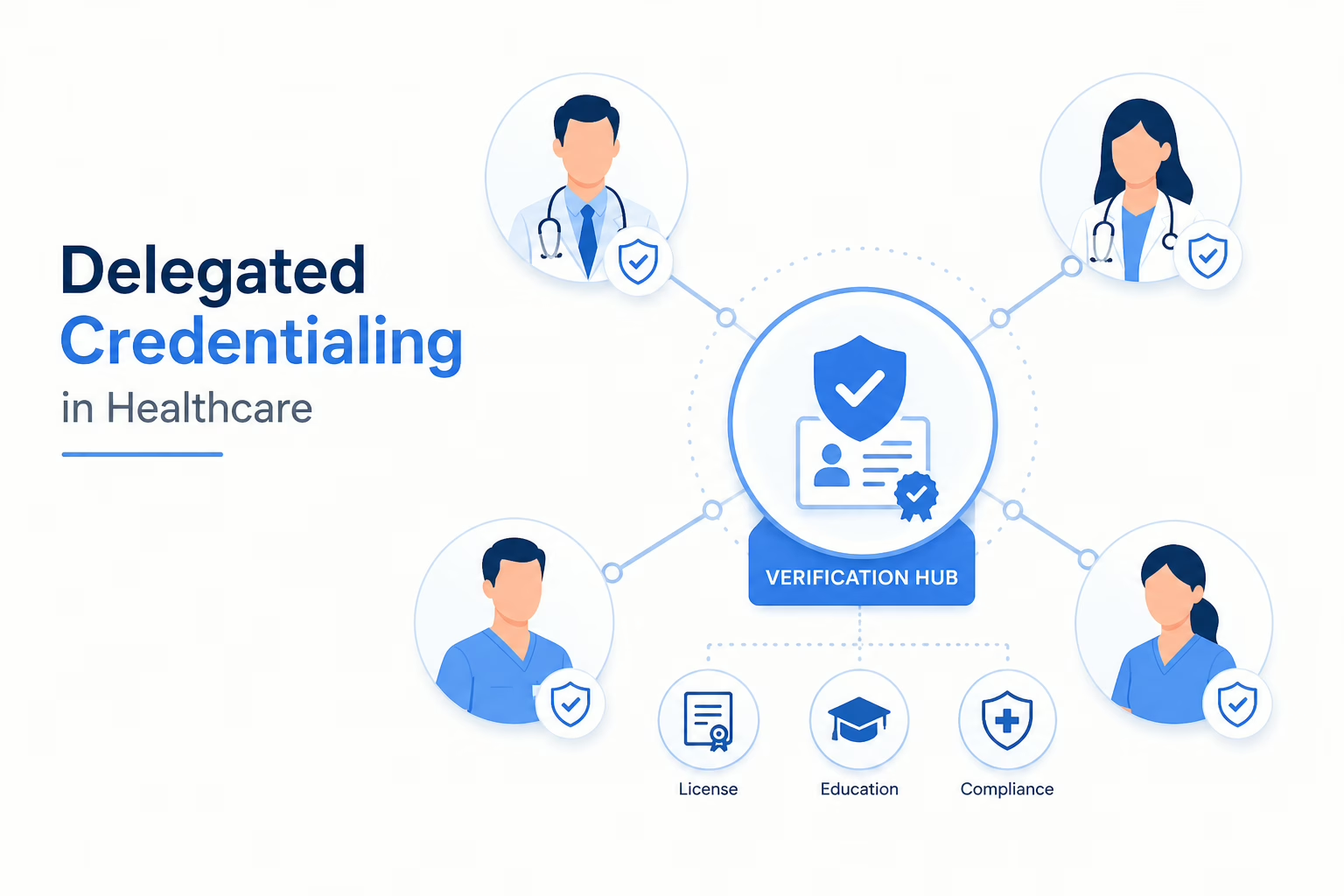
Delegated credentialing in healthcare occurs when a health plan or other organization formally authorizes another entity to perform defined credentialing activities on its behalf. Delegation does not remove accountability from the delegating organization. A successful arrangement requires a written agreement, clear scope, predelegation evaluation, reporting, oversight, audits where applicable, corrective-action processes, and reliable credentialing operations.
Delegated credentialing is often misunderstood as ordinary credentialing outsourcing.
They are not always the same.
A healthcare organization may hire a vendor to:
- Collect documents
- Maintain provider records
- Track expirations
- Prepare applications
- Follow up with payers
That arrangement does not automatically mean the payer has formally delegated credentialing authority.
Formal delegation requires a defined relationship in which the delegate performs activities that the delegating organization would otherwise need to perform itself.
What Is Delegated Credentialing?
Under NCQA’s credentialing framework, delegation occurs when an organization gives another entity authority to perform an activity that the organization would otherwise perform to satisfy an applicable requirement.
For credentialing, delegated activities can potentially include functions such as:
- Credential verification
- Application and attestation review
- Primary source verification
- Credentialing committee activities
- Credentialing decisions
- Recredentialing
- Ongoing monitoring
- Organizational provider assessment
The exact scope depends on the delegation agreement.
Who Usually Participates in a Delegated Credentialing Arrangement?
Delegation can involve several types of organizations.
Common examples include:
- Health plans
- Medical groups
- Independent practice associations
- Provider organizations
- Management services organizations
- Credentials verification organizations
The delegating organization determines which activities it is willing and permitted to delegate.
Is Hiring a Credentialing Company the Same as Delegated Credentialing?
No.
A practice can outsource credentialing administration without becoming a formally delegated credentialing entity.
For example, a credentialing company may help with:
- CAQH administration
- Document collection
- Payer applications
- Credential tracking
- Follow-up
But if the payer still performs its own credentialing review and makes the credentialing decision, formal credentialing authority has not necessarily been delegated.
Does Using Credentialing Software Count as Delegation?
Not by itself.
NCQA has specifically clarified that using another company’s software to collect credentialing information is not considered delegation when the software is only collecting information and the organization itself still reviews and verifies it.
The distinction is important:
| Activity | Typically Delegation? |
|---|---|
| Software collects provider documents | No, not by itself |
| Vendor extracts application data | Not necessarily |
| Vendor performs verification on behalf of organization | May be delegated activity |
| Delegate conducts credentialing committee functions | Potentially delegated credentialing |
| Delegate makes credentialing decisions under formal authority | Delegated credentialing activity |
What Can Be Delegated?
The delegation agreement should identify the specific credentialing functions being transferred.
Depending on the arrangement and applicable standards, these may include:
- Application processing
- Attestation review
- Primary source verification
- Credentialing committee functions
- Credentialing decisions
- Recredentialing
- Ongoing monitoring
- Organizational provider assessments
Do not describe the arrangement simply as “full delegation” without documenting which functions are actually included.
What Is Not Automatically Included in Delegated Credentialing?
Delegated credentialing should not automatically be assumed to include:
- Payer contracting
- Network adequacy decisions
- Rate negotiation
- Provider enrollment
- Group affiliation
- Location setup
- Product participation
- Claims adjudication
Those functions may be handled elsewhere or require separate agreements.
Who Remains Responsible After Credentialing Is Delegated?
The delegating organization remains accountable for the delegated function.
This is one of the most important principles in credentialing delegation.
A health plan cannot simply sign an agreement and stop monitoring the work.
NCQA expects the delegating organization to oversee the delegate’s performance unless applicable automatic-credit provisions reduce specific oversight requirements.
What Should Happen Before a Delegation Agreement Is Signed?
The delegating organization should evaluate whether the proposed delegate has the ability to perform the assigned credentialing functions.
A predelegation review can examine:
- Credentialing policies
- Staff qualifications
- Primary source verification procedures
- Committee structure
- Information systems
- Data security
- File documentation
- Ongoing monitoring processes
- Recredentialing controls
- Quality oversight
The purpose is to determine whether the organization is operationally ready before responsibility is transferred.
What Should Be in a Delegated Credentialing Agreement?
The agreement should clearly identify the responsibilities of both parties.
Important elements can include:
- Functions being delegated
- Functions retained by the health plan
- Credentialing standards to be followed
- Reporting requirements
- Performance expectations
- Audit rights
- Corrective-action requirements
- Subdelegation rules
- Data access
- Information-security responsibilities
- Termination provisions
The agreement should be signed, dated, and consistent with the applicable credentialing standards.
Why Is Scope Definition So Important?
A weak agreement can create confusion over who is responsible for a credentialing function.
For example:
If the delegate performs primary source verification but the payer retains final credentialing decisions, the agreement should say so explicitly.
If the delegate also conducts the credentialing committee and makes decisions, that should also be documented.
Ambiguous responsibility is a major operational risk.
What Is a CVO?
A Credentials Verification Organization, or CVO, specializes in verifying provider credential information.
Verification may include information from:
- Licensing authorities
- Certification organizations
- Education sources
- Other approved sources
A CVO may perform only verification functions rather than full-scope credentialing.
What Is the Difference Between a CVO and a Full-Scope Credentialing Delegate?
| CVO | Full-Scope Credentialing Organization |
|---|---|
| Focuses primarily on credential verification | Performs broader credentialing functions |
| May verify primary-source information | May also perform committee review and credentialing decisions |
| May support ongoing monitoring | May perform recredentialing and other full-scope activities |
| NCQA Credentialing Certification may apply | NCQA Credentialing Accreditation may apply |
Does a Delegated Entity Need NCQA Accreditation?
Not every delegation arrangement automatically requires the delegate to hold NCQA Credentialing Accreditation.
However, NCQA Accreditation or Certification can materially affect how the delegating organization is evaluated and which oversight activities receive automatic credit.
Organizations should evaluate the specific NCQA program, delegation scope, and health plan requirements involved.
What Is Automatic Credit in Delegated Credentialing?
NCQA may give a delegating organization credit for certain activities when the delegate already holds qualifying NCQA Accreditation or Certification.
This can reduce duplicate oversight work because NCQA has already evaluated aspects of the delegate’s processes.
The amount of automatic credit depends on:
- The delegate’s NCQA program
- The delegated function
- The elements covered by the delegate’s accreditation or certification
Can NCQA Certification Reduce Delegate Audits?
Yes, for qualifying activities.
NCQA guidance explains that when a client delegates applicable credential verification functions to an NCQA-Certified CVO, certain formal oversight activities may no longer be required for the elements covered by that certification.
This can include relief from activities such as:
- Predelgation evaluation for qualifying CVO functions
- Certain periodic reports
- Annual evaluation against applicable standards
- Credentialing-file audits for covered verification elements
The delegating organization still needs to understand exactly which activities receive automatic credit.
What Changed in NCQA Delegate Reporting?
NCQA clarified in October 2025 that organizations receive automatic credit for certain semiannual delegation reporting and evaluation requirements when an NCQA-Accredited or Certified delegate performs the applicable NCQA-required activity.
This does not mean every oversight responsibility disappears.
Organizations should identify exactly which requirements receive automatic credit under the current standards.
What Does Ongoing Delegation Oversight Look Like?
For arrangements where standard oversight applies, the delegating organization should maintain a defined monitoring process.
This can include:
- Performance reports
- Credentialing file reviews
- Policy review
- Timeliness metrics
- Quality findings
- Corrective-action tracking
- Regular meetings
Oversight should be assigned to specific staff or committees.
Why Are Credentialing File Audits Important?
File audits help the delegating organization confirm that the delegate is following the agreed credentialing process.
An audit can evaluate:
- Required verification completed
- Verification within applicable timeframes
- Complete documentation
- Committee review where applicable
- Correct credentialing decision
- Recredentialing timeliness
Where NCQA automatic credit applies, some of these audit requirements may be reduced or eliminated for the covered functions.
What Happens When a Delegate Fails an Audit?
A finding should not simply be recorded and ignored.
The delegating organization may need to:
- Document the deficiency.
- Require corrective action.
- Establish a completion deadline.
- Reassess whether the correction worked.
- Escalate persistent problems.
The delegation agreement should define the consequences of unresolved performance problems.
What Is Subdelegation?
Subdelegation occurs when the delegate transfers part of the delegated function to another entity.
For example:
A medical group may receive delegated credentialing authority and then use an external CVO for primary source verification.
The original delegation agreement should identify how subdelegates are handled.
Who Oversees a Subdelegate?
The delegation arrangement should specify whether:
- The delegating organization directly oversees the subdelegate
- The delegate oversees the subdelegate and reports back to the delegating organization
The presence of a subdelegate does not eliminate accountability for the delegated function.
Does Delegated Credentialing Mean Providers Are Automatically In-Network?
No.
Delegated credentialing and network participation are related but separate.
A provider may complete credentialing while still waiting for:
- Contract activation
- Group affiliation
- Location enrollment
- Product participation
- Effective date
Never treat a credentialing decision alone as proof that billing can begin.
Does Delegated Credentialing Eliminate Payer Enrollment?
No.
Credentialing evaluates professional qualifications.
Payer enrollment handles administrative participation and billing relationships.
Depending on the payer, separate steps may still be required for:
- Provider enrollment
- TIN affiliation
- Location setup
- Network product
- Effective dates
See our credentialing vs privileging vs enrollment guide for the broader distinction.
Does Delegated Credentialing Guarantee Faster Provider Onboarding?
No.
Delegation may reduce duplicate credentialing work when the payer accepts the delegate’s credentialing process.
However, overall onboarding can still depend on:
- Contracting
- Network availability
- Location setup
- Enrollment
- Provider documentation
- Group affiliation
- Payer effective date
Delegation can improve workflow efficiency without eliminating every external dependency.
Which Organizations Are Good Candidates for Delegated Credentialing?
Delegation is generally more relevant to organizations managing significant provider volume.
Examples can include:
- Large medical groups
- Independent practice associations
- Multi-specialty groups
- Provider networks
- Management organizations with established credentialing operations
A small practice with a handful of providers is less likely to have the operational infrastructure or payer relationship needed for formal delegation.
How Can an Organization Tell if It Is Ready for Delegation?
Before approaching payers about delegation, assess whether the organization can demonstrate:
- Written credentialing policies
- Trained credentialing staff
- Reliable primary source verification
- Credentialing committee structure where applicable
- Recredentialing workflow
- Ongoing monitoring
- Quality controls
- Secure credentialing information
- Audit-ready files
- Performance reporting
Delegation requires the organization to operate more like a credentialing infrastructure partner than an ordinary medical practice.
Delegated Credentialing Readiness Checklist
| Area | What to Confirm |
|---|---|
| Policies | Written credentialing and recredentialing procedures exist |
| Staff | Qualified staff own delegated activities |
| Verification | Primary source and recognized-source workflows are defined |
| Committee | Required credentialing committee structure exists |
| Monitoring | Sanctions and other required monitoring are maintained |
| Recredentialing | Periodic review process is documented |
| Security | Credentialing information is appropriately protected |
| Reporting | Performance reports can be produced reliably |
| Audits | Files can withstand delegate oversight reviews |
| Corrective action | Deficiencies can be documented, corrected, and reassessed |
What Should Be Measured After Delegation Begins?
Useful operational metrics may include:
- Credentialing files completed
- Files completed within required timeframes
- Verification defects
- Audit findings
- Recredentialing timeliness
- Corrective-action completion
- Data discrepancies
- Outstanding files
Metrics should match the actual obligations in the delegation agreement.
Common Delegated Credentialing Mistakes
Calling Ordinary Outsourcing “Delegation”
A vendor performing administrative work does not automatically have formally delegated authority from a payer.
Failing to Define Scope
The agreement should identify exactly which credentialing functions are delegated.
Assuming the Payer No Longer Has Responsibility
The delegating organization remains accountable for delegated functions.
Confusing a CVO With Full-Scope Credentialing
Verification and full credentialing are not identical.
Ignoring Subdelegates
Subdelegation should be governed and monitored under the delegation structure.
Assuming Delegation Includes Enrollment
Enrollment, contracting, affiliation, locations, and network activation may remain separate.
Assuming NCQA Accreditation Removes Every Audit
Automatic credit is function-specific. Organizations must determine which oversight requirements are actually relieved.
Focusing Only on Speed
Delegation should be evaluated based on quality, reliability, oversight, and scalability, not only turnaround time.
Frequently Asked Questions
What is delegated credentialing in healthcare?
Delegated credentialing occurs when an organization formally authorizes another entity to perform defined credentialing activities that the organization would otherwise perform itself.
Is credentialing outsourcing the same as delegated credentialing?
No. Outsourcing administrative work does not automatically mean a payer has delegated formal credentialing authority.
Does using credentialing software count as delegation?
No, not when the software only collects credentialing information and the organization itself still reviews and verifies that information.
Does the health plan remain responsible after delegation?
Yes. NCQA holds the delegating organization responsible for oversight of delegated NCQA activities, subject to applicable automatic-credit provisions.
What is the difference between a CVO and a credentialing delegate?
A CVO generally focuses on verification activities. A full-scope credentialing delegate may also perform committee review, credentialing decisions, recredentialing, and ongoing monitoring.
Does a delegate have to be NCQA accredited?
Not in every arrangement. However, qualifying NCQA Accreditation or Certification can affect eligibility, automatic credit, and oversight requirements.
Does delegated credentialing automatically make a provider in-network?
No. Contracting, enrollment, affiliation, product participation, locations, and effective dates may still need to be completed.
Can a small medical practice obtain delegated credentialing?
It is possible only when the payer is willing to delegate and the organization can meet the required operational and oversight expectations. Delegation is generally more practical for organizations managing larger provider networks.
Does delegated credentialing guarantee faster onboarding?
No. It may reduce duplicate credentialing work, but payer contracting, enrollment, location setup, network availability, and effective dates remain separate.
What should an organization do before asking a payer for delegation?
Build documented credentialing policies, reliable verification workflows, trained staff, recredentialing and monitoring processes, secure data management, quality controls, audit-ready files, and reporting capability.
Delegated Credentialing Is an Accountability Model, Not Just an Efficiency Tool
The strongest delegated credentialing programs are not built around the idea that credentialing work disappears.
The work moves to another organization, along with substantial operational responsibility.
A mature delegation model should clearly define:
- Who performs each function
- Which standards apply
- Which sources are used
- Who makes decisions
- What must be reported
- How performance is audited
- How problems are corrected
- How subdelegates are governed
Organizations considering delegated credentialing should therefore evaluate readiness based on credentialing infrastructure and quality controls, not simply provider volume.
eClinicAssist supports credentialing organizations and healthcare groups with provider-data management, enrollment tracking, document management, credential expiration monitoring, task workflows, payer records, approval tracking, effective dates, and related administrative infrastructure.
eClinicAssist does not grant delegated credentialing authority, make payer delegation decisions, provide NCQA accreditation, or guarantee that a payer will accept an organization’s credentialing decisions.
Contact eClinicAssist to discuss credentialing workflow infrastructure for a growing provider organization.
This article provides general administrative information and is not official NCQA, legal, accreditation, credentialing, or payer-specific advice. Delegation requirements vary by health plan, accreditation program, agreement, state, and delegated function. Organizations should review current NCQA standards, payer requirements, and applicable agreements before implementing delegated credentialing.