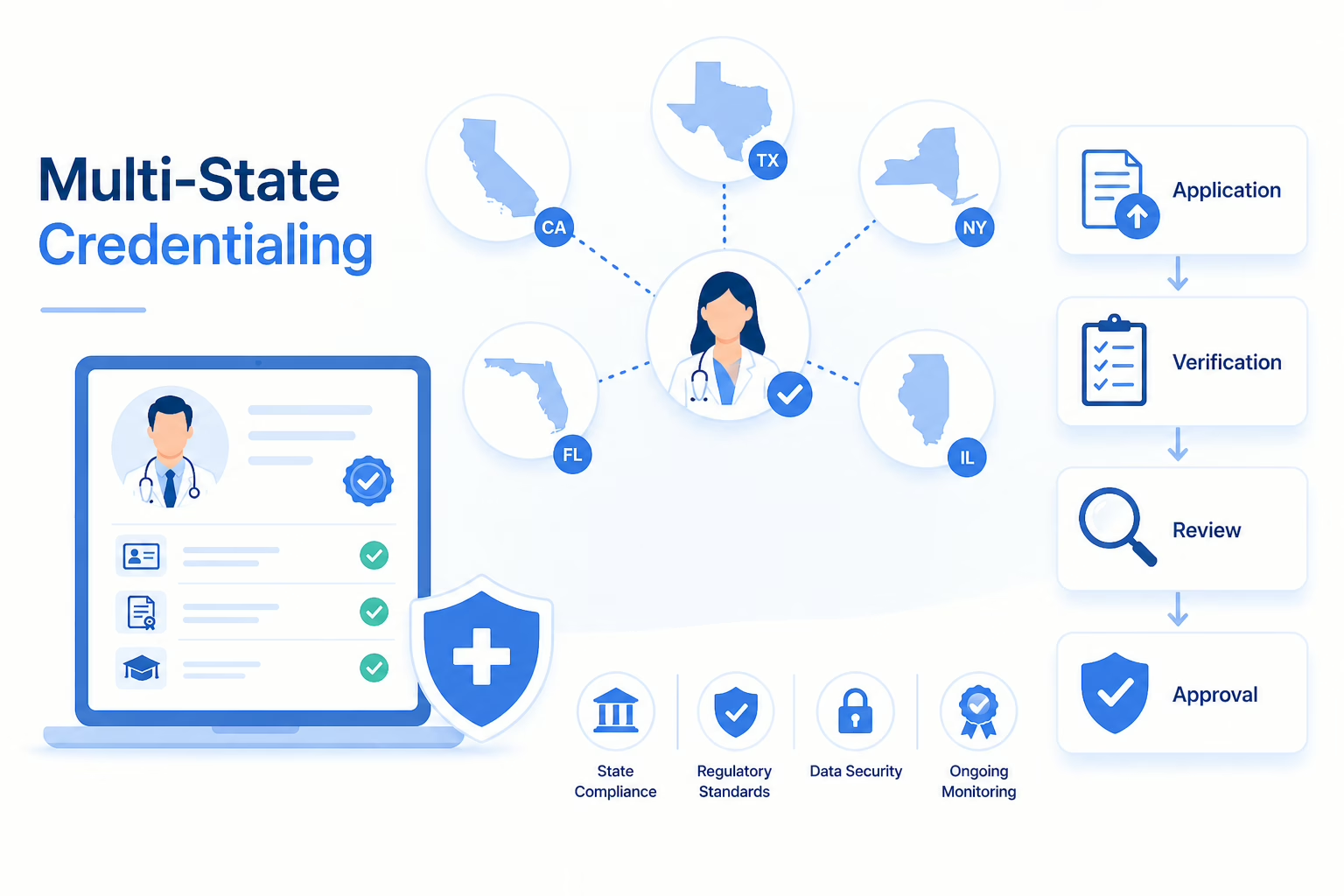
Multi-state credentialing is the process of managing provider credentialing, payer participation, and related administrative requirements across more than one state. It should be separated from multi-state licensing. A provider may need legal authority to practice in each patient’s state, while credentialing, enrollment, contracting, and effective-date requirements are handled separately by each payer or healthcare organization. Explore the multi-state credentialing process and the separate licensing considerations when providers relocate.
Multi-state expansion can create significant administrative complexity for healthcare practices, especially when telehealth, multiple practice locations, and different insurance networks are involved.
The biggest source of confusion is terminology.
Multi-state healthcare operations may involve:
- State professional licensing
- Telehealth registration
- Licensure compacts
- Commercial payer credentialing
- Payer enrollment
- Contracting
- Group affiliation
- Medicare enrollment
- Medicaid enrollment
- Facility privileging
These processes overlap, but they should not be treated as one multi-state credentialing application.
What Is Multi-State Credentialing?
Multi-state credentialing refers to coordinating provider credentialing and related payer or organizational approvals when a provider practices across multiple states.
The process may involve different:
- Health plans
- Provider networks
- Practice locations
- State Medicaid programs
- Healthcare facilities
- Group affiliations
Multi-state credentialing is not a legal license to practice medicine or another healthcare profession across state lines.
What Is the Difference Between Multi-State Licensing and Multi-State Credentialing?
| Process | Main Purpose | Who Controls It? |
|---|---|---|
| State licensing | Determines whether the provider is legally authorized to practice in the jurisdiction | State licensing authority |
| Credentialing | Evaluates the provider’s professional qualifications | Payer, hospital, health system, CVO, or other organization |
| Payer enrollment | Establishes the provider within a payer’s administrative system | Commercial payer, CMS, Medicaid agency, or other program |
| Contracting | Establishes commercial network participation terms | Payer and provider or organization |
A provider can therefore be licensed in a state but not yet credentialed or enrolled with a payer there.
Where Must a Telehealth Provider Be Licensed?
For interstate telehealth, the patient’s location is generally central to the licensing analysis.
HHS states that healthcare professionals must meet the licensure requirements of the state where they are located and be licensed or otherwise legally permitted to practice in the state where the patient is located.
Before providing cross-state telehealth, practices should verify:
- Where the provider is located
- Where the patient is physically located
- Whether a full state license is required
- Whether a compact pathway applies
- Whether the state offers telehealth registration
- Whether temporary-practice or reciprocity rules apply
See our telehealth licensure requirements guide for the licensing side of multi-state care.
What Licensing Pathways Can Support Multi-State Practice?
Depending on the profession and state, possible pathways can include:
- Full state licensure
- Licensure by endorsement
- Interstate compact pathways
- Reciprocity
- Temporary-practice exceptions
- Telehealth registration
The available option depends on the provider’s profession and the law of the state where the patient is located.
How Does the Interstate Medical Licensure Compact Work?
The Interstate Medical Licensure Compact, or IMLC, provides an expedited licensing pathway for eligible physicians.
It does not issue one nationwide medical license.
An eligible physician:
- Applies through the Compact process.
- Uses an eligible State of Principal License.
- Receives a Letter of Qualification if requirements are satisfied.
- Selects participating states where additional licensure is desired.
- Receives separate licenses from those individual states.
Each state license remains subject to that state’s laws, renewal requirements, and regulatory authority.
Does the Nurse Licensure Compact Cover Nurse Practitioners?
Not for the APRN license.
The Nurse Licensure Compact applies to RN and LPN/VN licenses.
The official NLC guidance specifically states that the NLC does not apply to APRN licensure.
A nurse practitioner may have an RN multistate license under the NLC but still need separate APRN licensure or authority in each state where advanced practice occurs, unless another applicable pathway is available.
This distinction is especially important for telehealth organizations employing NPs across multiple states.
Does a State License Automatically Make a Provider In-Network?
No.
Licensure allows the provider to practice within the scope permitted by state law.
Payer participation may separately require:
- Credentialing
- Network approval
- Contracting
- Enrollment
- Group affiliation
- Location setup
- Product participation
- Effective-date confirmation
State licensure and payer participation should therefore be tracked independently.
How Do Commercial Payers Handle Multi-State Credentialing?
There is no universal commercial payer model.
A payer may:
- Credential the practitioner through one central process
- Require state-specific network applications
- Require separate location additions
- Require different contracts by state or product
- Require separate group affiliations
The practice should determine the payer’s exact structure before assuming a provider must repeat an entire credentialing process in every state.
What Should Be Confirmed for Each Commercial Payer?
For every payer and state combination, track:
- Credentialing status
- Network status
- Contract status
- Group or TIN affiliation
- Practice location
- Applicable product
- Effective date
This is more useful than maintaining only a status such as “UHC approved” or “BCBS credentialed.”
How Does Medicaid Work Across Multiple States?
Medicaid is administered by individual states.
A provider expanding into another state may need to address:
- State Medicaid enrollment
- State-specific screening requirements
- Provider-type requirements
- Practice-location enrollment
- Managed care credentialing
- Managed care contracting
Approval in one state’s Medicaid program does not automatically establish participation in another state’s Medicaid program.
Similarly, enrollment in a state’s Medicaid program may not automatically activate participation with every Medicaid managed care plan.
How Does Medicare Work for Multi-State Telehealth?
Medicare enrollment should be handled separately from state licensure and commercial credentialing.
CMS currently states that it defers to state law for telehealth licensure requirements.
For Medicare enrollment, CMS also states that a telehealth practitioner is not automatically required to enroll in each state where a Medicare beneficiary happens to be located.
The applicable Medicare enrollment is based on the practitioner’s practice-location and reassignment arrangement.
This is different from the state-law question of whether the provider is legally permitted to treat the patient where the patient is located.
Does Multi-State Credentialing Have a Standard Timeline?
No.
There is no universal timeframe for multi-state credentialing.
Total onboarding time may depend on:
- State licensing
- Compact eligibility
- Licensing-board processing
- Commercial payer credentialing
- Network availability
- Contracting
- Medicaid enrollment
- Group affiliation
- Facility privileging
One state or payer can be complete while another remains pending.
What Documents Should a Multi-State Practice Maintain?
A centralized provider record can reduce duplicate internal work.
Depending on provider type, maintain information such as:
- Professional licenses by state
- License expiration dates
- National certification where applicable
- NPI
- DEA registrations where applicable
- State controlled-substance registrations where applicable
- Professional liability coverage
- Education and training
- Work history
- CAQH information
- Payer applications
- Payer effective dates
See our provider credentialing documents guide for a broader document checklist.
Should Provider Data Be Identical in Every State and System?
No.
The data should be accurate, but systems can legitimately contain different information because they serve different purposes.
For example:
- A state licensing board maintains state professional licensure.
- NPPES maintains NPI-associated information.
- CAQH stores professional data for participating organizations.
- PECOS maintains Medicare enrollment records.
- Commercial payers maintain their own group, location, product, and network relationships.
The goal is to identify true discrepancies without forcing unrelated databases to look identical.
How Should Multi-State Credentialing Be Organized?
Track licensing by provider and state
Maintain:
- State
- License number
- Status
- Expiration date
- Renewal requirements
Track each payer separately
For each payer, record:
- State
- Network
- Provider
- Group
- Location
- Product
- Status
- Effective date
Separate credentialing from enrollment
A status of “credentialed” should not automatically be converted to “active for billing.”
Track renewal dates independently
State licenses, DEA registrations, professional liability policies, certifications, and payer recredentialing can follow different cycles.
Maintain a documented next action
Every pending state or payer workflow should have an owner and next-action date.
What Are the Most Common Multi-State Credentialing Mistakes?
Assuming one state license covers every state
Interstate practice remains state-regulated, even when a compact provides an easier licensing pathway.
Treating the IMLC as a national medical license
IMLC physicians still receive separate licenses from participating states.
Assuming the NLC covers nurse practitioner authority
The NLC applies to RN and LPN/VN licensure, not APRN licensure.
Ignoring the patient’s location in telehealth
The state where the patient is physically located at the time of the visit is generally important for determining the provider’s legal authority to practice.
Assuming a payer relationship is nationwide
A provider may need different network, location, group, or product activation across states.
Combining Medicaid programs
Each state’s Medicaid enrollment must be evaluated separately.
Tracking only approval, not effective date
Always identify the state, payer, group, product, location, and confirmed effective date.
Multi-State Credentialing Checklist
| Area | What to Confirm |
|---|---|
| Patient state | Provider has legal authority to practice where the patient is located |
| Licensing pathway | Full license, compact, reciprocity, registration, or other valid pathway confirmed |
| Professional license | Status and renewal date tracked for each applicable state |
| Commercial payer | Credentialing, contracting, enrollment, network, and effective date confirmed |
| Medicaid | State enrollment and managed care requirements reviewed separately |
| Medicare | Applicable PECOS enrollment and practice-location setup confirmed |
| Group affiliation | Correct group, TIN, location, and payer product linked |
| Documents | State-specific professional credentials current |
| Renewals | Licenses and other expiring credentials monitored by state |
| Follow-up | Every pending workflow has an owner and next-action date |
Frequently Asked Questions
What is multi-state credentialing?
Multi-state credentialing is the coordination of provider credentialing and payer participation across multiple states. It is separate from state licensing, which determines legal authority to practice.
Do physicians need a separate license in each state?
Generally, a physician needs legal authority in each state where practice occurs. The IMLC can provide an expedited pathway for eligible physicians, but each participating state still issues its own license.
Does the IMLC create one nationwide medical license?
No. The IMLC streamlines the application process but results in separate state medical licenses.
Does the Nurse Licensure Compact cover nurse practitioners?
The NLC covers RN and LPN/VN multistate licensure. It does not cover APRN licensure, so nurse practitioners generally need separate APRN authority in each state where they practice unless another valid pathway applies.
What state rules apply during a telehealth visit?
Providers generally must be legally permitted to practice in the state where the patient is physically located at the time of the encounter.
Does an insurance credentialing approval apply nationwide?
Not necessarily. Network participation, group affiliation, location enrollment, contracts, and payer products can vary by state.
Does Medicaid enrollment transfer between states?
No. Medicaid is state-administered, so providers should review enrollment and managed care requirements separately in each state.
Does Medicare require enrollment in every state where a telehealth patient lives?
CMS currently states that providers are not required to enroll solely in the states where beneficiaries reside. Medicare enrollment depends on the practitioner’s applicable practice-location arrangement, while state telehealth licensure laws still apply separately.
How long does multi-state credentialing take?
There is no universal timeline. Licensing, payer credentialing, contracting, Medicaid enrollment, network availability, and location setup can all affect the overall process.
Separate Licensing From Credentialing When Expanding Across States
The strongest multi-state credentialing strategy begins by separating the different approvals involved.
For every provider and state, practices should know:
- Is the provider legally authorized to practice there?
- Which licensing pathway applies?
- Which commercial payers require action?
- Is Medicaid enrollment required?
- What Medicare enrollment arrangement applies?
- Is the provider linked to the correct group and location?
- What is the confirmed payer effective date?
eClinicAssist supports healthcare organizations with multi-state credentialing administration, licensing tracking, commercial payer enrollment, CAQH management, Medicare and Medicaid enrollment administration, provider-document management, follow-up, and effective-date tracking.
eClinicAssist does not issue professional licenses, determine whether a provider is legally permitted to practice in a state, make payer credentialing decisions, or guarantee network participation.
Contact eClinicAssist to discuss multi-state credentialing and payer enrollment support for your organization.
This article provides general administrative information and is not legal, licensing, telehealth, contractual, billing, or payer-specific advice. Interstate practice requirements vary by profession, state, patient location, payer, healthcare organization, and government program. Verify current rules with the applicable state licensing board, payer, CMS, Medicaid agency, or other responsible authority.