Provider relocation credentialing involves much more than changing an address. When a physician, nurse practitioner, physician assistant, or other clinician moves to a new state or starts practicing from a new location, the organization may need to update state licensure, NPPES, DEA information, CAQH, Medicare, Medicaid, commercial payers, group affiliations, practice locations, and effective dates separately.
A provider can be fully credentialed at one location and still be incomplete for another.
This is especially important when a provider:
- Moves permanently to another state
- Adds a second state
- Joins a new medical group
- Starts working at another office
- Adds telehealth patients in another state
- Changes employers
The safest approach is to treat relocation as a multi-system credentialing project rather than a simple address change.
Does a Provider Need a New NPI When Moving to Another State?
Usually, no.
CMS states that an NPI remains the same even when a healthcare provider changes:
- Name
- Address
- Practice location
- Other identifying information
The NPI identifies the provider. It is not a state license or geographic credential.
However, the information associated with that NPI still needs to be updated.
How Quickly Must NPPES Be Updated After an Address Change?
CMS states that covered healthcare providers must notify NPPES of changes to their NPI information within 30 days of the effective date of the change.
This can include:
- Practice address
- Mailing address
- Taxonomy
- Contact information
- Other information associated with the NPI
Updating NPPES does not automatically update every payer or government program.
Does an Existing State License Transfer When a Provider Moves?
No.
Professional licensing is generally jurisdiction-specific.
A provider moving from one state to another should determine whether the new state requires:
- A full professional license
- Participation through an interstate compact
- Reciprocity
- A telehealth registration
- Another profession-specific authorization
The correct pathway depends on the provider type and state.
A provider should not assume that an active license in the former state creates legal authority to practice in the new state.
Should the Old State License Be Cancelled?
Not automatically.
A provider may choose to maintain multiple state licenses if they continue practicing in more than one state or expect to return.
Before allowing an old license to lapse, consider:
- Telehealth patients
- Locum work
- Existing payer participation
- Hospital privileges
- Future practice plans
Each license also has its own renewal and continuing-education requirements.
What Should Be Updated First When a Provider Moves?
The correct order depends on the situation, but a practical sequence is:
- Confirm legal practice authority in the new state.
- Confirm the new employment and group structure.
- Finalize the practice location.
- Update NPPES.
- Review DEA requirements where applicable.
- Update CAQH.
- Update Medicare enrollment.
- Complete Medicaid enrollment where applicable.
- Update or enroll with commercial payers.
- Confirm group affiliations, locations, products, and effective dates.
Some steps can occur in parallel.
What Happens to DEA Registration When a Provider Moves?
DEA registration should be reviewed when a practitioner who handles controlled substances changes practice location or state.
DEA permits registrants to request modification of registration information, including name or address changes.
However, the provider must also have appropriate state authority for the controlled-substance activity.
DEA registration should not be treated as a substitute for:
- Professional licensure
- State prescribing authority
- State controlled-substance registration where required
Does Every Provider Need DEA Registration After Moving?
No.
DEA registration is relevant when the provider handles controlled substances and meets the required federal and state conditions.
A behavioral health professional, therapist, or other provider who does not prescribe controlled substances may have no DEA requirement.
Does CAQH Need to Be Updated After a Provider Moves?
Yes, when the provider uses CAQH and the practice or location information has changed.
CAQH practice-location records can include:
- Practice name
- Address
- Phone numbers
- Office hours
- Accessibility information
- Languages
- Organization NPI
- Other state-specific information
After changing material provider information, complete the applicable attestation workflow so the updated information is available as current attested data.
Does Updating CAQH Automatically Update Payers?
Not necessarily.
CAQH makes provider information available to authorized organizations, but each payer maintains its own credentialing and enrollment records.
A payer may still require:
- A location-change form
- A new enrollment application
- Group affiliation
- Contract amendment
- Additional credentialing
- Directory confirmation
Always verify the payer’s actual record.
What Must Be Updated With Medicare?
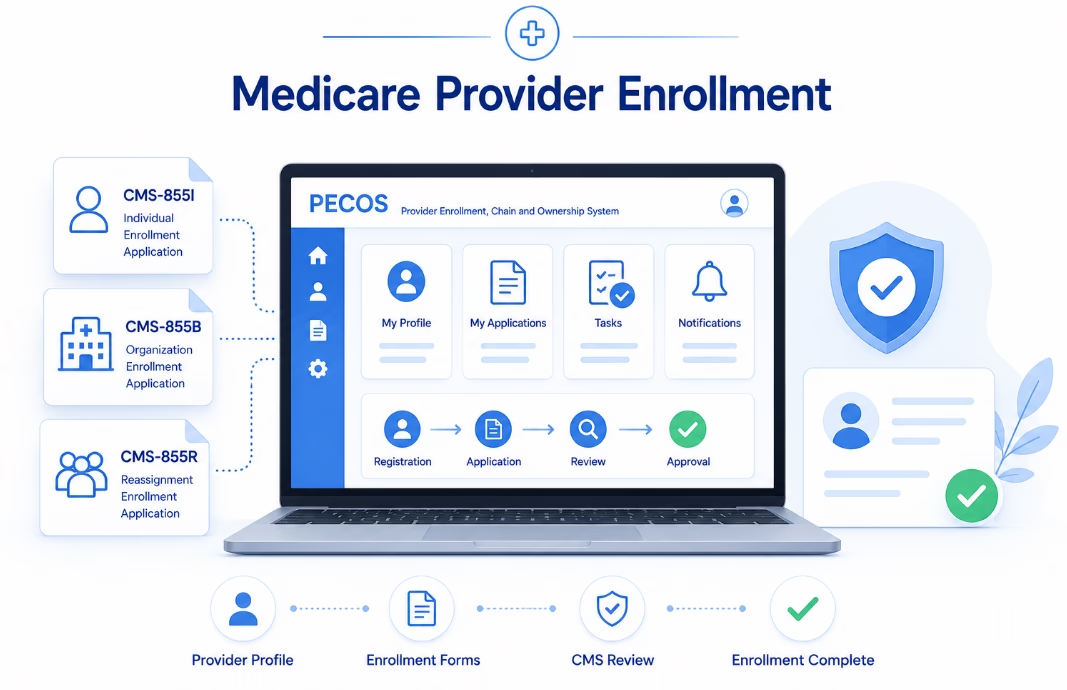
Medicare enrollment should be updated separately from NPPES and CAQH.
CMS currently requires physicians, non-physician practitioners, and physician or NPP organizations to report a change in practice location within 30 days.
This is generally handled through PECOS or the applicable Medicare enrollment form.
Does Updating NPPES Update PECOS Automatically?
No.
NPPES and Medicare enrollment serve different purposes.
A provider may have a correct NPI record while the Medicare enrollment record still contains an old practice location.
Both should be reviewed independently.
Does a Provider Keep the Same Medicare Enrollment When Moving?
Not necessarily in every operational sense.
The provider may retain an existing Medicare identity and enrollment relationship while still needing to:
- Add a new practice location
- Remove an old location
- Change reassignment relationships
- Join a new group
- Update managing information
The appropriate action depends on the provider’s enrollment structure.
What Happens When a Provider Joins a New Group?
Changing employers or practices can create a new set of administrative requirements even when the provider remains in the same state.
Possible steps include:
- New group affiliation
- Medicare reassignment
- Commercial payer affiliation
- Medicaid group linkage
- New service location
- New payer products
A provider’s individual approval with a payer does not automatically establish participation under the new group’s TIN.
Does Medicaid Enrollment Transfer to Another State?
No.
Medicaid is administered through individual state programs.
A provider starting practice in a new state may need:
- New state Medicaid enrollment
- Individual provider enrollment
- Group enrollment or affiliation
- Location enrollment
- Managed care credentialing
- MCO contracting
Enrollment in one state’s Medicaid program does not establish participation in another state’s Medicaid program.
What About Commercial Insurance Payers?
Each commercial payer should be evaluated separately.
Questions to ask include:
- Is the provider already credentialed by the payer?
- Does that credentialing apply to the new state?
- Is the new group contracted?
- Does the provider need a new affiliation?
- Does the payer require a new location application?
- Is the provider participating in the correct product?
- What effective date applies?
Does Being In-Network in One State Mean the Provider Is In-Network in Another?
Not necessarily.
National payer brands may operate different:
- Networks
- Products
- Contracts
- Regional entities
- State Medicaid plans
A provider should not assume that existing network participation follows them automatically across state lines.
Should the Provider’s Old Payer Locations Be Removed?
Yes, when the location is no longer valid and payer procedures require its removal.
Leaving obsolete locations active can create:
- Directory inaccuracies
- Patient confusion
- Incorrect correspondence
- Enrollment discrepancies
However, do not remove a location prematurely if the provider is still treating patients or billing for services associated with that location.
Does Board Certification Need to Change When a Provider Moves?
Usually not because of the move itself.
Board certification is separate from state licensure.
It should still be reviewed for:
- Current status
- Expiration date
- Payer requirements
- Employer requirements
- Facility privilege requirements
What About Hospital or Facility Privileges?
If the provider will practice in a new hospital, surgery center, or other facility that grants clinical privileges, a new privileging process may be required.
Existing privileges at another facility do not automatically transfer.
The new organization may separately review:
- Credentials
- Training
- Experience
- Current competence
- Requested privileges
How Does Telehealth Change the Relocation Workflow?
A provider may physically relocate while continuing to treat patients located in the previous state through telehealth.
That creates two separate questions:
- Where is the provider physically practicing?
- Where is the patient located?
Interstate telehealth practice should be evaluated under the applicable licensing and payer rules for the patient’s jurisdiction.
Do not automatically allow the provider’s former license to lapse if they will continue treating patients there.
Can a Provider Start Billing From the New Location Immediately?
Not necessarily.
Before billing from the new arrangement, verify:
- Legal practice authority
- Payer enrollment
- Group affiliation
- Location activation
- Network product
- Effective date
The physical move date and the payer effective date may be different.
Why Is the Effective Date So Important?
A payer may approve a provider or location but assign an effective date that differs from:
- The move date
- The application date
- The credentialing approval date
- The provider’s employment start date
Record the payer-confirmed effective date instead of assuming when participation began.
Build a Provider Relocation Checklist
| System or Requirement | What to Review |
|---|---|
| Professional license | Authority to practice in new state |
| NPPES | New practice and contact information |
| DEA | Address and registration requirements where applicable |
| State controlled substance | New-state requirement where applicable |
| CAQH | Add new location and update practice information |
| Medicare | Practice location and reassignment changes |
| Medicaid | New state enrollment and affiliations |
| Commercial payers | Credentialing, affiliation, location, product, and contract status |
| Privileges | New facility privileges where applicable |
| Billing | Confirmed payer effective dates and service locations |
Create a Provider Relocation Matrix
For organizations moving several providers or opening a new state, use a provider-by-system tracker.
| Provider | License | NPPES | CAQH | Medicare | Payers |
|---|---|---|---|---|---|
| Provider A | Active | Updated | Updated | Pending | 3 active, 2 pending |
| Provider B | Pending | Not started | Not started | Not started | Not started |
This makes it clear that relocation is not complete simply because one system has been updated.
Common Provider Relocation Mistakes
Assuming the NPI Changes
The NPI generally remains the same. The associated NPPES information must be updated.
Updating NPPES but Forgetting Medicare
NPPES and Medicare enrollment are separate records.
Updating CAQH and Assuming Every Payer Is Updated
Payers may still require direct action.
Assuming the Old State License Covers the New State
Licensure authority is jurisdiction-specific.
Forgetting Medicaid
Medicaid enrollment does not simply transfer to another state.
Ignoring Group Affiliation
An individually credentialed provider may still need to be linked to the new group.
Ignoring the New Practice Location
A payer may require the new location to be enrolled or activated separately.
Assuming Credentialing Approval Is the Billing Start Date
Use the payer-confirmed effective date.
Cancelling the Old License Too Early
This can create problems if the provider continues seeing patients in that state, including by telehealth.
Should Provider Relocation Be Managed Before the Move?
Whenever possible, yes.
Some steps can take significant time, particularly:
- New state licensure
- Medicaid enrollment
- Commercial payer credentialing
- Facility privileging
- Group affiliation
Organizations should map the dependencies before scheduling the provider’s billing start date.
Frequently Asked Questions
Does a provider need a new NPI when moving to another state?
Usually no. CMS states that an NPI remains the same even when the provider changes address or other identifying information. NPPES should still be updated.
How quickly should NPPES be updated?
Covered healthcare providers are generally required to report NPPES changes within 30 days of the effective date of the change.
Does a state medical license transfer to another state?
No. The provider must establish appropriate practice authority in the new state through the pathway available for that profession and jurisdiction.
Does Medicare need to be updated when a provider moves?
Yes. CMS currently requires practice-location changes for physicians, NPPs, and their organizations to be reported within 30 days.
Does updating CAQH update Medicare?
No. CAQH and Medicare enrollment are separate systems.
Does updating NPPES update commercial payers?
Not necessarily. Commercial payers may require their own location, affiliation, enrollment, or contract updates.
Does Medicaid transfer to the new state?
No. Medicaid enrollment is state-specific.
Can a provider remain licensed in both states?
Yes, if the provider meets each state’s licensing and renewal requirements.
Can the provider start billing immediately after moving?
Not necessarily. Confirm payer enrollment, affiliation, location status, network participation, and effective dates first.
Treat Provider Relocation as a Credentialing Project
A provider move should not be managed as a single address-change task.
The organization should separately confirm:
- New-state practice authority
- NPPES information
- DEA information where applicable
- CAQH
- Medicare
- Medicaid
- Commercial payer records
- Group affiliations
- Practice locations
- Facility privileges where applicable
- Effective dates
This reduces the risk of assuming that one successful update automatically completed the provider’s transition everywhere else.
eClinicAssist supports healthcare organizations with provider licensing coordination, CAQH management, Medicare and Medicaid enrollment administration, commercial payer credentialing, group affiliations, practice-location updates, payer follow-up, and effective-date tracking.
eClinicAssist does not issue professional licenses, DEA registrations, determine legal authority to practice, make payer credentialing decisions, or guarantee approval or reimbursement.
Contact eClinicAssist to discuss credentialing and payer enrollment when a provider moves, changes groups, or begins practicing in a new state.
This article provides general administrative information and is not legal, licensing, prescribing, Medicare, Medicaid, credentialing, or payer-specific advice. Requirements vary by provider type, state, payer, practice structure, and government program. Verify current requirements with the applicable licensing authority, DEA, CMS, Medicaid agency, payer, or healthcare organization.