Healthcare practice marketing helps medical clinics attract new patients, communicate their services, and build a recognizable presence in their communities. For new practices, having qualified providers, an operational facility, and appropriate insurance participation is only part of establishing a successful business.
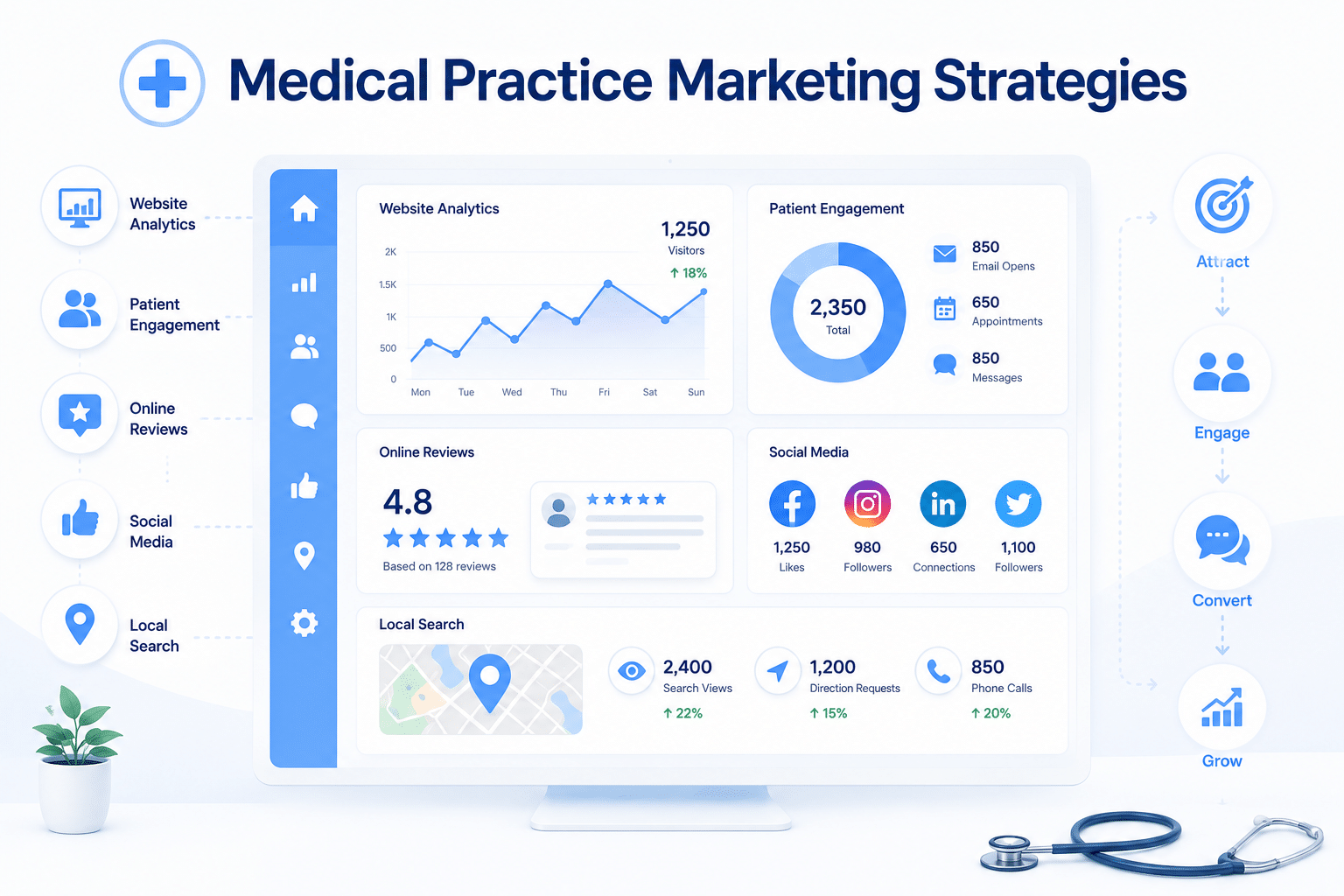
Effective healthcare practice marketing combines local search visibility, an informative website, accurate insurance directory listings, community relationships, patient experience, and measurable advertising campaigns. The goal is not simply to generate website traffic or social media engagement, but to help appropriate patients discover the practice and schedule care.
Whether you are opening a primary care clinic, urgent care center, specialty practice, or another healthcare facility, this guide explains practical marketing strategies that can support patient acquisition and long-term growth.
Why Healthcare Practice Marketing Matters
Patients have many ways to research healthcare services before making an appointment.
Depending on their needs, they may compare nearby providers, search for a particular specialty, check insurance participation, read patient reviews, or ask friends and family for recommendations.
New healthcare practices must make it easy for patients to find reliable information about their services and determine whether the practice is appropriate for their needs.
Effective Marketing Can Help Practices:
- Increase visibility in relevant local searches.
- Introduce providers and available services.
- Communicate accepted insurance information accurately.
- Build community awareness.
- Generate appointment inquiries.
- Improve the patient scheduling experience.
- Develop professional referral relationships.
- Measure which marketing channels contribute to completed visits.
Marketing results vary by specialty, location, competition, patient demand, insurance participation, and operational capacity.
No marketing strategy guarantees a specific number of patients or amount of revenue.
1. Build a Recognizable Healthcare Practice Brand
A practice’s brand includes more than its logo or colors.
It also reflects how patients understand the practice’s services, values, communication, and overall experience.
Important Branding Elements
- Practice name and visual identity.
- Consistent logo and colors.
- Clear description of available services.
- Professional website design.
- Appropriate provider biographies.
- Consistent contact and location information.
- Clear, professional patient communication.
For example, a family medicine clinic might emphasize accessible primary care, preventive services, and continuity of care.
An urgent care center may prioritize information about walk-in availability, operating hours, and common conditions treated.
Marketing messages should reflect services actually offered and avoid unsupported claims about clinical outcomes or superiority.
2. Create a Healthcare Website Designed to Generate Appointments
A medical practice website should help visitors quickly find the information needed to decide whether to contact the clinic.
An attractive design matters, but usability and accurate information are equally important.
Essential Website Information
- Practice name and location.
- Phone number and contact options.
- Office hours.
- Services and conditions treated.
- Provider credentials and biographies.
- Insurance participation information.
- Appointment scheduling instructions.
- Directions and parking information.
- Accessibility information when relevant.
- Appropriate emergency guidance.
Important information should be easy to locate on both desktop and mobile devices.
Improve Website Conversion
Website conversion refers to the actions visitors take after discovering a practice online.
Useful conversion opportunities may include:
- Calling the practice.
- Submitting a general appointment inquiry.
- Using an authorized online scheduling system.
- Requesting directions.
- Viewing a relevant service page.
Appointment forms and website tracking tools must be configured with appropriate privacy and security safeguards.
Practices should avoid collecting sensitive clinical information through ordinary unsecured contact forms.
3. Use Local SEO to Reach Patients Searching Nearby
Local search engine optimization (SEO) helps healthcare practices improve the relevance and accessibility of their online information for location-based searches.
Potential patients may search for terms such as:
- Family doctor near me.
- Primary care clinic in Houston.
- Urgent care accepting walk-ins.
- Pediatrician in Katy, Texas.
- Medical clinic accepting new patients.
- Internal medicine doctor near me.
The appropriate keywords depend on the practice’s specialty, services, and actual service area.
Local Healthcare SEO Checklist
- Create accurate location and service pages.
- Use descriptive page titles and headings.
- Provide helpful information about services.
- Keep business contact details consistent.
- Use descriptive internal links between related pages.
- Make the website mobile-friendly.
- Maintain accessible, useful page content.
- Ensure important pages can be indexed by search engines.
- Update inaccurate or outdated information.
A multi-location healthcare organization should provide meaningful information about each actual location.
Creating numerous nearly identical city pages without unique local value is generally less useful than maintaining strong pages for genuine locations and services.
4. Optimize Your Google Business Profile
A Google Business Profile helps eligible healthcare practices display information in Google Search and Maps.
A complete, accurate profile can make it easier for potential patients to find the practice and understand its services.
Google Business Profile Optimization Checklist
- Use the correct business name.
- Select relevant business categories.
- Maintain an accurate address or eligible location information.
- Keep phone numbers current.
- Update regular and special operating hours.
- Provide the correct website link.
- Add authentic photos of the location when appropriate.
- Maintain accurate information about available services.
- Review profile changes periodically.
Practices should follow Google’s eligibility and representation requirements, particularly when managing individual practitioner profiles and multiple locations.
Visit Google Business Profile for current management resources.
5. Keep Insurance Network Listings Accurate
Patients often use insurance company directories to identify healthcare providers who may participate in their health plans.
For new practices, accurate payer enrollment information and directory listings can support patient discovery.
However, credentialing, contracting, and provider directory updates are separate administrative activities.
Directory Information to Review
- Provider name.
- Individual and organizational NPI information, where relevant.
- Practice location.
- Phone number.
- Provider specialty.
- Network participation status.
- Accepting-new-patients status, where applicable.
- Other information required by the insurer.
A practice should not advertise participation in a particular insurance network until the relevant arrangements and effective dates have been confirmed.
For more information, review our insurance network enrollment strategy for healthcare practices.
6. Build an Ethical Online Review Strategy
Online reviews can help prospective patients understand others’ reported experiences with a healthcare practice.
However, healthcare organizations must approach review collection and responses carefully.
Recommended Review Practices
- Invite patients to share honest feedback without pressuring them.
- Use Google-supported review links or QR codes.
- Avoid incentives for Google reviews.
- Do not selectively request only positive reviews.
- Do not purchase or fabricate reviews.
- Respond professionally without disclosing protected health information.
- Use feedback to identify potential service improvements.
Google prohibits incentives in exchange for reviews and certain review manipulation practices.
The Federal Trade Commission also regulates deceptive reviews and testimonials, including fake reviews and certain undisclosed relationships.
Read Google’s guidance for obtaining reviews and the FTC’s consumer reviews guidance.
Protect Patient Privacy in Review Responses
Healthcare practices should not publicly confirm that a reviewer is a patient or disclose information about treatment, appointments, or medical history.
Even when someone voluntarily describes their healthcare experience online, the practice must independently follow applicable privacy obligations.
Responses should remain general and direct individuals to appropriate private communication channels.
7. Use Social Media to Build Community Awareness
Social media can support communication with patients and local communities.
For many practices, consistent and useful content is more sustainable than attempting to produce viral material.
Social Media Content Ideas
- General health education.
- Provider introductions.
- Office opening announcements.
- Updated operating hours.
- Seasonal health information.
- Community participation.
- Information about newly available services.
- General answers to common appointment questions.
Content should be accurate, within the practice’s professional scope, and appropriate for its intended audience.
Avoid publishing identifiable patient stories, photographs, or testimonials without the appropriate authorization and legal review.
8. Protect Patient Privacy in Healthcare Marketing
Healthcare marketing must account for applicable privacy laws and advertising requirements.
Under the HIPAA Privacy Rule, certain uses or disclosures of protected health information for marketing require prior written patient authorization, subject to specific exceptions.
Practices should assess privacy requirements before using patient testimonials, treatment photographs, direct marketing lists, or tracking technologies that may process protected health information.
Important Marketing Privacy Considerations
- Obtain required authorizations before using protected patient information for marketing.
- Limit access to sensitive information.
- Review website forms and advertising technology.
- Use appropriate safeguards for patient communications.
- Avoid public disclosures when responding to reviews.
- Review vendor relationships and applicable business associate obligations.
- Maintain procedures for evaluating new marketing campaigns.
Visit the HHS HIPAA marketing guidance for an overview of federal requirements.
9. Develop Community Outreach and Professional Referral Relationships
Local relationships can help new medical practices become better known in their communities.
Depending on specialty and services, useful outreach opportunities may include:
- Community health organizations.
- Local physicians and specialists.
- Schools and educational organizations.
- Employers and business associations.
- Community events.
- Professional networking groups.
- Other healthcare organizations.
For example, a primary care practice may introduce its services to nearby specialists, while a specialty clinic may communicate relevant referral criteria to local primary care offices.
Professional referral arrangements must comply with applicable laws and payer requirements.
Practices should avoid paying for patient referrals or entering arrangements that violate the federal Anti-Kickback Statute, physician self-referral laws, or applicable state restrictions.
Outreach should focus on communicating legitimate services and improving appropriate access to care.
10. Improve Patient Experience to Support Practice Growth
Marketing can generate interest, but the experience patients receive after contacting a practice also influences whether they schedule and return for care.
Important operational considerations include:
- Prompt phone answering.
- Clear appointment availability.
- Accurate office hours.
- Helpful front-desk communication.
- Reasonable scheduling processes.
- Clear insurance and billing explanations.
- Accessible instructions for follow-up.
- Professional handling of complaints.
Practice administrators should evaluate whether operational problems are preventing interested patients from obtaining appointments.
For example, advertising may generate phone calls, but missed calls or unclear scheduling instructions can prevent those inquiries from becoming completed visits.
11. Use Paid Advertising Carefully
Paid advertising may help eligible practices reach patients searching for relevant services.
Common options include search advertising and location-targeted social media campaigns.
However, practices should evaluate whether an advertising channel matches their services, budget, and patient population.
Before Launching a Campaign
- Confirm the advertised service is available.
- Verify relevant provider and insurance participation information.
- Use an accurate landing page.
- Provide a clear appointment or contact option.
- Review advertising platform healthcare policies.
- Check applicable privacy and consent requirements.
- Define how campaign performance will be evaluated.
Marketing claims about treatments, outcomes, insurance acceptance, pricing, or qualifications must be accurate and appropriately supported.
A campaign should not promise guaranteed clinical outcomes or imply universal insurance coverage.
12. Measure Patient Acquisition, Not Just Website Traffic
Healthcare practices should evaluate marketing based on outcomes that matter to the business and patients.
Website visits, impressions, and social media engagement can provide useful context, but they do not necessarily indicate that more patients are receiving care.
Useful Healthcare Marketing Metrics
| Metric | What It Measures |
|---|---|
| Appointment inquiries | Calls, forms, and other requests for appointments. |
| Booked appointments | Inquiries that become scheduled visits. |
| Completed new-patient visits | New patients who actually receive care. |
| Appointment conversion rate | Percentage of relevant inquiries that result in bookings. |
| Patient acquisition cost | Marketing expenditure divided by acquired new patients, using a consistently defined measure. |
| Missed-call rate | Percentage of incoming calls that are not answered. |
| Source of new patients | Marketing or referral channels associated with new visits. |
For example, a campaign generating fewer inquiries may still be more valuable if those inquiries consistently convert into appropriate, completed appointments.
When measuring conversions, practices should avoid sending protected health information to unauthorized analytics or advertising vendors.
90-Day Healthcare Practice Marketing Plan
New practices can use a phased approach to organize marketing activities without attempting every channel at once.
Days 1-30: Establish the Foundation
- Finalize accurate practice branding.
- Launch or improve the website.
- Publish essential service and location information.
- Set up or verify eligible Google Business Profiles.
- Review insurance directory information.
- Implement basic appointment inquiry tracking.
Days 31-60: Increase Local Visibility
- Improve local service pages.
- Publish useful patient education content.
- Begin appropriate community outreach.
- Establish an ethical review request process.
- Introduce the practice through suitable social media channels.
- Evaluate appointment inquiries and scheduling performance.
Days 61-90: Evaluate and Optimize
- Review completed new-patient visits.
- Identify effective referral and marketing channels.
- Investigate missed calls and booking difficulties.
- Improve underperforming website pages.
- Consider targeted advertising where appropriate.
- Reallocate resources based on measurable results.
The appropriate pace depends on practice size, staffing, service demand, and available resources.
This is a suggested planning framework rather than a promise of specific growth within 90 days.
Common Healthcare Practice Marketing Mistakes
Healthcare organizations may waste resources when marketing activities are disconnected from patient needs and operational readiness.
1. Advertising Before the Practice Is Ready
Promoting appointment availability before staffing, scheduling, or relevant insurance participation is established may lead to patient frustration.
2. Publishing Incorrect Insurance Information
Advertising inaccurate in-network status can create scheduling and billing problems.
3. Ignoring Local Search Visibility
A practice with an attractive website may still be difficult to find if its service and location information is incomplete.
4. Focusing Only on Social Media Engagement
Views, likes, and shares do not necessarily translate into patient appointments.
5. Neglecting Patient Communication
Missed calls, unclear office hours, or confusing appointment instructions can reduce the effectiveness of otherwise successful campaigns.
6. Using Misleading Reviews or Testimonials
Fake reviews, selective positive-review solicitation, or unauthorized patient testimonials create reputational and compliance risks.
7. Failing to Measure Results
Without reliable performance tracking, practices may continue spending on activities that do not meaningfully contribute to patient acquisition.
How Credentialing and Payer Enrollment Support Practice Growth
Healthcare marketing and payer credentialing serve different purposes, but they can affect the patient acquisition process.
Patients may search for providers who participate in their insurance plans.
When a practice completes relevant payer enrollment requirements and maintains accurate directory information, eligible patients may find it easier to identify available providers.
However, credentialing approval, contracting, payer directory updates, and marketing activities are separate processes.
Practices should coordinate these activities without assuming that payer participation guarantees referrals or increased patient volume.
For additional information, see our payer relationship strategies for healthcare growth.
Healthcare Practice Marketing Checklist
- Establish accurate branding and service messaging.
- Maintain a useful, mobile-friendly website.
- Publish accurate practice locations and hours.
- Provide clear appointment options.
- Optimize eligible Google Business Profiles.
- Maintain accurate insurance directory information.
- Implement ethical review collection procedures.
- Protect patient information in marketing materials.
- Publish helpful local healthcare content.
- Develop appropriate professional referral relationships.
- Improve front-desk and scheduling workflows.
- Evaluate paid advertising carefully.
- Track appointment inquiries and completed visits.
- Review marketing performance regularly.
How eClinicAssist Supports Growing Healthcare Practices
Launching and growing a healthcare practice requires coordination between business operations, staffing, provider credentialing, insurance participation, and patient-facing services.
eClinicAssist supports healthcare organizations with administrative credentialing and payer enrollment activities, including:
- Provider credentialing documentation.
- CAQH profile management.
- Medicare and Medicaid enrollment administration.
- Commercial insurance credentialing and contracting follow-up.
- Provider-group affiliation tracking.
- Payer enrollment status monitoring.
- Provider demographic updates.
- Recredentialing and renewal tracking.
Our services can help practices coordinate important enrollment activities as they prepare to serve new patients and expand their operations.
Marketing campaign management, advertising performance, and patient acquisition results are separate from payer credentialing decisions and depend on the services actually arranged with the practice.
Opening a new medical practice or expanding your provider team?
Contact eClinicAssist to discuss your credentialing and payer enrollment needs.
Frequently Asked Questions About Healthcare Practice Marketing
What is healthcare practice marketing?
Healthcare practice marketing involves communicating a medical practice’s services, location, qualifications, and appointment options to appropriate audiences through channels such as local search, websites, community outreach, and advertising.
What is the best marketing strategy for a new medical practice?
A strong starting point is an accurate website, an eligible Google Business Profile, useful local service information, clear appointment access, and reliable insurance participation details. The best channels depend on specialty and location.
How can a small clinic attract more patients?
Small clinics can improve local search visibility, maintain accurate online listings, build appropriate community relationships, improve appointment scheduling, and measure which channels generate completed visits.
Does healthcare SEO help with patient acquisition?
SEO can improve the discoverability of relevant healthcare information. However, search visibility does not guarantee patient appointments or a specific number of new visits.
Can healthcare practices ask patients for Google reviews?
Yes, practices may request genuine reviews while following Google’s policies and applicable laws. They should not offer incentives for Google reviews, selectively solicit only positive reviews, or pressure patients.
Can medical practices use patient testimonials in advertising?
Patient testimonials may be used only when the practice satisfies applicable authorization, privacy, advertising, and consumer protection requirements. HIPAA-regulated uses of protected health information for marketing may require prior written authorization.
Does payer credentialing improve marketing results?
Appropriate payer enrollment and accurate insurance directory listings may help eligible patients identify participating providers. Credentialing does not independently guarantee search rankings, referrals, or patient volume.
What marketing metrics should a healthcare practice track?
Useful measures include appointment inquiries, booked appointments, completed new-patient visits, conversion rates, missed calls, patient acquisition cost, and the sources of new patients.
How much should a new medical practice spend on marketing?
There is no universal budget. Spending should reflect specialty, location, competition, operating capacity, financial resources, and measurable patient acquisition performance.
Final Thoughts: Building a Medical Practice That Patients Can Find
Healthcare practice marketing is one part of establishing a sustainable medical business. A well-organized practice must also maintain qualified clinical personnel, accurate enrollment records, reliable patient access, and appropriate operational safeguards.
From business formation and staffing to credentialing, technology, insurance participation, and patient acquisition, each stage contributes to practice readiness.
Once the practice is operational, ongoing improvement matters. Administrators should continue refining patient communication, monitoring appointment access, reviewing marketing results, and keeping payer information accurate.
The objective is not simply to attract more attention. It is to make appropriate care easier to find while supporting a professional, reliable patient experience.
Disclaimer: This article provides general educational and administrative information about healthcare practice marketing, business operations, and provider enrollment. It does not constitute legal, medical, advertising, financial, or regulatory advice. Marketing and privacy obligations vary by jurisdiction, platform, professional category, and individual circumstances. Practices should review applicable HIPAA requirements, advertising standards, state laws, payer contracts, and referral regulations with qualified advisers. eClinicAssist does not guarantee search rankings, patient acquisition, payer participation, credentialing approval, or revenue outcomes.