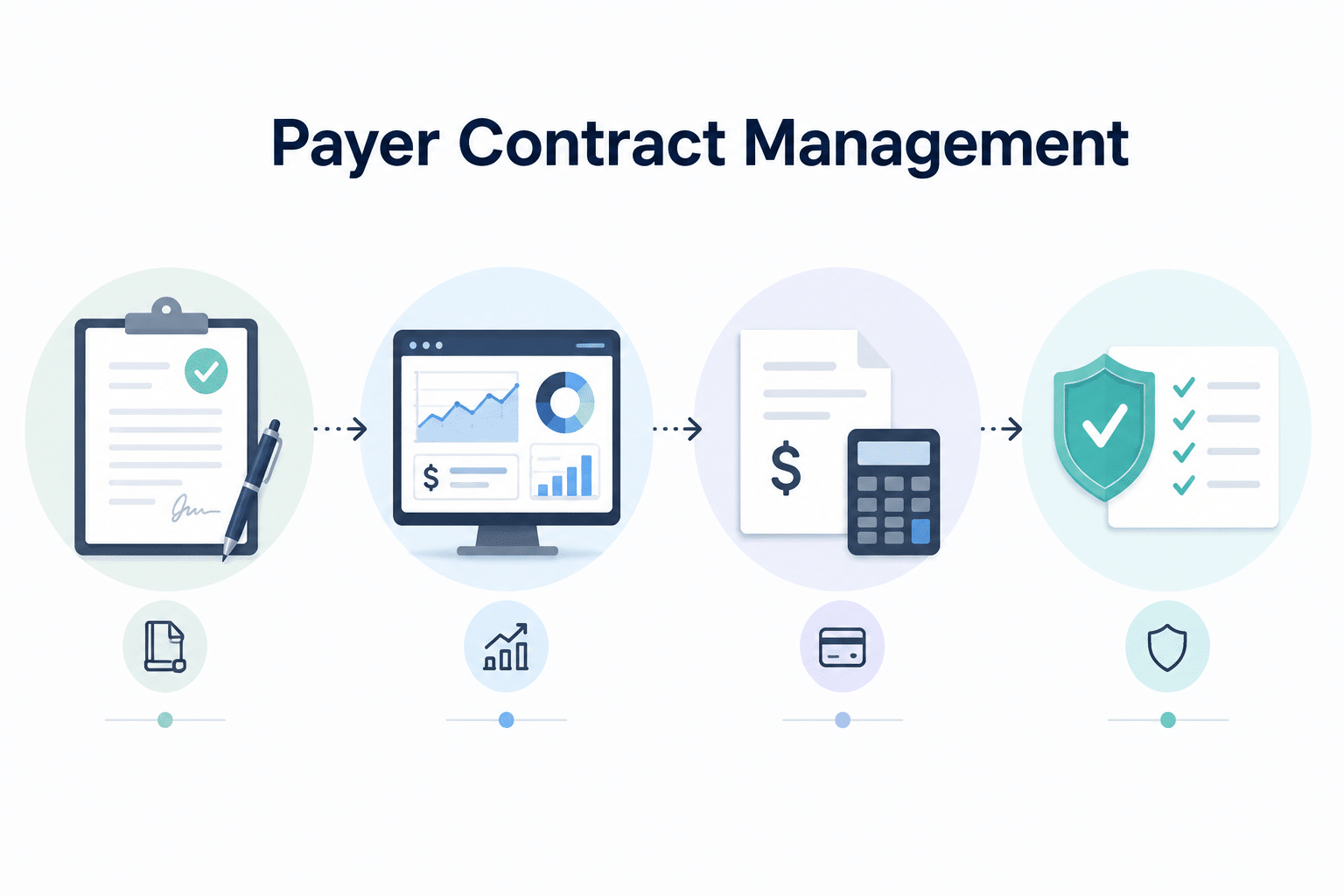
Payer contract management is the ongoing process of organizing, reviewing, monitoring, and applying healthcare payer agreements and related documents. A reliable system should track reimbursement terms, fee schedules, amendments, products, effective dates, renewal and termination provisions, timely filing rules, provider affiliations, and payment performance against the terms actually in effect.
Signing a payer agreement is not the end of contract management.
Commercial payer relationships can change over time through amendments, fee schedule updates, new products, provider manual revisions, reimbursement policies, network changes, and organizational updates.
Without a structured system, practices may struggle to answer basic questions such as:
- Which contract version is currently in effect?
- Which fee schedule applies?
- Which providers and locations are included?
- What products are covered?
- When can the contract be renegotiated or terminated?
- Is a payment actually below the contracted amount?
What Is Payer Contract Management?
Payer contract management is the process of maintaining and applying the agreements that govern a healthcare organization’s commercial payer relationships.
Depending on the arrangement, relevant documents may include:
- Provider agreement
- Participation agreement
- Fee schedule
- Rate exhibit
- Amendments
- Product attachments
- Provider manuals incorporated by reference
- Reimbursement policies
- Network notices
- Termination notices
The signed base agreement is important, but it may not be the only document controlling the payer relationship.
What Information Should Be Tracked for Every Payer Contract?
| Contract Field | What to Record |
|---|---|
| Payer | Legal payer or contracting entity |
| Network or product | Commercial, exchange, employer, Medicare Advantage, Medicaid managed care, or other applicable product |
| Contracting entity | Practice, group, facility, or other contracted organization |
| TIN and NPI | Identifiers associated with the agreement |
| Effective date | Date the agreement or amendment becomes effective |
| Fee schedule | Current rate methodology or attached reimbursement schedule |
| Renewal | Expiration, automatic renewal, and notice deadlines |
| Termination | Without-cause, for-cause, cure, and notice provisions |
| Filing rules | Applicable claim and appeal deadlines |
| Amendments | Current and historical contract modifications |
Do Payer Contracts Determine Reimbursement Rates?
Commercial payer agreements often establish or reference the methodology used to determine reimbursement.
Examples can include:
- Fixed fee schedules
- A percentage of another fee schedule
- Case rates
- Per diem arrangements
- Bundled payments
- Capitation
- Other negotiated methodologies
The exact amount due may also depend on:
- Place of service
- Procedure code
- Modifier
- Multiple-procedure rules
- Bundling policy
- Provider type
- Product
- Location
The contract should therefore be read together with the applicable fee schedule and reimbursement policies.
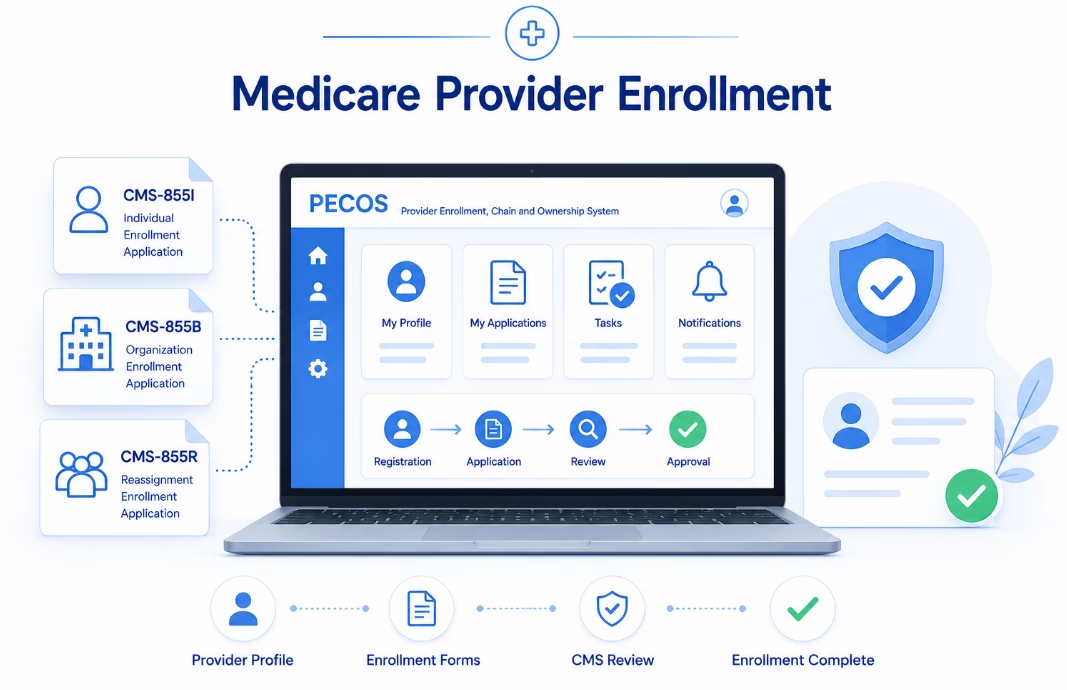
Is Traditional Medicare a Negotiated Payer Contract?
Not in the same way as a commercial network agreement.
For services paid under the Medicare Physician Fee Schedule, CMS establishes payment rates through the federal Physician Fee Schedule methodology.
Participating Medicare physicians and suppliers agree to accept assignment for covered services under Medicare participation rules.
Practices should therefore separate Traditional Medicare payment administration from commercial contract negotiation.
What Is a Payer Fee Schedule?
A payer fee schedule identifies or helps determine the allowed reimbursement associated with covered services under the payer relationship.
Fee schedules may be:
- Attached directly to the agreement
- Delivered separately
- Based on a stated percentage or methodology
- Updated through an amendment or notice
Practices should retain the fee schedule applicable to each time period rather than keeping only the most recent version.
Why Should Historical Fee Schedules Be Retained?
Historical schedules can be necessary when reviewing claims with older dates of service.
If rates changed on July 1, for example, a claim from June may be governed by a different schedule from a claim in August.
A useful archive should record:
- Version
- Effective date
- Termination date where applicable
- Related amendment
- Products affected
What Is an Underpayment?
An underpayment occurs when the payer pays less than the amount that should have been paid under the applicable contractual and payment terms.
A low payment is not automatically an underpayment.
Before escalating a suspected discrepancy, verify:
- Correct contract.
- Correct product.
- Correct fee schedule version.
- Correct date of service.
- Correct CPT or HCPCS code.
- Correct place of service.
- Applicable modifiers.
- Bundling or multiple-procedure adjustments.
- Patient cost sharing.
- Any applicable payer payment policy.
How Should Practices Audit Contracted Rates?
A practical contract-rate audit compares expected reimbursement against actual allowed amounts.
Start with high-volume or high-dollar services.
For each selected code, record:
- Contracted rate
- Expected allowed amount
- Actual payer allowed amount
- Difference
- Payer adjustment reason
- Whether further review is needed
This is more reliable than comparing only total payments between payers.
Should Practices Compare Rates Between Payers?
Practices can analyze their own contractual reimbursement data to understand how different agreements perform.
Useful measures can include:
- Allowed amount by service
- Payment as a percentage of a chosen benchmark
- Volume by payer
- Denial rate
- Administrative workload
- Days in accounts receivable
- Patient volume associated with the network
A lower rate alone does not necessarily mean the contract is unfavorable.
Network volume, service mix, administrative burden, authorization requirements, denial behavior, and other terms can also matter.
What Documents Should Be Stored in a Payer Contract File?
A centralized payer file should contain more than the original signature page.
Consider storing:
- Executed contract
- Fee schedules
- Amendments
- Product attachments
- Rate-change notices
- Renewal notices
- Termination notices
- Relevant payer correspondence
- Current provider manuals or references where contractually relevant
- Negotiation history
Use version control so staff can distinguish active terms from superseded documents.
What Is a Payer Contract Summary Sheet?
A contract summary is an internal quick-reference document containing the operational terms staff needs most often.
It can summarize:
- Effective date
- Network products
- Fee schedule methodology
- Timely filing requirement
- Appeal deadline
- Renewal structure
- Termination notice requirement
- Contact information
- Credentialing or affiliation requirements
The summary should clearly identify the underlying contract source and last review date.
It should never replace the actual governing agreement.
What Is an Incorporated Provider Manual?
Some payer contracts reference a provider manual or policies that become part of the operational relationship through the agreement’s incorporation language.
This matters because the payer may update certain operational requirements outside the original signed contract.
Practices should determine:
- Which external documents are incorporated
- How updates are communicated
- When updates become effective
- Whether the contract gives the practice objection or termination rights
How Should Contract Amendments Be Managed?
Every amendment should be connected to the original agreement.
Track:
- Date received
- Date signed, if a signature is required
- Effective date
- Sections modified
- Rates affected
- Products affected
- Whether operational workflows must change
Do not overwrite the prior contract version.
Maintaining history is important for determining which terms applied to earlier dates of service.
Why Are Contract Renewal Deadlines Important?
Some payer agreements have a defined expiration date.
Others automatically renew unless one party provides notice within a specified period.
For that reason, practices should track both:
- Contract renewal or expiration date
- Deadline for giving notice
A contract that automatically renews on January 1 may require notice months earlier if the practice wants to renegotiate or terminate it.
What Contract Termination Terms Should Be Reviewed?
Termination provisions deserve their own contract summary.
Review:
- Termination without cause
- Required notice period
- Termination for cause
- Cure period
- Required notice method
- Effective termination date
- Obligations for existing patients
- Claims submitted after termination
- Records or transition obligations
The effect of termination depends on the agreement, applicable law, payer product, and patient circumstances.
How Does Credentialing Relate to Payer Contract Management?
Credentialing and contracting are related but separate.
Credentialing evaluates provider qualifications.
Contracting establishes the participation terms between the payer and provider organization.
Additional administrative work may still be required for:
- Provider enrollment
- Group affiliation
- Location additions
- Product activation
- Effective-date confirmation
A provider being credentialed should therefore not automatically be treated as fully active under the contract.
See our credentialing vs enrollment guide for the distinction between these processes.
How Should New Providers Be Added to Existing Contracts?
A group contract does not necessarily mean every new provider is automatically ready to bill under it.
For each provider, confirm:
- Credentialing status
- Enrollment status
- Group affiliation
- Practice location
- Applicable payer product
- Effective date
The exact process is payer-specific.
Do Payer Contracts Determine Timely Filing Rules?
They may.
Timely filing requirements can be found in:
- The contract
- A provider manual incorporated into the contract
- A product-specific attachment
- Applicable payer policy
- Applicable law
Track the source of the deadline rather than placing an unsupported number into a generic payer spreadsheet.
What Other Deadlines Should Contract Management Track?
Depending on the agreement, deadlines may include:
- Initial claim filing
- Corrected claims
- Appeals
- Disputes
- Refund responses
- Medical record requests
- Credentialing submissions
- Contract renewal notices
- Termination notices
How Should Payer Policy Changes Be Managed?
Payers may update reimbursement, authorization, clinical, or administrative policies.
When an update is received:
- Identify the policy.
- Confirm the affected product.
- Record the effective date.
- Determine whether the contract incorporates the policy.
- Identify affected services or departments.
- Update internal workflows where appropriate.
- Retain the notice for future reference.
How Can Technology Support Payer Contract Management?
Technology can help centralize:
- Contracts
- Amendments
- Fee schedules
- Deadlines
- Renewal notices
- Payer contacts
- Rate audits
- Assigned tasks
Automation can also create alerts for upcoming notice periods and contract reviews.
Software does not determine what a contract legally means or whether a payment violates the agreement.
How Should Payer Contract Performance Be Reviewed?
A contract should be evaluated on more than headline reimbursement rates.
Useful performance indicators can include:
| Metric | Why It Matters |
|---|---|
| Allowed amount | Shows actual contractual payment levels by service |
| Denial rate | Helps identify payer or workflow problems |
| Underpayment variance | Shows differences between expected and actual contractual payment |
| Authorization burden | Shows administrative effort required before care |
| AR performance | Shows how quickly claims are resolved |
| Patient volume | Shows the network’s practical contribution to the practice |
When Should a Payer Contract Be Reviewed for Renegotiation?
Possible triggers include:
- Upcoming renewal
- Materially outdated rates
- Service expansion
- New locations
- Significant provider growth
- Repeated verified underpayments
- Major administrative burden
- Material changes in payer policies
A renegotiation request does not guarantee the payer will change rates or terms.
See our insurance contract negotiation guide for the negotiation workflow.
How Should Staff Use Payer Contract Information?
Not every employee needs access to every contract.
Instead, departments should receive the information relevant to their work.
Credentialing and enrollment teams
May need:
- Network requirements
- Provider-add process
- Location-add process
- Effective-date information
Billing teams
May need:
- Fee schedule
- Filing limits
- Appeal requirements
- Applicable reimbursement policies
Front-office teams
May need:
- Network products
- Referral procedures
- Authorization workflows
- Eligibility procedures
Training should be based on the actual payer arrangement rather than generalized assumptions.
Do Good Payer Relationships Guarantee Faster Resolution?
No.
Having accurate payer contacts and maintaining professional communication can make escalation easier, but dispute resolution still depends on factors such as:
- Contract terms
- Payer procedures
- Evidence
- Appeal rights
- Applicable deadlines
Important disputes should be documented rather than handled only through informal phone conversations.
Payer Contract Management Checklist
| Area | What to Confirm |
|---|---|
| Contract | Current executed agreement retained |
| Products | Applicable networks and products identified |
| Fee schedule | Current and historical rate versions retained |
| Amendments | Effective dates and affected provisions tracked |
| Provider manuals | Relevant incorporated documents identified |
| Renewal | Expiration and notice deadlines tracked |
| Termination | Notice, cure, effective date, and transition terms summarized |
| Claims deadlines | Timely filing and dispute deadlines documented |
| Providers | Credentialing, affiliation, location, product, and effective date confirmed |
| Rate validation | Expected versus actual allowed amounts periodically reviewed |
| Version control | Superseded documents preserved and clearly labeled |
Frequently Asked Questions
What is payer contract management?
Payer contract management is the ongoing process of organizing, monitoring, applying, and reviewing healthcare payer agreements, fee schedules, amendments, network terms, deadlines, and payment performance.
Does the signed payer contract contain every billing rule?
Not necessarily. Some operational requirements may also appear in incorporated provider manuals, reimbursement policies, amendments, product attachments, or other governing documents.
What is a payer underpayment?
An underpayment occurs when the payer pays less than the amount due under the applicable contract, fee schedule, reimbursement methodology, and related payment rules.
Is a low reimbursement automatically an underpayment?
No. The actual contracted amount must first be calculated using the correct agreement, product, rate version, service, modifier, place of service, and applicable payment rules.
Should practices keep old fee schedules?
Yes. Historical rate information can be important when validating claims from earlier dates of service.
What is an auto-renewing payer contract?
An auto-renewing agreement continues for another contractual period unless one party gives the required notice within the stated timeframe.
Is provider credentialing the same as payer contracting?
No. Credentialing evaluates provider qualifications. Contracting establishes participation terms. Enrollment, group affiliation, location setup, and effective dates may be additional steps.
Can contract management software identify every underpayment?
No. Technology can support rate comparison and tracking, but correct underpayment analysis still depends on accurate contract interpretation, claims data, payer policies, and reimbursement rules.
Are Medicare fee-for-service rates negotiated like commercial contracts?
No. Traditional Medicare Physician Fee Schedule payments are established through federal payment methodology rather than individual commercial-style rate negotiations.
Manage the Entire Payer Relationship, Not Just the Signed Contract
Effective payer contract management requires visibility into more than a PDF stored in a shared folder.
Practices should know:
- Which contract is active
- Which products it covers
- Which fee schedule applies
- Which amendments changed the original terms
- When notice must be given before renewal or termination
- Which providers and locations are active
- Whether actual payments match expected contractual reimbursement
A well-organized system makes these questions easier to answer, but it does not replace careful review of the governing payer documents.
eClinicAssist supports healthcare organizations with payer enrollment, provider credentialing administration, group and location tracking, payer application follow-up, provider-document management, CAQH administration, and related payer-management workflows.
eClinicAssist does not provide legal interpretation of payer contracts, guarantee negotiated rates, determine whether a payment legally violates an agreement, or guarantee payer participation or reimbursement.
Contact eClinicAssist to discuss payer enrollment, credentialing, and provider-management support for your organization.
This article provides general administrative information and is not legal, antitrust, billing, reimbursement, contractual, or payer-specific advice. Contract terms vary by payer, organization, network, product, state, and agreement. Healthcare organizations should review their governing documents and seek qualified legal or financial advice when appropriate.