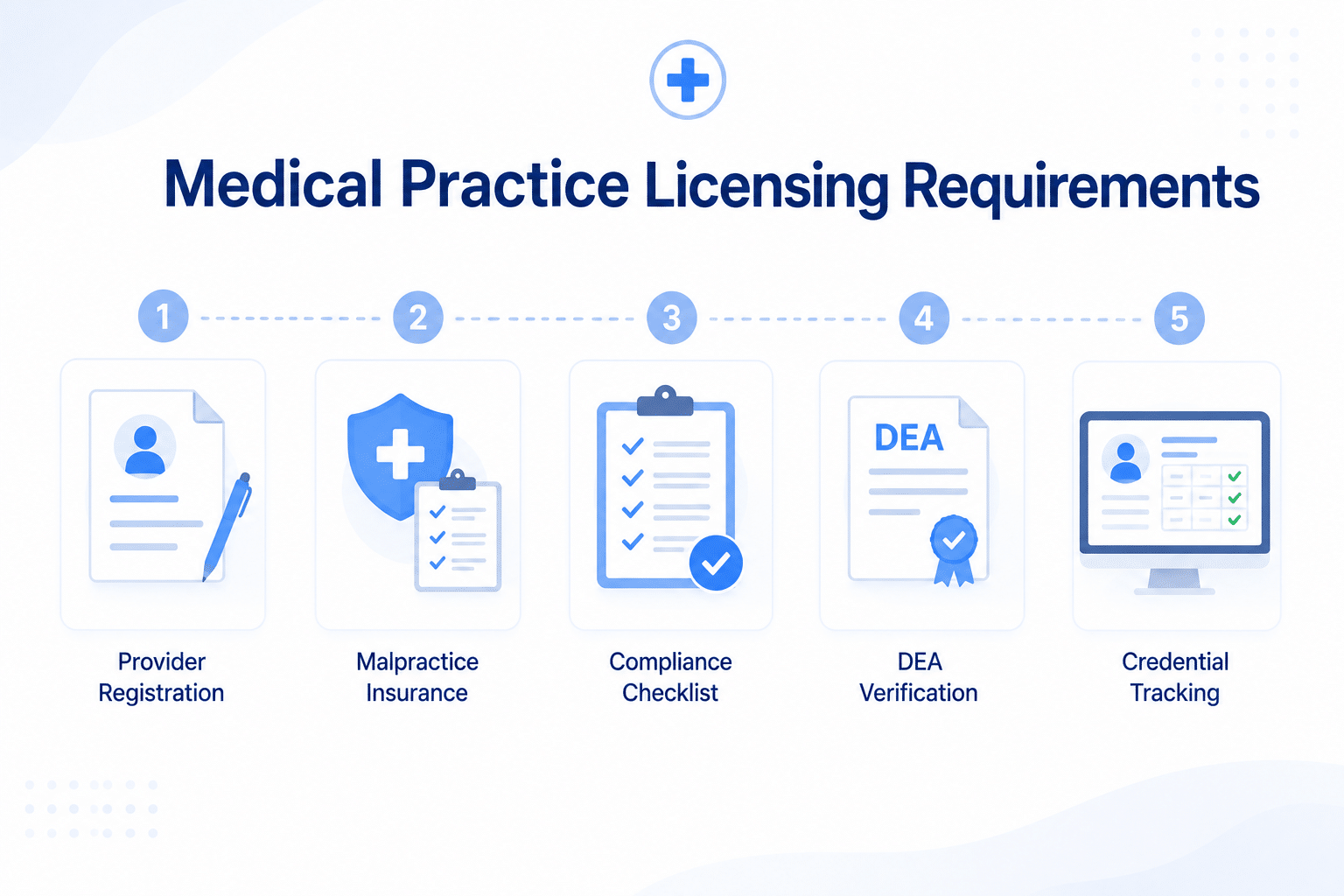
Medical practice licensing requirements vary by state, ownership structure, facility type, provider profession, and services offered. A new clinic may need business registrations, individual professional licenses, NPIs, controlled-substance registrations, laboratory certification, local permits, payer enrollment, and insurance coverage. These requirements are related, but they are not all the same type of license.
One of the most common startup mistakes is treating “medical practice licensing” as a single application. In reality, several government agencies, licensing boards, payers, and other organizations may be involved.
A primary care office performing waived laboratory tests may have a different compliance checklist from a behavioral health telehealth practice, an imaging center, an urgent care clinic, or a specialty practice performing procedures.
The safest approach is to identify every service the practice plans to provide, determine which entity and provider approvals apply, and track each requirement separately.
Is There One Medical Practice License for Every Clinic?
No. There is no single nationwide medical practice license that every outpatient clinic obtains.
The required approvals depend on the state and the nature of the organization. A new practice may need some combination of:
- State business formation or registration
- Professional entity approval where applicable
- Local business licenses or permits
- Individual healthcare professional licenses
- Facility-specific licenses where applicable
- Controlled-substance registrations
- CLIA certification for laboratory testing
- Other service-specific permits or registrations
Not every item applies to every practice.
Providers building a new organization should review our starting a medical practice guide for the broader launch sequence.
1. Business Formation and State Registration
The practice first needs an appropriate legal structure.
Depending on the state and ownership arrangement, options may include:
- Sole proprietorship
- Partnership
- Limited liability company
- Professional limited liability company
- Professional corporation
- Other state-authorized professional entities
Healthcare ownership rules are not uniform across the United States. Some states restrict who may own or control a medical practice through corporate-practice-of-medicine or professional-entity laws.
The entity structure should therefore be reviewed with qualified legal and tax professionals familiar with the applicable state.
Formation documents may include articles or certificates of formation, bylaws, operating agreements, ownership records, assumed-name registrations, and related corporate records.
2. Individual Healthcare Provider Licenses
The professional license belongs to the individual provider, not automatically to the practice entity.
Physicians, nurse practitioners, physician assistants, psychologists, therapists, social workers, dentists, pharmacists, and other healthcare professionals are regulated through profession-specific state licensing authorities.
Licensing requirements may involve:
- Education
- Professional training
- Examinations
- Background checks where required
- Professional disclosures
- Application fees
- Renewal requirements
- Continuing education
A practice should verify the actual license status, number, expiration date, and any restrictions before the provider begins work requiring that license.
For a detailed provider-level workflow, see our healthcare provider licensing guide.
3. Multi-State and Telehealth Licensing
A provider’s home-state license does not automatically authorize practice everywhere in the United States.
HHS explains that healthcare professionals generally need to satisfy the requirements of the state where they are practicing and be licensed or otherwise legally permitted to practice where the patient is located.
Depending on the profession and jurisdiction, possible pathways can include:
- A full state license
- Interstate licensure compacts
- Licensure reciprocity
- Temporary-practice provisions
- Telehealth registration
The available pathway depends on the profession and state.
Practices planning interstate remote care should review our telehealth licensure requirements for multi-state care.
4. National Provider Identifier Registration
An NPI is not a professional license.
CMS defines the National Provider Identifier as a unique 10-digit identifier established under the HIPAA Administrative Simplification standards.
Covered healthcare providers must obtain and use NPIs in applicable HIPAA standard transactions.
Type 1 NPI
A Type 1 NPI identifies an individual healthcare provider.
Type 2 NPI
A Type 2 NPI identifies an eligible healthcare organization or organizational subpart.
Whether a new practice needs a Type 2 NPI depends on its legal and billing structure. Do not automatically assume every business entity requires a separate organizational NPI without evaluating how the practice will conduct healthcare transactions.
An NPI does not establish:
- State professional licensure
- Medicare enrollment
- Medicaid enrollment
- Commercial payer participation
- Hospital privileges
CMS maintains the National Plan and Provider Enumeration System, or NPPES, for NPI applications and updates.
5. DEA and Controlled-Substance Requirements
DEA registration is separate from the provider’s state professional license.
Under the federal Controlled Substances Act, persons who handle controlled substances generally must obtain the appropriate DEA registration unless an applicable exception applies.
Depending on the provider’s activities and state, additional state controlled-substance registrations or prescribing requirements may also apply.
A practice should determine:
- Which providers will handle or prescribe controlled substances
- Whether federal DEA registration is required
- Whether the state requires a separate controlled-substance registration
- Whether the provider’s professional scope permits the intended prescribing activity
- Whether the registration address and practice arrangement are appropriate
See our DEA registration guide for additional administrative guidance.
6. Facility and Service-Specific Licenses
Some practices provide services that trigger additional facility or program requirements beyond individual professional licensure.
Potential examples include:
- Ambulatory surgical facilities
- Clinical laboratories
- Imaging services
- Pharmacies or medication-dispensing operations
- Behavioral health facilities
- Home health services
- Other state-regulated healthcare facilities
The exact requirements depend on state law and the services provided.
A conventional physician office should not assume that requirements applicable to a licensed facility automatically apply to it, and a facility should not assume that individual provider licenses satisfy all facility-level requirements.
7. CLIA Certification for Laboratory Testing
A medical practice that performs applicable laboratory testing on human specimens generally must evaluate Clinical Laboratory Improvement Amendments, or CLIA, requirements.
Even practices performing only waived tests generally need the appropriate CLIA Certificate of Waiver.
The required certificate depends on the complexity and type of testing performed.
Examples of office-based testing that may raise CLIA questions include certain:
- Rapid infectious-disease tests
- Urinalysis tests
- Pregnancy tests
- Glucose tests
- Other point-of-care laboratory testing
A location that only collects specimens and sends them to another laboratory may be treated differently from a location that actually performs testing.
Practices should identify intended tests before opening and determine the appropriate CLIA status rather than adding testing later without reviewing the regulatory requirements.
8. Malpractice and Professional Liability Coverage
Professional liability insurance is important, but it should not automatically be labeled a medical practice license.
Requirements can depend on:
- State law
- Employer requirements
- Hospital or facility requirements
- Payer credentialing standards
- Provider specialty
- Contractual obligations
Payers and facilities may request evidence of coverage during credentialing.
Practices should evaluate:
- Coverage limits
- Claims-made versus occurrence coverage
- Retroactive dates
- Tail coverage obligations
- Covered providers and locations
- Telehealth coverage when applicable
For additional background, see our guide to malpractice insurance in credentialing.
9. Business Insurance
A healthcare practice may also evaluate business insurance based on its operations and legal requirements.
Potential coverage can include:
- General liability
- Property coverage
- Workers’ compensation where required
- Cyber liability
- Business interruption coverage
- Employment-related coverage
- Other coverage appropriate to the practice
Insurance transfers or mitigates certain financial risks. It does not by itself establish regulatory compliance.
For example, purchasing cyber liability insurance does not make a practice HIPAA compliant. HIPAA privacy and security obligations must be addressed separately when the law applies.
10. CAQH Is a Credentialing Tool, Not a License
The CAQH Provider Data Portal is widely used in commercial healthcare credentialing, but it is not a state license or government authorization to operate a medical practice.
Providers use the portal to maintain professional information that authorized participating organizations can access for credentialing and other administrative workflows.
Information can include:
- Professional licenses
- Education and training
- Work history
- Practice locations
- Professional liability coverage
- DEA information when applicable
Completing or attesting a CAQH profile does not establish payer approval, network participation, or state licensure.
For current CAQH administration guidance, see our CAQH Provider Data Portal guide.
11. Payer Enrollment Is Also Separate From Licensing
After the practice and providers have the required underlying credentials, insurance participation generally requires separate payer processes.
Depending on the payer, this can include:
- Credentialing
- Network participation requests
- Contracting
- Provider enrollment
- Group affiliation
- Location enrollment
- Effective-date confirmation
Medicare has its own enrollment process.
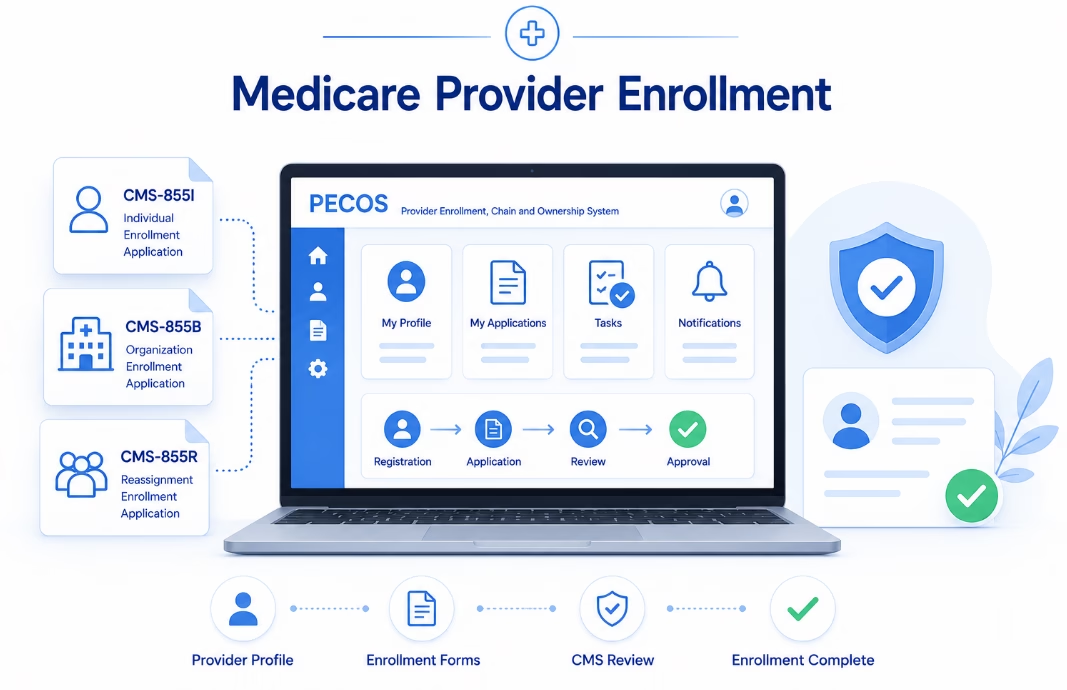
CMS instructs providers and suppliers to obtain an NPI and then complete the applicable Medicare enrollment application through PECOS or an approved paper application. Medicare Administrative Contractors process those enrollment applications.
An NPI or active professional license alone does not make a provider Medicare-enrolled.
What Licenses and Registrations Should a New Practice Check?
Use a service-based checklist instead of assuming every practice has identical requirements.
| Area | What to Check |
|---|---|
| Business entity | State formation, professional entity rules, DBA and local business requirements |
| Providers | Active professional licenses and applicable scope-of-practice requirements |
| NPI | Type 1 and Type 2 NPIs where applicable to the provider and organization |
| Controlled substances | DEA and state controlled-substance registrations where applicable |
| Laboratory testing | Appropriate CLIA certificate when testing is performed |
| Facility | Any state or local facility license triggered by the services provided |
| Insurance | Professional liability and other business coverage appropriate to the practice |
| Payer participation | Commercial, Medicare, and Medicaid enrollment processes separately |
| Renewals | Expiration dates, renewal requirements, and responsible staff member |
How Should Practices Organize Licensing and Registration Requirements?
1. Build the checklist around services
Start with what the clinic will actually do.
A practice offering office visits only may have a different regulatory footprint from one performing laboratory testing, dispensing medications, conducting imaging, providing telehealth across states, or operating a licensed facility.
2. Separate provider-level and entity-level requirements
Do not place every license under the organization record.
Track individual professional licenses separately from business registrations, facility licenses, CLIA certificates, payer contracts, and other entity-level records.
3. Record the issuing authority
For every item, document which agency or organization controls it.
Examples include:
- Secretary of State or similar business authority
- Professional licensing board
- DEA
- CMS
- State Medicaid agency
- Local government
- Commercial payer
4. Track expiration dates and renewal requirements
Some records are permanent unless business information changes, while others require periodic renewal.
A central tracker should identify:
- Provider or entity
- License or registration
- Issuing authority
- Number
- Effective date
- Expiration date
- Renewal status
- Responsible staff member
5. Do not use payer credentialing as proof of licensure
Licensing boards, government programs, facilities, and payers serve different functions. Verify each approval independently.
Common Medical Practice Licensing Mistakes
Treating every requirement as one license
An NPI, CAQH profile, DEA registration, professional license, CLIA certificate, and payer enrollment are different administrative records.
Assuming the requirements are the same in every state
Entity laws, professional licensing, facility requirements, controlled-substance rules, and local permits vary substantially.
Applying for payer enrollment before core practice information is ready
Payer applications may depend on legal business information, NPIs, locations, provider credentials, tax information, and other prerequisite data.
Forgetting service-specific requirements
Adding laboratory testing, imaging, medication dispensing, or other services can change the practice’s regulatory requirements.
Failing to track renewals
Professional licenses, DEA registrations, insurance policies, facility approvals, and other records may have different renewal cycles.
Frequently Asked Questions
Does every medical office need a medical practice license?
No single nationwide “medical practice license” applies to every outpatient office. Requirements depend on state law, the business structure, provider professions, facility type, and services offered.
Is an NPI a license?
No. CMS defines the NPI as a standard healthcare provider identifier. It does not grant authority to practice and does not itself enroll a provider with Medicare or an insurance network.
Does every practice need a Type 2 NPI?
Not automatically. Whether an organizational NPI is appropriate depends on the entity and how it conducts healthcare transactions and billing.
Does every provider need DEA registration?
No. DEA registration is relevant to practitioners and organizations whose activities involving controlled substances require registration under federal law. State requirements may also apply separately.
Is CAQH part of medical licensing?
No. The CAQH Provider Data Portal is used for provider information and credentialing workflows. It does not issue professional licenses.
Does malpractice insurance count as a license?
No. Professional liability insurance is risk coverage. It may be required by a payer, facility, employer, contract, or state rule depending on the circumstances, but it is not the same as professional licensure.
Can a practice bill Medicare after receiving an NPI?
Not solely because it has an NPI. CMS requires applicable providers and suppliers to complete Medicare enrollment, generally through PECOS or the relevant enrollment application process.
Do telehealth providers need a full license in every state?
They must be legally authorized under the applicable state’s rules. Depending on the profession and jurisdiction, that may involve a full license, compact, reciprocity, temporary-practice provision, telehealth registration, or another valid pathway.
How eClinicAssist Supports Practice Setup and Licensing
Practice setup can involve several parallel workstreams, including professional licensing, provider documentation, NPIs, payer credentialing, Medicare and Medicaid enrollment, CAQH administration, renewals, and multi-state licensing.
eClinicAssist supports healthcare practices with professional licensing administration, provider credentialing, payer enrollment, CAQH management, documentation tracking, renewals, and related administrative processes.
eClinicAssist does not determine legal entity eligibility, issue professional or facility licenses, provide legal advice, or control payer and government-program approvals.
Contact eClinicAssist to discuss licensing, credentialing, and payer enrollment support for a new or expanding medical practice.
This article provides general administrative information and is not legal, tax, licensing, clinical, insurance, or compliance advice. Requirements vary by state, profession, ownership structure, facility type, and services provided. Verify current requirements with the relevant state agencies, licensing boards, federal programs, local authorities, and qualified professional advisers.