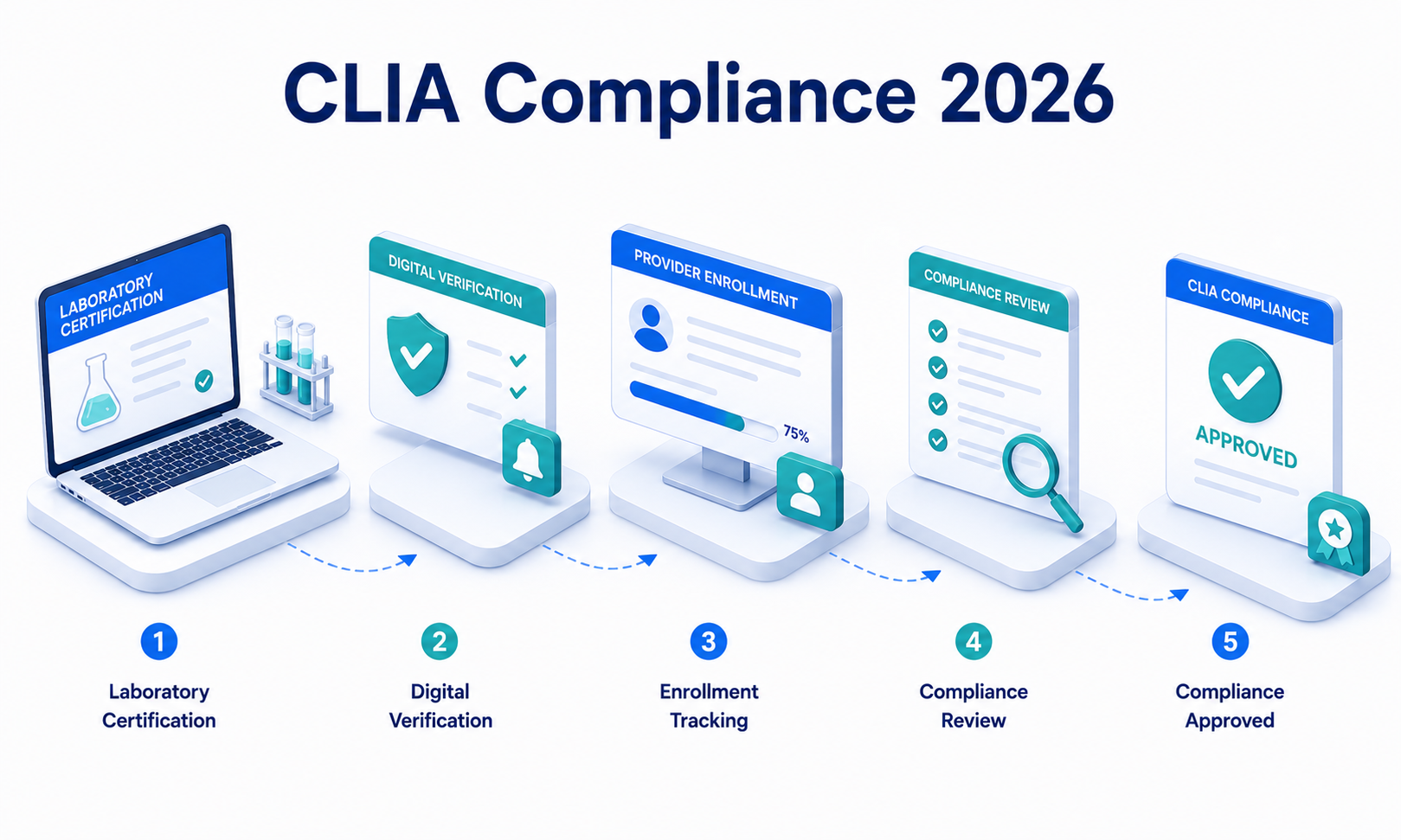
Major changes to CLIA compliance 2026 requirements are creating urgent concerns for healthcare providers, practice managers, and billing teams across the USA. Beginning June 1, 2026, Texas Children’s Health Plan (TCHP) and other payers are shifting toward automatic denial policies for laboratory claims missing valid Clinical Laboratory Improvement Amendments (CLIA) certification data.
For healthcare practices, this is far more than a simple administrative update. These new enforcement standards directly affect reimbursement, provider enrollment, medical billing workflows, and revenue cycle management. If your digital credentialing records do not align correctly with your laboratory services, your claims may be denied automatically.
Because of this, healthcare organizations should begin auditing their CLIA documentation and PEMS records immediately.
Why CLIA Compliance 2026 Matters
CLIA regulations have existed for decades to ensure laboratory testing quality and patient safety. However, payer enforcement mechanisms are becoming much stricter through automated verification systems and AI-driven billing audits.
Historically, missing or expired CLIA information often generated informational warnings while claims still processed for payment. Starting June 1, 2026, many payers are transitioning to “Hard Stop” denial systems that reject laboratory claims immediately when CLIA requirements are not properly verified.
As a result, healthcare practices may experience:
- Immediate claim denials
- Delayed reimbursements
- Revenue cycle disruption
- Increased administrative appeals
- Additional compliance risks
Even practices performing basic waived testing are affected by these updates.
Understanding the CLIA Compliance 2026 Timeline
The rollout is occurring in two separate phases.
Warning Period: Through May 31, 2026
Currently, many claims with missing or incomplete CLIA information are still being processed. However, payers are actively flagging these claims with informational edits and warnings.
If your billing team notices CLIA-related alerts on remittance advice documentation, those warnings should not be ignored. They indicate that the payer has already identified a compliance issue.
Practices should use this transition period to correct enrollment and documentation problems before denials begin.
Denial Period: Starting June 1, 2026
Beginning June 1, 2026, laboratory claims without valid CLIA certification alignment may be denied automatically.
Denials may occur if:
- The CLIA certificate is expired
- The certificate is missing from PEMS
- The certification level does not match the billed test complexity
- The CLIA number is not linked correctly to the billing NPI
Although office visit charges may still process, laboratory reimbursement will often be denied until corrections are completed.
Why Digital CLIA Records Are Critical
One major issue affecting healthcare organizations is the difference between physical certificates and digital enrollment records.
Many practices assume that displaying a valid CLIA certificate onsite is enough. Unfortunately, if the certificate is not uploaded and synced properly within TMHP PEMS, the payer system may treat the provider as non-compliant.
Additionally, CMS officially stopped mailing paper CLIA certificates as of March 1, 2026. Certificates are now issued electronically through the CMS portal.
Practices must ensure that:
- CLIA numbers remain active
- Expiration dates are current
- Certification levels match test complexity
- Provider addresses align correctly across systems
Even small mismatches can trigger denials.
Organizations that maintain strong TMHP provider enrollment workflows generally experience fewer payer-related enrollment problems during compliance transitions.
Common CLIA Compliance 2026 Mistakes
Several operational mistakes are expected to increase denial rates after June 1.
Common problems include:
- Expired certificates
- Incorrect service location information
- Failure to upload updated digital certificates
- Incorrect CLIA complexity levels
- Multi-site NPI mismatches
For example, billing a moderate complexity laboratory test while holding only a Certificate of Waiver may result in automatic denial due to complexity mismatch.
Multi-site practices face additional risk because each service location must maintain its own properly linked CLIA documentation.
How to Prepare for CLIA Compliance 2026
Healthcare practices should begin proactive internal audits immediately.
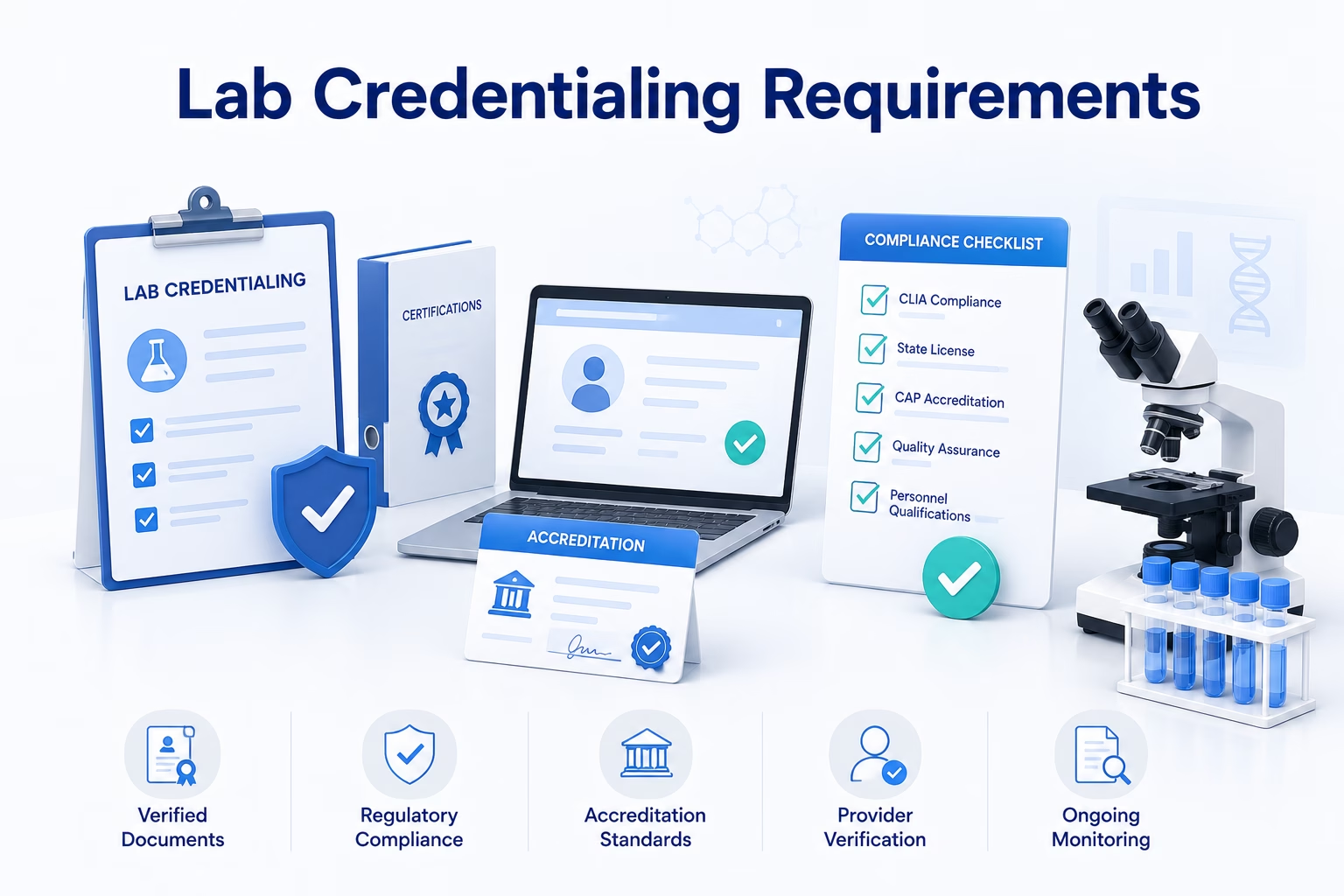
Verify CLIA Certification Levels
First, confirm that your certificate matches the complexity of services your practice performs.
Certification types may include:
- Certificate of Waiver
- Provider-Performed Microscopy (PPM)
- Moderate Complexity
- High Complexity
Incorrect certification levels will likely trigger denials under the updated payer systems.
Review CPT Laboratory Billing Codes
Practices should generate reports for laboratory CPT codes billed during the last 90 days. Cross-reference those codes with CMS CLIA requirements to identify possible complexity mismatches.
Organizations that also maintain accurate credentialing audit checklist workflows often identify compliance issues earlier and reduce administrative risk.
Update PEMS Documentation
Practices should:
- Download updated electronic CLIA certificates
- Upload documentation into PEMS
- Confirm address alignment
- Verify approval status after submission
Because PEMS synchronization may take 7–10 business days, practices should avoid waiting until the final weeks before enforcement begins.
Protect Revenue Before Denials Begin
The upcoming CLIA compliance 2026 enforcement changes represent a major operational shift for healthcare organizations performing laboratory testing. Practices that fail to update digital records, verify certification levels, or maintain accurate PEMS data may face immediate claim denials and unnecessary revenue disruption.
Most importantly, proactive preparation now can prevent months of billing problems later.
If your organization needs support with laboratory compliance audits, PEMS documentation, or provider enrollment workflows, eClinicAssist helps healthcare practices strengthen compliance systems and protect long-term revenue cycle stability.