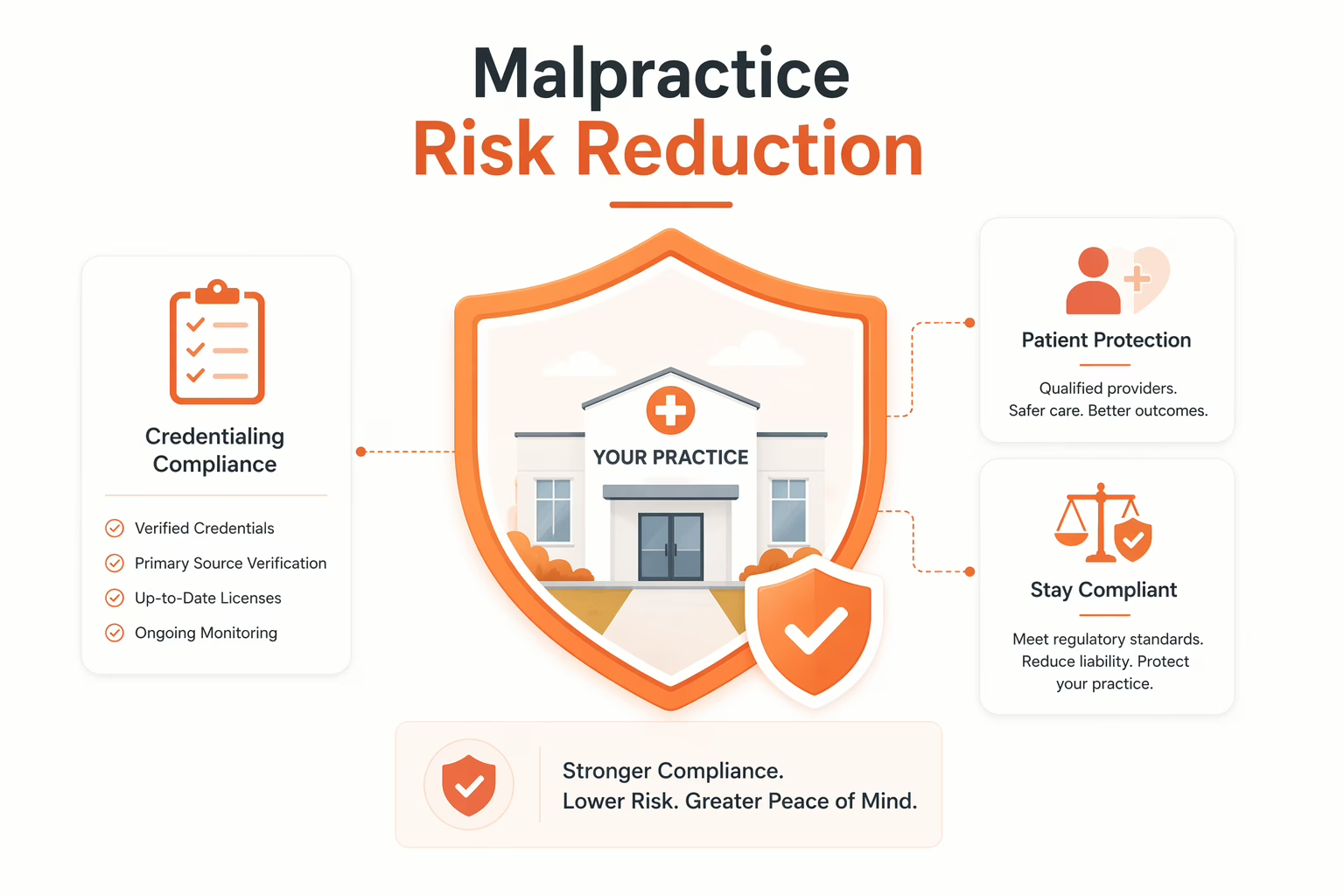
Medical malpractice risk reduction is an important part of managing a healthcare practice. While professional liability insurance can help address certain financial consequences of malpractice claims, preventing avoidable patient safety incidents requires clear communication, reliable clinical workflows, accurate documentation, and appropriate provider oversight. Our medical malpractice insurance guide explains the role coverage can play alongside preventive risk management.
Medical malpractice risk reduction involves identifying potential patient safety and professional liability risks, implementing preventive procedures, and monitoring whether those procedures are effective. Important strategies include improving patient communication, ensuring diagnostic test follow-up, maintaining accurate medical records, verifying provider credentials, and addressing clinical safety concerns promptly.
This guide explains ten practical strategies healthcare practice managers, medical directors, administrators, and clinical teams can use to strengthen risk management while maintaining efficient practice operations.
What Is Medical Malpractice Risk Reduction?
Medical malpractice risk reduction refers to the policies, clinical practices, and administrative safeguards healthcare organizations use to reduce the likelihood and potential consequences of professional negligence claims.
Medical malpractice generally concerns allegations that a healthcare professional failed to meet an applicable standard of care and that the failure caused harm.
Not every poor clinical outcome is the result of negligence, and not every malpractice allegation is legally established.
Effective risk reduction focuses primarily on safer care processes rather than simply avoiding litigation.
Why Malpractice Risk Management Matters
Healthcare organizations operate in environments where clinical decisions, patient communication, documentation, and teamwork influence patient safety.
When important information is missed or a necessary follow-up does not occur, the consequences can include delayed diagnosis, treatment complications, patient dissatisfaction, or preventable harm.
The Agency for Healthcare Research and Quality (AHRQ) identifies communication failures, inadequate diagnostic follow-up, and weaknesses in care transitions as important patient safety concerns.
Learn more through the AHRQ Patient Safety Network’s diagnostic errors guidance.
Potential Consequences of Unmanaged Risk
- Preventable patient safety incidents.
- Professional liability claims.
- Legal defense expenses.
- Administrative investigations and reviews.
- Increased staff workload.
- Potential reputational concerns.
- Disruption of clinical operations.
- Possible insurance premium or coverage implications.
These consequences are not inevitable. The circumstances of each event and the applicable insurance, clinical, and legal requirements determine the actual outcome.
1. Improve Communication With Patients
Clear patient communication is one of the most important components of effective risk management.
Patients should receive understandable information about their diagnoses, recommended treatments, medications, potential risks, and follow-up instructions.
Practical Communication Strategies
- Use language appropriate to the patient’s understanding.
- Explain important treatment options and relevant risks.
- Encourage patients to ask questions.
- Use qualified medical interpreters when appropriate.
- Provide clear written discharge and follow-up instructions.
- Explain symptoms that require urgent reassessment.
- Use teach-back methods when appropriate to check understanding.
For example, telling a patient to return if symptoms worsen may be less useful than explaining which specific changes should prompt urgent evaluation.
Documentation should accurately reflect the information communicated and the patient’s response.
2. Maintain Complete and Accurate Medical Records
Clinical documentation supports continuity of care, communication between healthcare professionals, and review of clinical decisions.
Incomplete, inaccurate, or inconsistent records may complicate patient care and later evaluation of an event.
Important Documentation Elements
- Relevant history and presenting symptoms.
- Examination findings.
- Clinical assessment and differential diagnosis when appropriate.
- Diagnostic tests ordered and reviewed.
- Treatment decisions and supporting rationale.
- Medication instructions.
- Patient discussions and informed consent when applicable.
- Follow-up plans.
- Return precautions.
- Referrals and care coordination.
Records should be completed according to applicable clinical, legal, and organizational requirements.
Important: Documentation should accurately represent care that occurred. Practices should never create false entries, backdate records, or alter clinical documentation to conceal an error.
Corrections and late entries should follow the organization’s approved procedures and preserve the medical record’s integrity.
3. Establish Reliable Diagnostic Test Follow-Up
Failure to recognize, communicate, or act on significant diagnostic results can create patient safety risks.
Ordering a test is only one part of the diagnostic process. Practices should also establish responsibility for receiving, reviewing, communicating, and acting on results.
Recommended Test Result Workflow
- Record the test order and responsible clinician.
- Track whether the test was completed.
- Identify missing or outstanding results.
- Route results to the appropriate clinician.
- Escalate critical findings using an established protocol.
- Communicate results and next steps to the patient.
- Document clinically appropriate follow-up actions.
A practice should not assume that no news automatically means normal results.
Electronic alerts can support follow-up, but staff must know who is responsible for responding to unresolved findings.
4. Verify Provider Qualifications and Maintain Credentialing Oversight
Appropriate provider credentialing is an important administrative safeguard when hiring or onboarding healthcare professionals.
Credentialing may involve reviewing and verifying professional licenses, education, training, certifications, and relevant professional history.
Key Credentialing Safeguards
- Verify applicable professional licenses.
- Review required education and training information.
- Confirm board certifications when relevant.
- Review professional disclosures and applicable disciplinary information.
- Confirm privileges or authorizations for specific clinical activities when required.
- Monitor applicable credential expiration dates.
- Maintain current provider records.
- Escalate relevant qualification or eligibility concerns.
Verification requirements depend on the provider type, organization, state, and applicable accreditation or participation standards.
Credentialing helps organizations make informed eligibility decisions, but it cannot independently guarantee clinical competence or prevent adverse events.
For more information, read our provider credentialing process guide.
5. Standardize High-Risk Clinical Workflows
Clinical protocols can help reduce unnecessary variation in processes where missed steps may create patient safety risks.
Protocols should be appropriate for the practice setting, specialty, patient population, and clinical circumstances.
Workflows Worth Reviewing
- Patient identification.
- Medication administration.
- Prescription reconciliation.
- Abnormal test result follow-up.
- Referral coordination.
- Telephone triage.
- Care transitions.
- Discharge instructions.
- Emergency escalation.
- Patient handoffs.
Clinical protocols should support professional judgment rather than substitute for individualized patient assessment.
Medical leadership should review and approve clinical policies and update them as appropriate.
6. Improve Medication Safety
Medication-related errors may arise during prescribing, dispensing, administration, reconciliation, or patient education.
Practices should establish procedures that address relevant medication risks.
Medication Safety Practices
- Maintain accurate medication lists.
- Review relevant allergies and contraindications.
- Use appropriate prescribing information.
- Confirm medication and dose when clinically indicated.
- Review potential interactions.
- Provide clear instructions to patients.
- Document clinically important medication changes.
- Reconcile medications during relevant transitions of care.
Electronic prescribing systems and clinical decision support tools can help identify certain risks but may also generate alert fatigue or other workflow challenges.
Practices should periodically evaluate how their medication safety processes perform in actual clinical use.
7. Strengthen Informed Consent and Shared Decision-Making
Informed consent is a process through which patients receive relevant information and have an opportunity to make decisions about proposed care.
Consent requirements vary by state, procedure, and clinical circumstances.
Good Consent Practices
- Explain the proposed treatment or procedure.
- Discuss material risks and expected benefits as appropriate.
- Describe reasonable alternatives when applicable.
- Allow opportunities for patient questions.
- Assess the patient’s capacity and understanding when appropriate.
- Follow applicable consent documentation requirements.
A signed consent form may be important, but it does not replace an adequate informed consent discussion.
Organizations should follow applicable state laws and professional requirements for consent.
8. Improve Referral Coordination and Care Transitions
Patients may receive care from several healthcare professionals or organizations.
Without reliable communication, important information may be lost during referral, discharge, or transfer.
AHRQ has identified communication failures during transitions of care as a contributor to patient safety events.
Referral and Handoff Safeguards
- Communicate the clinical reason for referral.
- Identify urgent referrals that require timely action.
- Transmit relevant patient information securely.
- Document when a referral was initiated.
- Track referrals when follow-up is clinically necessary.
- Review returned consultation information.
- Clarify responsibility for subsequent care.
- Inform patients of relevant next steps.
Read the AHRQ guidance on patient handoffs for additional patient safety considerations.
9. Monitor Licenses, Certifications, and Professional Liability Coverage
Administrative oversight supports risk management by helping practices maintain accurate professional records.
Depending on the professional category and applicable requirements, important records may include:
- Professional licenses.
- Board certifications.
- Prescribing registrations.
- Relevant training requirements.
- Professional liability insurance.
- Credentialing and recredentialing deadlines.
- Hospital privileges or organizational authorizations.
Missing or outdated records can create administrative complications and, in certain situations, raise concerns about eligibility to provide specific services.
However, professional liability insurance requirements differ by state, employer, facility, and payer.
Not every healthcare provider is subject to an identical mandatory coverage requirement.
For additional information, see our provider credentialing documents guide.
10. Establish a Continuous Safety Improvement Program
Risk management should involve more than conducting occasional staff training or maintaining written policies.
Practices should establish a repeatable process for identifying concerns, evaluating performance, and implementing improvements.
Practical Improvement Activities
- Review patient safety events and near misses.
- Investigate recurring documentation issues.
- Evaluate delayed or missed test results.
- Review referral and care transition problems.
- Assess patient complaints for recurring themes.
- Identify training needs.
- Assign responsibility for corrective actions.
- Confirm whether implemented changes are effective.
Organizations should encourage appropriate reporting and learning while maintaining required confidentiality and following applicable patient safety, peer review, and reporting laws.
Not every event indicates malpractice. Reviews should distinguish between system weaknesses, individual clinical concerns, and events requiring formal investigation.
What Role Does Medical Malpractice Insurance Play?
Medical malpractice insurance can help healthcare professionals and organizations manage financial exposure from certain professional liability claims.
Depending on policy terms, coverage may include eligible defense expenses, settlements, or judgments.
Important policy considerations include:
- Coverage limits.
- Claims-made versus occurrence coverage.
- Retroactive dates.
- Extended reporting periods or tail coverage.
- Policy exclusions.
- Coverage for individual providers and organizations.
- Consent-to-settle provisions.
Insurance does not prevent clinical incidents or guarantee coverage for every claim.
Healthcare organizations should review their policies with qualified insurance professionals and legal advisers.
How Malpractice Risk Management Relates to Credentialing and Billing
Clinical risk management, provider credentialing, and revenue cycle management are separate functions, but they can affect one another operationally.
For example, a practice may need to confirm a newly hired practitioner’s license status and professional liability documentation before completing certain onboarding requirements.
If an insurer requires additional credentialing documentation, the provider’s network participation process may remain pending.
This can affect when the organization is able to bill under the intended in-network arrangement.
However, medical malpractice claims do not automatically result in health insurance claim denials.
Similarly, a medical billing denial is not evidence that malpractice occurred.
Billing problems may involve coding, coverage, authorization, enrollment, or documentation issues unrelated to professional negligence.
For administrative strategies, read our guide to reducing payer enrollment delays.
Example: Preventing a Missed Diagnostic Follow-Up
Consider a hypothetical primary care practice that orders a diagnostic test for a patient.
The test returns an abnormal finding, but the result is not routed to the responsible clinician because the electronic workflow was configured incorrectly.
Without a follow-up system, the practice may not recognize that the result requires clinical review and patient communication.
A stronger process would include:
- Tracking the test order.
- Confirming receipt of the result.
- Routing the result to an appropriate clinician.
- Escalating significant findings according to clinical policy.
- Documenting patient communication.
- Confirming that required follow-up actions were completed.
This example demonstrates how reliable clinical workflows can address potential safety weaknesses before they contribute to preventable harm.
The appropriate medical response to an abnormal result must always be determined by qualified clinical personnel.
Medical Malpractice Risk Reduction Checklist
Practice managers can use the following checklist when reviewing administrative and operational safeguards.
| Area | Key Review Question | Primary Responsibility |
|---|---|---|
| Patient communication | Are important instructions and follow-up expectations clearly communicated? | Clinical leadership and care teams |
| Clinical documentation | Are patient records accurate, complete, and timely? | Clinical staff and medical director |
| Diagnostic follow-up | Are ordered tests and significant results tracked appropriately? | Clinical leadership |
| Provider credentialing | Are required qualifications verified and records maintained? | Credentialing team and authorized decision-makers |
| Medication safety | Are appropriate medication review and safety procedures in place? | Clinical team |
| Informed consent | Are relevant discussions and consent requirements appropriately addressed? | Treating clinicians |
| Referrals | Are clinically important referrals and care transitions coordinated? | Clinical and care coordination teams |
| Insurance records | Are relevant professional liability documents current? | Practice administration |
| Staff training | Are employees trained on procedures relevant to their responsibilities? | Practice leadership |
| Quality improvement | Are safety concerns evaluated and corrective actions followed through? | Medical director and quality leadership |
This is a general operational checklist. Clinical risk management programs should be adapted to each practice’s services, patient population, and applicable professional requirements.
How eClinicAssist Supports Healthcare Practice Risk Management
Effective risk management requires coordination between clinical leadership, administrators, credentialing personnel, and other practice teams.
While clinical safety and malpractice liability decisions belong to appropriately qualified professionals, accurate administrative records can support organized provider oversight.
eClinicAssist helps healthcare practices with:
- Provider credentialing documentation.
- Primary source verification coordination.
- CAQH profile management.
- Professional license and document tracking.
- Provider enrollment administration.
- Recredentialing follow-up.
- Coordination of provider information with billing operations.
Our services focus on administrative credentialing and payer enrollment support. We do not provide legal defense, clinical risk assessments, malpractice insurance underwriting, or clinical patient safety certification.
Need assistance strengthening your provider credentialing and administrative oversight processes?
Contact eClinicAssist to discuss your credentialing and enrollment needs.
Frequently Asked Questions About Medical Malpractice Risk Reduction
What is medical malpractice risk reduction?
Medical malpractice risk reduction involves identifying potential patient safety and professional liability risks and implementing clinical and administrative safeguards to reduce preventable incidents and improve operational oversight.
What are common risk factors in medical practices?
Potential risk factors include communication problems, incomplete documentation, diagnostic follow-up failures, medication errors, inadequate handoffs, and weaknesses in provider oversight.
Can better documentation prevent malpractice lawsuits?
Accurate documentation supports patient care and provides an important record of clinical decisions, but it does not prevent every lawsuit or guarantee a successful legal defense.
How does credentialing support malpractice risk reduction?
Credentialing helps organizations review professional qualifications and applicable eligibility information. It supports responsible provider onboarding but does not independently guarantee clinical competence or prevent adverse events.
Does malpractice insurance eliminate professional liability risk?
No. Malpractice insurance may provide financial protection for eligible claims, subject to policy terms, exclusions, and limits. It does not replace clinical safety procedures or guarantee coverage for every allegation.
Why is diagnostic test follow-up important?
Reliable test follow-up helps ensure significant findings are reviewed, communicated, and addressed through appropriate clinical processes. Failures in these activities can contribute to diagnostic delays and patient harm.
Do malpractice claims automatically cause medical billing denials?
No. Professional liability claims and health insurance billing denials are separate matters. Billing denials generally involve coverage, coding, authorization, eligibility, documentation, or payer participation issues.
How frequently should practices review risk management procedures?
Review frequency should reflect the practice’s services, clinical risks, applicable requirements, and identified concerns. Regular reviews and prompt evaluation after relevant safety events can support ongoing improvement.
Can eClinicAssist provide medical malpractice risk assessments?
eClinicAssist provides administrative provider credentialing and payer enrollment support. Clinical malpractice risk assessments and legal advice should be provided by appropriately qualified clinical risk management or legal professionals.
Disclaimer: This article provides general educational and administrative information about medical malpractice risk reduction, healthcare credentialing, and practice operations. It is not medical, legal, insurance, or professional risk-management advice. Clinical decisions, patient safety procedures, legal obligations, and insurance requirements vary by specialty, jurisdiction, and individual circumstances. Consult qualified clinical leadership, legal counsel, and insurance professionals for guidance specific to your practice. eClinicAssist does not guarantee prevention of malpractice claims, clinical outcomes, credentialing approval, payer participation, or reimbursement.