
The credentialing denial appeal process depends on why the application was denied. First determine whether the payer issued a true adverse credentialing decision, rejected an enrollment application, closed an incomplete file, declined network participation, or identified a correctable administrative issue. Then follow the exact reconsideration, appeal, correction, or resubmission instructions in the notice.
A credentialing denial can be frustrating, but the word “denied” does not always mean the same thing.
Before writing an appeal letter, determine exactly what happened.
A payer may have:
- Issued an adverse credentialing decision
- Closed an application because information was missing
- Rejected a provider enrollment request
- Declined a network request because the panel is closed
- Found an inconsistency requiring correction
- Denied participation based on its credentialing criteria
Each situation may require a different response.
What Is a Credentialing Denial?
A credentialing denial generally refers to an organization’s decision not to approve a practitioner under its credentialing standards.
The reasons may involve:
- Licensure issues
- Professional history
- Sanctions or disciplinary actions
- Malpractice history
- Incomplete or inaccurate information
- Failure to satisfy organizational credentialing criteria
However, practices should not use “credentialing denial” to describe every unsuccessful payer application.
Credentialing Denial vs Enrollment Rejection vs Closed Network
| Outcome | What It Usually Means | Possible Next Step |
|---|---|---|
| Credentialing denial | Provider did not receive approval under the organization’s credentialing criteria | Review appeal or reconsideration rights |
| Administrative closure | Application was closed because required information or action was not completed | Correct, reopen, or reapply depending on payer policy |
| Enrollment rejection | Administrative enrollment requirements were not met | Correct or appeal according to program rules |
| Closed network | Payer is not currently accepting additional providers for that network, specialty, or area | Ask about network-access options, exceptions, or future availability |
| Contracting decision | Payer declined to offer or execute a participation agreement | Review contracting or network-development options |
This classification should happen before any appeal is drafted.
Does Every Credentialing Denial Have Appeal Rights?
No universal appeal right applies to every payer decision.
The provider should review:
- The denial notice
- The payer’s credentialing policy
- The participation agreement where applicable
- The provider manual
- Any applicable accreditation requirements
- Government-program regulations when relevant
NCQA Credentialing Accreditation standards include practitioner appeal rights among the areas evaluated for accredited credentialing organizations.
That does not mean every network, enrollment, or contracting decision has the same appeal procedure.
Step 1: Read the Entire Denial Notice
Do not begin with a generic appeal template.
Identify:
- Exact reason for the decision
- Date of the notice
- Credentialing, enrollment, or contracting department involved
- Whether an appeal or reconsideration is available
- Submission deadline
- Required format
- Required supporting evidence
- Submission address, portal, fax, or email
If the notice is unclear, contact the payer and ask what type of decision was issued.
Step 2: Determine Whether the Problem Is Correctable
Some decisions result from administrative deficiencies rather than an adverse evaluation of the provider’s qualifications.
Examples include:
- Missing signature
- Expired professional liability certificate
- Missing work-history explanation
- Incorrect practice location
- Incomplete ownership information
- Missing license copy
- Unanswered payer request
If the payer allows the information to be corrected without a formal appeal, that may be the more appropriate route.
Step 3: Confirm the Facts Before Disputing the Decision
Review the provider file against the reason stated in the denial.
Check relevant sources such as:
- Professional licensing board
- NPPES
- CAQH Provider Data Portal
- Professional liability documents
- Board certification records
- Work history
- Practice information
- Payer application records
Do not change information simply to make every system look identical.
Determine which information is actually incorrect and which differences exist because the systems serve different purposes.
Step 4: Gather Evidence That Directly Addresses the Denial
An appeal should respond to the specific reason stated by the payer.
Supporting evidence may include:
- Current professional license verification
- Corrected application pages
- Updated professional liability documentation
- Work-history clarification
- Board certification evidence where relevant
- Documentation resolving an identified discrepancy
- Correspondence showing information was previously submitted
More documentation is not automatically better.
The strongest submission is organized around the actual issue under review.
Step 5: Follow the Payer’s Appeal Instructions Exactly
If the notice provides appeal rights, follow those instructions rather than assuming another payer’s process applies.
Confirm:
- Deadline
- Required form
- Required signature
- Authorized representative requirements
- Supporting documents
- Submission destination
Keep proof that the appeal was submitted.
Step 6: Build the Appeal Around the Decision
A credentialing appeal should generally identify:
- Provider name
- NPI or payer reference number
- Date of the adverse decision
- Specific decision being appealed
- Reason the practice believes reconsideration is appropriate
- Supporting evidence
- Requested resolution
Avoid emotional arguments or unrelated business concerns.
The objective is to demonstrate why the original decision should be reconsidered under the applicable requirements.
Step 7: Track the Appeal Separately From the Original Application
An appeal creates a new administrative workflow.
Track:
- Appeal submission date
- Deadline
- Submission confirmation
- Case or reference number
- Supporting evidence submitted
- Responsible staff member
- Last follow-up
- Next follow-up
- Final decision
Do not leave the original credentialing record simply marked as “pending.”
Step 8: Follow Up Without Assuming Follow-Up Guarantees Approval
Reasonable follow-up can confirm that the appeal was received and identify outstanding requirements.
Ask questions such as:
- Was the appeal received?
- Was it considered timely?
- Is documentation missing?
- Which department is reviewing it?
- Is another action required from the provider?
Follow-up improves visibility. It does not control the payer’s decision.
When Should You Correct and Resubmit Instead of Appeal?
Correction or resubmission may be more appropriate when the original application failed for a straightforward administrative reason and the payer permits correction.
Examples include:
- Missing document
- Incomplete application field
- Incorrect address
- Expired document that has now been renewed
- Incorrect NPI or organizational information
Always confirm with the payer whether it wants:
- A corrected application
- A new application
- A reconsideration request
- A formal credentialing appeal
Can a Closed Payer Panel Be Appealed?
Not necessarily.
A payer may decide that its network already has sufficient providers in a particular specialty or geographic area.
This is different from concluding that the provider failed credentialing standards.
If the panel is closed, ask:
- Is the closure specialty-specific?
- Is it geographic?
- Does it apply to every payer product?
- Does the payer accept network-access requests?
- Are exceptions available for access needs?
- Can the practice reapply later?
Do not characterize a closed-panel response as a credentialing failure unless the payer actually issued a credentialing denial.
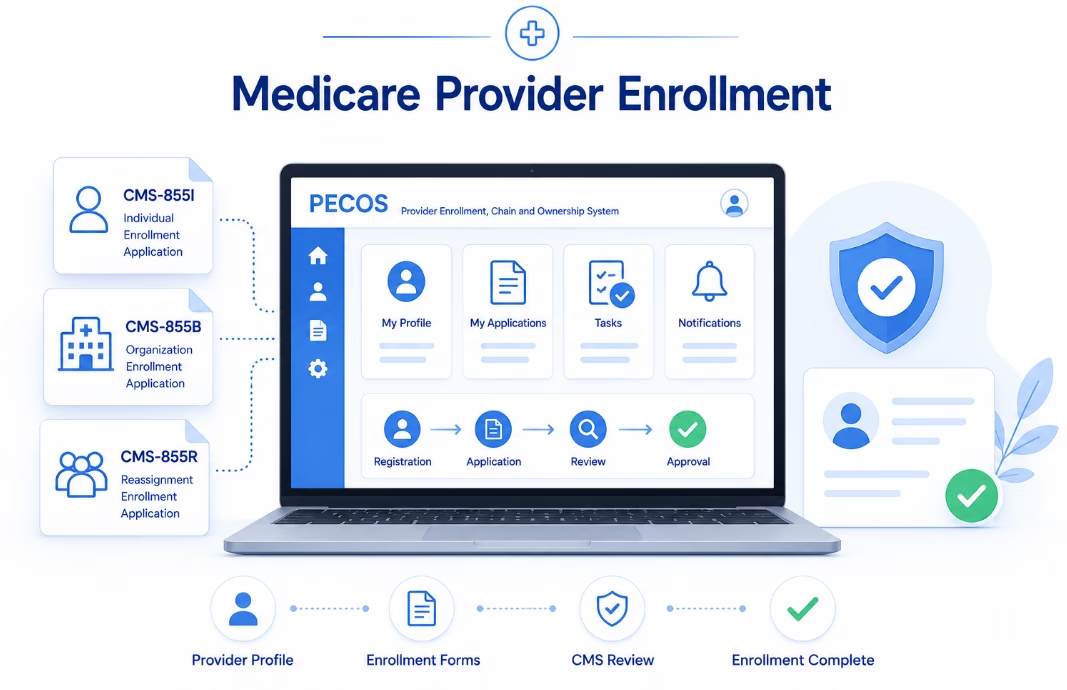
What About Medicare Provider Enrollment Denials?
Medicare provider enrollment appeals are separate from commercial payer credentialing appeals.
CMS has formal rules for certain enrollment denials and revocations.
Current Medicare guidance distinguishes between:
- Corrective Action Plans, or CAPs, where available
- Reconsideration requests
- Further administrative appeal levels where applicable
What Is a Medicare Corrective Action Plan?
A Corrective Action Plan allows a provider or supplier to demonstrate that specified deficiencies have been corrected when CAP rights apply.
CAP availability depends on the legal basis for the Medicare enrollment action.
Current CMS model language states that for an enrollment denial, CAP rights apply to specified noncompliance denials under 42 C.F.R. § 424.530(a)(1).
A CAP should therefore not be treated as a universal remedy for every Medicare enrollment denial.
What Is a Medicare Reconsideration?
A reconsideration asks CMS or the appropriate Medicare enrollment appeals reviewer to reconsider the initial enrollment determination.
Under current CMS guidance:
- A CAP, when available, generally must be received within 35 calendar days of the initial determination.
- A reconsideration request generally must be received within 65 calendar days of the initial determination.
The determination letter should be reviewed carefully because it identifies the applicable appeal rights and instructions.
Why Medicare Deadlines Should Not Be Applied to Commercial Payers
CMS appeal deadlines apply to Medicare provider enrollment actions governed by Medicare rules.
They are not universal commercial credentialing deadlines.
A commercial payer may have:
- A different appeal period
- A reconsideration rather than an appeal
- No appeal for a particular network decision
- A separate process for administrative closures
Always use the actual decision notice and payer policy.
Can Provider Data Discrepancies Cause Credentialing Problems?
Yes, particularly when incorrect information prevents the payer from verifying the provider or understanding the application.
However, avoid the common advice that every field in every system must be identical.
NPPES, CAQH, licensing boards, payer systems, and internal practice records serve different purposes.
Focus on accuracy and relevant consistency.
Our credentialing application red flags guide covers common application issues in more detail.
How Can Practices Reduce Avoidable Credentialing Denials?
Verify payer requirements before submission
Confirm:
- Provider type eligibility
- Network availability when possible
- Required forms
- Required supporting documents
- Application method
Review applications before submission
Check for:
- Blank required fields
- Expired documents
- Unexplained professional-history gaps
- Incorrect locations
- Incomplete ownership information
- Unsigned forms
Maintain provider documentation
A structured provider credentialing document file reduces the need to rebuild the application package every time.
Respond to payer requests promptly
If a payer requests additional information, record the exact response deadline and assigned staff member.
Track application history
Maintain submission dates, reference numbers, correspondence, missing items, and follow-up activity.
Use the correct workflow
Do not use “credentialing appeal” for every adverse payer response.
Distinguish:
- Credentialing
- Enrollment
- Contracting
- Network access
- Group affiliation
Credentialing Denial Response Checklist
| Question | What to Confirm |
|---|---|
| What happened? | Credentialing denial, enrollment rejection, administrative closure, or network decision |
| Why? | Exact reason stated in writing |
| Can it be appealed? | Review notice, payer policy, and applicable requirements |
| What is the deadline? | Exact submission deadline from the governing notice or policy |
| What evidence is needed? | Only documents relevant to the stated issue |
| Where is it submitted? | Correct department, portal, address, fax, or email |
| Was it received? | Confirmation and reference number retained |
| What happens next? | Follow-up date, outstanding actions, and final determination tracked |
Frequently Asked Questions
What is the credentialing denial appeal process?
It is the process for asking a credentialing organization to reconsider an adverse credentialing decision when appeal rights are available. The exact steps, deadlines, and evidence requirements depend on the organization.
Can every credentialing denial be appealed?
No. Appeal rights depend on the type of decision, payer policy, contractual terms, accreditation requirements, and applicable law or government-program rules.
Is a closed insurance panel a credentialing denial?
Not necessarily. A provider may meet credentialing standards while the payer declines additional network participation because its panel is closed.
Should we appeal an incomplete application?
Not automatically. If the payer allows the missing information to be corrected, reopening or resubmitting the application may be more appropriate.
How long do we have to appeal?
There is no universal commercial payer deadline. Review the actual decision notice. Medicare provider enrollment has separate federal appeal timelines.
What is the difference between an appeal and reconsideration?
The terminology depends on the payer or program. Both generally involve asking an organization to review an earlier decision, but the formal requirements and available levels of review may differ.
Can we appeal a Medicare provider enrollment denial?
Many Medicare enrollment denials carry reconsideration rights. A CAP may also be available for specified noncompliance grounds. The CMS or MAC determination letter should identify the applicable rights and instructions.
What are the current Medicare enrollment appeal deadlines?
Current CMS guidance generally provides 35 calendar days to submit a CAP when CAP rights apply and 65 calendar days to submit a reconsideration request following the initial determination.
Does winning a credentialing appeal guarantee reimbursement?
No. Credentialing approval does not automatically complete contracting, payer enrollment, group affiliation, effective-date setup, or the other requirements for claim payment.
Identify the Decision Before You Appeal It
The most important step in the credentialing denial appeal process happens before the appeal is written.
Determine whether the organization actually issued a credentialing denial or whether the case involves enrollment, missing information, contracting, network availability, or another administrative issue.
Then follow the process that applies to that specific decision.
eClinicAssist supports healthcare organizations with credentialing administration, payer enrollment, provider documentation, application tracking, payer follow-up, correction of administrative deficiencies, and coordination of credentialing appeal documentation where applicable.
eClinicAssist does not make payer credentialing decisions, guarantee appeal outcomes, provide legal representation, or control network availability.
Contact eClinicAssist to discuss credentialing and payer enrollment support for your providers.
This article provides general administrative information and is not legal, contractual, accreditation, Medicare appeals, or payer-specific advice. Appeal rights, deadlines, evidence requirements, and available remedies vary by payer, program, decision type, provider, contract, and applicable law. Always follow the instructions in the applicable determination notice.