
Telehealth credentialing requirements are not a single national checklist. A practice may need to address professional licensure, payer credentialing and enrollment, facility privileging, state telehealth rules, privacy requirements, and payer billing policies before a provider is ready to deliver and bill for remote care. The exact requirements depend on the provider, patient location, payer, and care setting.
For practice managers, the key is to separate these requirements instead of treating “telehealth credentialing” as one approval. A provider may be properly licensed but not yet effective with a payer, or credentialed by a payer but still subject to separate facility privileging or state telehealth requirements.
What Are Telehealth Credentialing Requirements?
Credentialing is the process through which a payer, hospital, health system, or other organization evaluates a healthcare professional’s qualifications. Telehealth does not eliminate that process.
Remote care can introduce additional considerations because the provider and patient may be in different states, services may be delivered through different technologies, and payer coverage rules may differ from in-person care.
A telehealth readiness review may therefore involve several separate areas:
- Professional licensure and scope of practice
- Payer credentialing and enrollment
- Network contracting and effective dates
- Facility credentialing and privileging when applicable
- Telehealth privacy and security requirements
- State-specific telehealth laws
- Payer coverage and billing rules
- Clinical documentation and consent requirements
Practices that are new to credentialing can begin with our provider credentialing process guide.
1. Confirm Where the Patient Will Be Located
For interstate telehealth, patient location is one of the first questions to resolve.
Healthcare professionals generally must satisfy the professional licensing requirements of the state where the patient is physically located during the telehealth encounter. Depending on the profession and state, that authority may come through a full license, interstate compact, telehealth registration, reciprocity arrangement, or another legally recognized pathway.
This is why a patient’s permanent home address alone may not be enough. A patient who normally lives in one state may attend an appointment while traveling or temporarily residing somewhere else.
Practices expanding into multiple states should review our telehealth licensure requirements for multi-state care before building payer enrollment or scheduling workflows around a new market.
2. Separate Licensure From Payer Credentialing
Holding the appropriate professional license does not automatically make a provider participating with an insurance plan.
A payer may separately require:
- A credentialing application or CAQH profile
- Provider enrollment or roster submission
- Group affiliation
- A participation agreement
- Location enrollment
- Additional telehealth information
- A network effective date before in-network billing begins
Practices should confirm exactly which provider, group, location, product, and network have been approved rather than relying on a general statement that credentialing is “complete.” Review common credentialing compliance risks that can affect a practice.
3. Review Scope-of-Practice Requirements
Providers must remain within the scope permitted by the applicable professional licensing laws and regulations.
Telehealth does not expand a provider’s scope simply because the service is delivered remotely. Requirements can vary by profession and state, particularly for physicians, nurse practitioners, physician assistants, psychologists, behavioral health clinicians, and other licensed professionals.
Practices should also evaluate whether supervision, collaboration, prescribing, or other profession-specific requirements apply to the planned service.
4. Understand Facility Credentialing and Privileging
Facility-based telemedicine can involve credentialing and privileging rules that differ from ordinary office-based payer credentialing.
For Medicare-participating hospitals and critical access hospitals, CMS permits certain telemedicine arrangements in which the originating facility may rely on credentialing and privileging decisions made by a qualifying distant-site hospital or telemedicine entity when regulatory requirements are satisfied.
This is sometimes called credentialing by proxy.
It should not be confused with a universal rule requiring every telehealth practitioner to complete two separate credentialing applications. Whether facility privileging applies depends on the care setting and the organizations involved.
5. Confirm Payer Enrollment and Telehealth Coverage
Credentialing approval does not automatically mean every telehealth service is reimbursable.
Before services begin, practices should confirm the payer’s current requirements for:
- Provider participation
- Group affiliation
- Applicable service locations
- Covered telehealth services
- Eligible provider types
- Permitted modalities
- Place of service and modifiers
- Documentation requirements
- Member benefits and plan-specific restrictions
Medicare, Medicaid, Medicare Advantage, and commercial plans should not be assumed to follow identical policies.
For Medicaid specifically, states have considerable flexibility in deciding which telehealth services, provider types, technologies, and payment methods they cover.
6. Do Not Assume Telehealth Must Always Be Audio-Video
Telehealth is broader than live video.
Depending on the payer, program, service, and jurisdiction, covered remote care may include:
- Real-time audio-video communication
- Audio-only communication
- Asynchronous or store-and-forward technology
- Remote patient monitoring
- Other approved telecommunications technologies
Medicare and state Medicaid programs have different rules regarding which modalities are permitted for particular services. Commercial payer requirements also vary.
The practice should verify the modality for the specific service being provided rather than adopting one telehealth technology rule for every payer.
7. Address HIPAA Privacy and Security Requirements
Telehealth encounters involving covered healthcare providers remain subject to HIPAA requirements for protected health information.
Privacy and security involve more than selecting a video application. Practices should evaluate:
- How patient information is transmitted
- Where data is stored
- Who can access the information
- Whether vendors require business associate agreements
- How staff conduct telehealth sessions
- Whether reasonable safeguards protect conversations and records
HHS also advises healthcare providers to use private settings when conducting telehealth when possible and to use reasonable safeguards when complete privacy cannot be achieved.
Privacy requirements should be reviewed separately from payer credentialing. A payer’s approval of a provider does not certify the practice’s technology as HIPAA compliant.
8. Determine Applicable Consent Requirements
Telehealth consent requirements are not identical across the United States.
Depending on the jurisdiction and program, a practice may need to obtain or document consent for telehealth services in a particular manner. Requirements may also differ for specific services or populations.
Before creating a standard multi-state consent workflow, verify the requirements of each state and applicable payer or government program.
9. Keep Provider Documentation Current
Telehealth credentialing still depends on the same core provider qualifications used in other credentialing workflows.
Common records may include:
- Professional licenses
- Education and training
- Work history
- Board certification where applicable
- Professional liability coverage
- DEA registration where applicable
- Practice locations
- Hospital affiliations where relevant
- Professional disclosures
Our provider credentialing documents guide provides a broader checklist for organizing these records.
10. Treat CAQH, NPPES, PECOS, and Payer Systems Separately
Provider information may exist across several administrative systems, but those systems do not perform the same function.
- CAQH Provider Data Portal supports provider-data collection used by participating organizations.
- NPPES manages National Provider Identifier records.
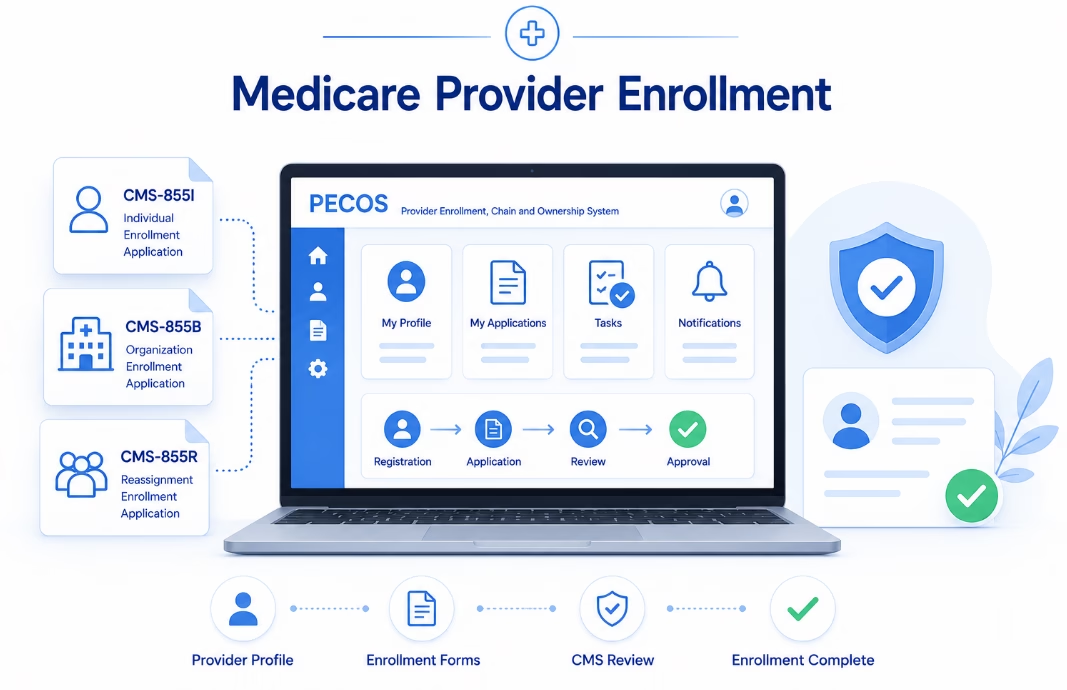
- PECOS supports Medicare enrollment.
- Payer portals support plan-specific credentialing, enrollment, demographic, and contracting workflows.
Practices should investigate inaccurate or outdated information, but they should not assume that every field must be identical across systems that serve different purposes.
Step-by-Step Telehealth Credentialing Workflow
Step 1: Define the telehealth service model
Identify the provider types, services, patient states, facilities, and insurance plans involved.
Step 2: Verify state authorization to practice
Determine whether each provider needs a full license or may qualify through an interstate compact, registration, reciprocity pathway, or another state-authorized mechanism.
Step 3: Review credentialing documentation
Confirm that licenses, professional history, liability coverage, certifications, CAQH data, and other required information are current.
Step 4: Determine facility requirements
If services involve hospitals or other facilities, confirm whether credentialing, privileging, credentialing by proxy, or additional facility approvals apply.
Step 5: Verify payer participation
Confirm credentialing, enrollment, contracting, group affiliation, applicable locations, network products, and effective dates.
Step 6: Review telehealth coverage and billing rules
Verify eligible services, provider types, modalities, coding, modifiers, place of service, documentation, and patient-specific benefits.
Step 7: Establish privacy and consent workflows
Review HIPAA requirements and applicable state or payer requirements for consent, privacy, security, and documentation.
Step 8: Track ongoing requirements
Maintain expiration dates, credentialing cycles, payer updates, licenses, state registrations, and other recurring obligations.
Telehealth Credentialing Readiness Checklist
| Area | What to Confirm |
|---|---|
| Patient location | States where patients will physically receive telehealth services |
| Professional authority | License, compact privilege, registration, or other applicable state authority |
| Credentialing | Provider qualifications and payer or facility review requirements |
| Enrollment | Provider, group, location, product, and effective-date status |
| Facility privileges | Whether privileging or a qualifying telemedicine arrangement applies |
| Telehealth coverage | Eligible services, providers, modalities, and patient benefits |
| Privacy and security | HIPAA safeguards and applicable vendor relationships |
| Consent | Applicable state, program, payer, and service requirements |
| Billing | Coding, modifiers, place of service, documentation, and payer rules |
Frequently Asked Questions
Is telehealth credentialing different from regular provider credentialing?
The core verification of provider qualifications remains similar, but telehealth may introduce additional licensing, facility, payer, technology, and state-law considerations because care can cross geographic and organizational boundaries.
Does a telehealth provider need a license in every patient state?
The provider generally needs legal authority to practice in the state where the patient is located, but a full traditional license is not always the only available pathway. Interstate compacts, telehealth registrations, reciprocity, or specific exceptions may apply depending on the state and profession.
Does a provider have to be credentialed at both the originating and distant sites?
Not universally. Facility credentialing and privileging requirements depend on the setting and applicable regulations. Medicare rules allow qualifying hospitals and critical access hospitals to use certain credentialing-by-proxy arrangements with distant-site hospitals or telemedicine entities.
Does Medicare require video for every telehealth service?
No. Medicare currently permits audio-only telecommunications for certain services and circumstances. Requirements depend on the service, patient location, provider type, and applicable Medicare rules.
Do Medicaid telehealth rules work the same in every state?
No. State Medicaid programs have substantial flexibility over telehealth coverage, eligible providers, modalities, locations, and reimbursement policies.
Is telehealth consent always required?
Consent requirements vary. State laws, Medicaid programs, payers, and particular services may impose different consent rules. Practices should verify the applicable requirements rather than relying on one national consent policy.
Does payer credentialing approval mean the provider can immediately bill telehealth?
Not necessarily. Practices should separately confirm enrollment, contracting, network effective dates, telehealth coverage, service eligibility, coding requirements, and the patient’s benefits.
How eClinicAssist Supports Telehealth Credentialing
Telehealth expansion can require coordination across professional licensing, credentialing, payer enrollment, documentation, and multiple state and payer workflows.
eClinicAssist supports healthcare practices with provider credentialing, payer enrollment, CAQH management, professional licensing administration, documentation tracking, recredentialing, and related administrative processes.
eClinicAssist does not determine state scope-of-practice rules, certify telehealth technology as legally compliant, control payer network decisions, or guarantee reimbursement.
Contact eClinicAssist to discuss credentialing, payer enrollment, and licensing support for your telehealth providers.
This article provides general administrative information and is not legal, clinical, billing, or compliance advice. Telehealth requirements vary by state, profession, payer, program, service, and care setting. Verify current requirements with the applicable licensing board, payer, government program, facility, and qualified legal or compliance advisers when appropriate.