
Recredentialing management for a multi-provider practice requires more than tracking one renewal date per clinician. Each provider may have different payer recredentialing cycles, CAQH attestations, licenses, certifications, professional liability coverage, Medicare revalidation dates, locations, and group affiliations. The most reliable approach is a centralized provider-by-payer system with clear owners, deadlines, dependencies, and escalation rules.
Recredentialing is relatively easy to overlook when a practice has only a few providers.
As the provider roster grows, the problem changes.
A 30-provider medical group may be managing:
- Dozens of commercial payer relationships
- Multiple state licenses
- CAQH profiles
- Professional certifications
- Professional liability policies
- Medicare enrollment records
- Medicaid relationships
- Multiple practice locations
- Group affiliations
At that scale, recredentialing should be managed as an operating system rather than a calendar reminder.
What Is Recredentialing Management?
Recredentialing management is the ongoing process of preparing for, tracking, completing, and documenting periodic reviews of provider qualifications by payers or healthcare organizations.
The process can involve:
- Provider data review
- License verification
- Certification review
- Professional liability information
- Work history
- Sanctions or disciplinary information
- CAQH maintenance
- Payer requests
- Credentialing decisions
The exact requirements depend on the organization performing the review.
Why Multi-Provider Practices Need a Different Recredentialing System
One provider can have many independent credentialing relationships.
For example, Provider A might have:
- Payer 1 recredentialing due in March
- Payer 2 recredentialing due in July
- Payer 3 review initiated without a predictable anniversary date
- CAQH re-attestation due every 120 days
- State license expiring in September
- Board certification expiring the following year
- Medicare revalidation on a completely different schedule
A single field labeled “Recredentialing Due Date” cannot represent this accurately.
Build a Provider-by-Payer Recredentialing Matrix
The core of the system should be a provider-by-payer matrix.
| Provider | Payer | Last Review | Next Due | Status | Next Action |
|---|---|---|---|---|---|
| Provider A | Payer 1 | Completed | March 2027 | Current | Monitor |
| Provider A | Payer 2 | Completed | July 2027 | Current | Monitor |
| Provider B | Payer 1 | Completed | Pending confirmation | Review opened | Submit requested document |
This prevents staff from confusing provider-level readiness with payer-specific status.
Do All Payers Recredential Providers Every Three Years?
No universal cycle applies to every payer.
NCQA’s credentialing framework generally uses a recredentialing cycle of no more than 36 months for practitioners within its applicable scope.
However, individual payer arrangements and other credentialing programs may use different requirements.
Practices should track the actual payer relationship rather than automatically assigning every provider a generic three-year due date.
What Is the Difference Between Recredentialing, CAQH Attestation, and Medicare Revalidation?
| Process | Purpose | Typical Timing |
|---|---|---|
| Payer recredentialing | Periodic review of provider qualifications for a payer or credentialing organization | Depends on payer or credentialing framework |
| CAQH re-attestation | Provider confirms that CAQH professional information remains accurate | Generally every 120 days, 180 days for Illinois providers |
| Medicare revalidation | Provider or supplier recertifies Medicare enrollment information | Generally every 5 years, 3 years for DMEPOS suppliers, with possible off-cycle review |
| License renewal | Renews legal authority to practice | Determined by licensing authority |
These should never be stored as one generic “renewal” status.
Separate Provider Credentials From Payer Deadlines
Every provider should have a master credential record containing items such as:
- Professional licenses
- Board certification
- DEA registration where applicable
- State controlled-substance registrations where applicable
- Professional liability coverage
- National certification
- CAQH information
Then each payer relationship should reference the provider information it needs.
This reduces duplicate data entry and makes it easier to identify which credential is preventing a specific payer review from moving forward.
Create a Recredentialing Readiness Window
Do not wait until the payer’s deadline to discover that supporting documents are missing.
A practice can create internal readiness windows before anticipated recredentialing activity.
For example, the team might review:
- Whether required licenses will remain valid through the review
- Whether CAQH is current
- Whether professional liability information is current
- Whether the practice location is accurate
- Whether work history needs updating
- Whether group affiliation remains correct
The appropriate lead time should be based on the payer and provider’s actual dependencies, not a universal 90-day rule.
Use an Exception Queue Instead of Reviewing Every Provider the Same Way
Large practices should separate normal maintenance from exceptions that require attention.
An exception queue can include:
- Credential expiring soon
- Missing document
- CAQH due
- Payer request outstanding
- Recredentialing due
- Provider data discrepancy
- Location mismatch
- Affiliation issue
- No confirmed payer decision
This allows staff to focus on files that actually need work instead of repeatedly reviewing providers whose records are already current.
Assign a Clear Owner to Every Open Recredentialing Item
An open item without an owner is easy to lose.
Every recredentialing task should identify:
- Provider
- Payer
- Issue
- Assigned owner
- Date identified
- Required action
- Due date
- Next follow-up
Ownership should remain visible even when the task depends on the provider, payer, licensing board, insurance carrier, or another outside party.
Do Not Treat “Waiting on Provider” as a Final Status
Provider-dependent tasks should identify exactly what is missing.
Instead of:
Waiting on provider
Use:
- Updated CV requested October 3
- New malpractice certificate requested October 5
- CAQH attestation requested October 7
- License renewal copy pending
This creates an actionable record rather than an ambiguous status.
How Should CAQH Fit Into Recredentialing Management?
CAQH should be maintained continuously when the relevant payer uses it.
CAQH currently requires re-attestation generally every 120 days, or every 180 days for Illinois providers.
Providers should also update material changes when they occur.
A completed CAQH profile does not mean payer recredentialing is complete.
The payer still determines the provider’s credentialing status.
What Provider Data Should Be Checked Before Recredentialing?
Review the provider record for changes involving:
- Name
- Professional license
- Certification
- Professional liability coverage
- DEA information where applicable
- Work history
- Practice locations
- Contact information
- Group affiliation
- Sanctions or disciplinary information
See our provider credentialing documents guide for a broader document framework.
Should Information Be Identical Across Every System?
The underlying facts should be accurate and reasonably consistent.
However, different systems may ask different questions or represent information differently.
Focus on genuine discrepancies such as:
- Different license expiration dates
- Inactive practice locations
- Incorrect group relationships
- Outdated professional liability coverage
- Missing employment history
Do not force unrelated fields to match simply for visual consistency.
How Should Recredentialing Follow-Up Work?
Follow-up should be driven by the status of the application.
Each record should answer:
- What was submitted?
- When was it submitted?
- Did the payer confirm receipt?
- Is anything outstanding?
- Who owns the next action?
- When should the next follow-up occur?
A generic recurring call every few days is not necessarily useful.
Follow-up should be tied to a meaningful next step.
When Should a Recredentialing Issue Be Escalated?
Escalation may be appropriate when:
- The payer cannot locate a submitted file
- Repeated requests conflict with information already provided
- The deadline is approaching with no clear status
- The payer reports a provider or group mismatch
- An affiliation or location problem blocks completion
- Participation status becomes unclear
Escalation documentation should include reference numbers, contact history, documents submitted, and the unresolved issue.
How Should Recredentialing Be Handed Off to Billing?
Billing does not need every credentialing note.
It needs the final operational information.
A completed payer update should communicate:
- Provider
- Payer
- Group
- Location
- Product where applicable
- Credentialing status
- Effective or continued participation date when relevant
- Any restrictions that affect billing
Billing should not be asked to interpret statuses such as “recredentialing submitted” or “CAQH current.”
Does Missing Recredentialing Automatically Stop Claims?
No.
The consequences depend on what the payer actually does with the provider’s participation status.
If a payer terminates, suspends, or otherwise changes participation because required recredentialing was not completed, billing may be affected.
But a missed internal reminder does not itself mean every claim immediately becomes nonpayable.
Confirm the payer’s actual decision and effective date.
Do Expired Credentials Automatically Cause Claim Denials?
No universal rule applies.
The impact depends on:
- Which credential expired
- Whether it was required
- Payer policy
- Provider participation status
- Effective dates
- Applicable law
Credential expiration should trigger investigation and corrective action, not an automatic assumption about claims.
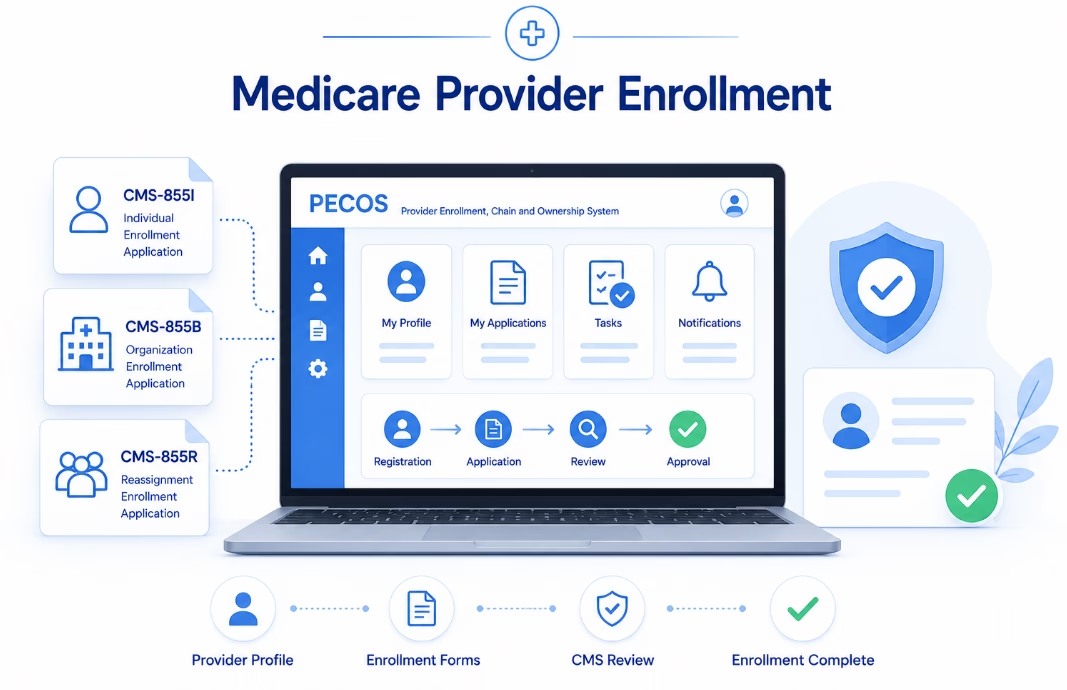
Track Medicare Revalidation Separately
Medicare revalidation is not commercial payer recredentialing.
CMS currently requires most enrolled providers and suppliers to revalidate generally every five years.
DMEPOS suppliers generally revalidate every three years.
CMS may also request off-cycle revalidation.
CMS publishes upcoming due dates in its Medicare Revalidation List and states that providers remain responsible for monitoring their due dates.
What Happens if Medicare Revalidation Is Missed?
CMS states that failure to revalidate on time can result in a Medicare payment hold or deactivation of billing privileges.
If billing privileges are deactivated, the provider may need to submit a complete enrollment application to reactivate them.
CMS also states that Medicare will not reimburse services furnished during a period of deactivation.
This is materially different from missing an internal commercial payer credentialing reminder.
Create a Monthly Recredentialing Operating Review
A multi-provider practice can review its credentialing portfolio monthly instead of waiting for individual crises.
A useful review might include:
| Queue | What to Review |
|---|---|
| Due soon | Payer recredentialing expected or already opened |
| Credential expirations | Licenses, certifications, DEA, professional liability |
| CAQH | Attestations and outstanding documents |
| Payer requests | Open requests requiring provider or staff response |
| Escalations | Files approaching deadlines or with unclear payer status |
| Completed | Recently finished reviews requiring final documentation |
Recredentialing Management Checklist
- Maintain one master provider roster.
- Track recredentialing by provider and payer.
- Track provider credential expiration separately.
- Track CAQH attestation separately.
- Track Medicare revalidation separately.
- Assign an owner to every open item.
- Record the next action instead of generic statuses.
- Use exception queues for files requiring attention.
- Document payer requests and responses.
- Escalate unclear or approaching deadlines.
- Communicate final payer status to billing.
- Preserve completed recredentialing history.
Frequently Asked Questions
How often does payer recredentialing occur?
There is no single cycle for every payer. NCQA’s applicable credentialing framework generally uses a cycle of no more than 36 months, but payer requirements can vary.
Is CAQH attestation the same as recredentialing?
No. CAQH re-attestation confirms that provider data remains current. The payer or credentialing organization performs its own recredentialing review.
How often must CAQH be re-attested?
CAQH currently requires re-attestation generally every 120 days, or every 180 days for Illinois providers.
Is Medicare revalidation the same as payer recredentialing?
No. Medicare revalidation is a CMS enrollment-maintenance process. Most providers and suppliers generally revalidate every five years, while DMEPOS suppliers generally revalidate every three years.
Should every recredentialing file be started 90 days early?
Not as a universal rule. Internal preparation should begin early enough to resolve the provider’s actual document and payer requirements.
Does an expired malpractice policy automatically cause claims to deny?
No. The effect depends on the payer’s requirements, participation status, effective dates, and actual action taken.
What is the best way to track recredentialing for many providers?
Use a provider-by-payer matrix supported by a master credential record, exception queues, assigned owners, next-action dates, and documented payer decisions.
Should billing monitor recredentialing applications?
Billing usually needs the resulting payer status rather than every credentialing task. Credentialing should communicate confirmed participation, group, location, product, and effective-date information when relevant.
Manage Recredentialing as a Portfolio, Not a Deadline
For a multi-provider practice, the challenge is not remembering one recredentialing date.
The challenge is maintaining visibility across many providers, payers, documents, affiliations, and renewal cycles at the same time.
A reliable operating model separates:
- Payer recredentialing
- Credential expiration
- CAQH maintenance
- Medicare revalidation
- Medicaid requirements
- Group affiliation
- Location maintenance
That structure allows staff to identify the actual risk before a provider file becomes an emergency.
eClinicAssist supports healthcare organizations with recredentialing tracking, provider-document management, credential expiration monitoring, CAQH administration, payer follow-up, Medicare and Medicaid enrollment administration, group affiliation, and payer-status tracking.
eClinicAssist does not make payer credentialing decisions, determine official recredentialing cycles for individual plans, guarantee continued network participation, or guarantee claim payment.
Contact eClinicAssist to discuss recredentialing and provider credential management for your organization.
This article provides general administrative information and is not legal, accreditation, credentialing, billing, Medicare, or payer-specific advice. Requirements and cycles vary by payer, credentialing organization, provider type, state, and government program. Verify current requirements with the applicable payer, CMS, licensing authority, or credentialing organization.