
Payer credentialing requirements vary by payer, provider type, network, state, and program. Commercial health plans may require credentialing, contracting, enrollment, and group affiliation, while Medicare uses a separate CMS enrollment process through PECOS and Medicaid follows state-administered enrollment and screening rules. Practices should verify requirements separately for each payer. Compare Medicare and Medicaid enrollment processes with payer-specific credentialing rules.
One of the biggest mistakes in provider onboarding is treating every payer as though it uses the same credentialing process.
It does not.
A commercial health plan may require professional credentialing before network participation. Medicare uses federal provider enrollment requirements. Medicaid enrollment is administered by state Medicaid agencies and managed care organizations. Even within the same insurance company, requirements can vary by product, provider type, location, and network.
The most reliable approach is to identify exactly which process the provider is entering before collecting documents or submitting an application.
What Are Payer Credentialing Requirements?
Payer credentialing requirements are the professional and administrative requirements a payer uses when evaluating a provider for participation or establishing the provider in its network or system.
Depending on the payer, the overall workflow may include:
- Credentialing
- Provider enrollment
- Contracting
- Group affiliation
- Practice-location setup
- Network-product participation
- Effective-date confirmation
These steps may overlap operationally, but they should not be treated as interchangeable.
Payer Credentialing Requirements at a Glance
| Payer Type | Primary Process | Common Administrative Components |
|---|---|---|
| Commercial health plans | Credentialing, contracting, and enrollment | CAQH, provider documents, network review, group affiliation, effective date |
| Medicare | CMS provider enrollment | PECOS, enrollment application, supporting documents, EFT, revalidation |
| Medicaid | State provider enrollment and screening | State application, screening, ownership, licensing, risk-based requirements |
| Medicaid managed care | State enrollment plus plan-specific participation processes | State requirements, MCO credentialing or contracting, product-specific affiliation |
1. Commercial Payer Credentialing Requirements
Commercial insurers commonly evaluate individual practitioners before admitting them to a provider network.
The credentialing review may include:
- Professional license
- Education and training
- Work history
- Board certification where applicable
- Professional liability coverage
- DEA registration where applicable
- Sanctions and disciplinary history
- Malpractice history
- Practice locations
The exact requirements differ by health plan.
Some payers use the CAQH Provider Data Portal for professional information, while others require additional applications, portals, forms, or supporting documents.
For the broader workflow, see our provider credentialing process guide.
Does Commercial Credentialing Mean the Provider Is In-Network?
Not necessarily.
Credentialing approval may be only one part of network participation.
Additional steps may include:
- Network approval
- Contract execution
- Group enrollment
- Provider affiliation
- Location setup
- Payer-system loading
- Effective-date confirmation
A provider can therefore pass credentialing but still not be active under the intended billing arrangement.
2. CAQH Requirements for Commercial Payers
Many commercial health plans use provider information maintained through the CAQH Provider Data Portal, now operated under DataSpring branding.
Common CAQH information includes:
- Provider demographics
- Professional licenses
- Education and training
- Work history
- Practice locations
- Professional liability coverage
- DEA information where applicable
- Supporting documents
DataSpring currently states that provider profiles generally must be re-attested every 120 days, or every 180 days for Illinois providers.
Some directory-management workflows can prompt more frequent confirmation, including 90-day activity, but that should not be described as the universal CAQH credentialing rule.
See our CAQH Provider Data Portal guide for more detail.
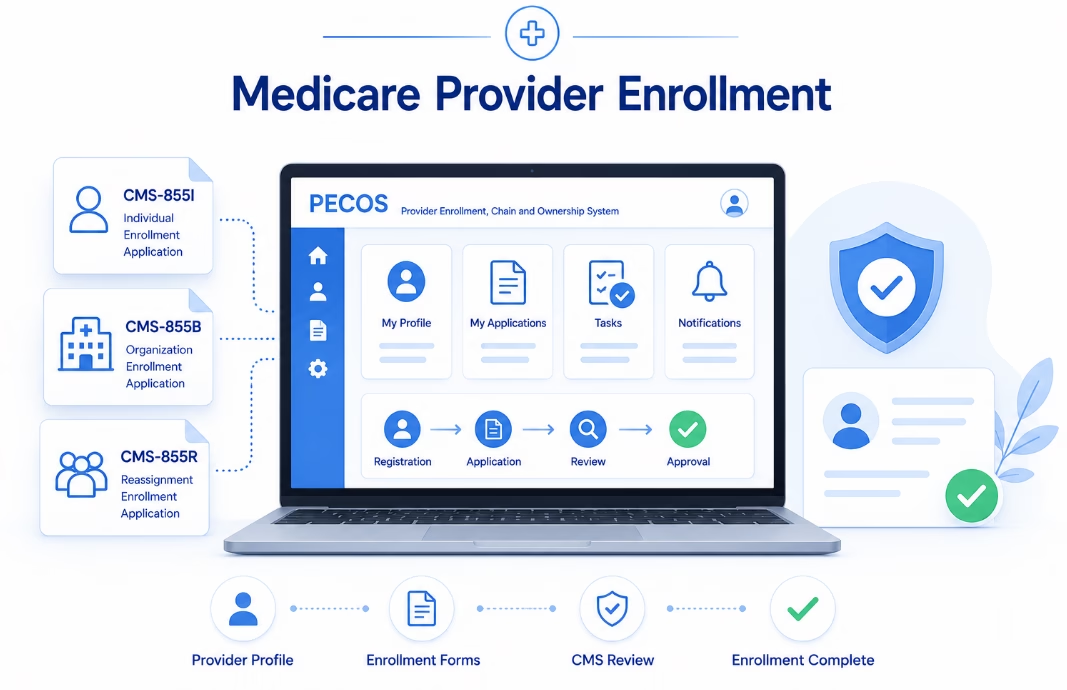
3. Medicare Is an Enrollment Process, Not Generic Commercial Credentialing
Medicare provider participation should be managed separately from commercial payer credentialing.
CMS uses PECOS as the online Medicare enrollment management system.
Eligible providers and suppliers use PECOS to:
- Submit initial Medicare enrollment
- Review existing enrollment information
- Upload supporting documents
- Report enrollment changes
- Complete revalidation
Medicare Administrative Contractors process applicable enrollment applications.
What Does Medicare Enrollment Require?
Requirements depend on provider or supplier type, but the Medicare enrollment process can include:
- NPI
- Applicable enrollment application
- Professional or organizational information
- Practice locations
- Ownership and control information where applicable
- Supporting documents
- Electronic signature or certification
- Enrollment fee where applicable
- EFT information
CMS states that providers enrolling in Medicare, revalidating, or making certain enrollment changes must establish EFT information as part of the applicable process.
How Often Does Medicare Revalidation Occur?
CMS currently states that:
- Most providers and suppliers generally revalidate every five years.
- DMEPOS suppliers generally revalidate every three years.
- CMS may request off-cycle revalidation.
Do not convert those revalidation cycles into a general statement that “Medicare credentialing happens every three to five years.”
Revalidation is a Medicare enrollment requirement.
How Quickly Must Practices Respond to Medicare Requests?
CMS currently instructs providers to respond to Medicare Administrative Contractor requests for additional enrollment information within 30 days.
If the requested information is not provided, the MAC may reject the enrollment application.
This is an example of a real program-specific deadline that should be tracked separately from internal follow-up dates.
4. Medicaid Provider Enrollment Requirements
Medicaid enrollment is administered at the state level.
Providers should therefore review requirements for each state in which they intend to participate.
Requirements may include:
- Professional license verification
- NPI
- Ownership and controlling-interest information
- Provider-type-specific screening
- State enrollment forms
- Site visits where applicable
- Fingerprinting where required
- Revalidation
The exact requirements depend on the state and provider type.
Does Every Medicaid Provider Need Fingerprinting?
No.
CMS uses risk-based provider screening rules.
Fingerprinting is required for providers in applicable high-risk categories.
CMS guidance has historically included newly enrolling home health agencies and certain DMEPOS suppliers among categories subject to high-risk screening.
States may also establish additional screening requirements.
Practices should therefore verify the requirements with the applicable state Medicaid agency rather than assuming fingerprinting applies to every provider.
5. Medicaid Managed Care Adds Another Layer
Enrollment with a state Medicaid program does not always complete participation with every Medicaid managed care plan.
Depending on the state and health plan, a provider may also need:
- Managed care credentialing
- Contracting
- Provider affiliation
- Location enrollment
- Network-product activation
This is why “Medicaid approved” should not automatically be interpreted as active with every Medicaid managed care organization.
6. Provider Documents Commonly Used in Payer Credentialing
A well-maintained provider file can make payer applications easier to prepare.
Depending on the payer and provider type, commonly requested information may include:
- Professional license
- CV or work history
- Education and training
- Professional liability insurance
- Board certification where applicable
- DEA registration where applicable
- NPI
- W-9
- Practice locations
- Group information
- Ownership information where applicable
Not every payer requires every document.
See our provider credentialing documents guide for a more complete checklist.
7. Should NPPES, CAQH, PECOS, and Payer Records Match?
They should contain accurate information, but the systems should not be treated as identical databases.
Each has a different role:
| System | Primary Purpose |
|---|---|
| NPPES | Assigns NPIs and maintains associated provider information |
| CAQH Provider Data Portal | Maintains provider professional information for authorized participating organizations |
| PECOS | Manages Medicare enrollment records |
| State licensing board | Maintains professional licensing status |
| Commercial payer system | Maintains payer-specific credentialing, contracting, enrollment, and network relationships |
Meaningful discrepancies should be investigated, but practices should not force every field to be identical if the systems legitimately represent different information.
8. Taxonomy Requirements
Taxonomy codes describe healthcare-provider classifications and specializations.
Taxonomy may be relevant to:
- NPPES
- Medicare enrollment
- Commercial payer enrollment
- Claims processing
However, taxonomy alone does not establish:
- Licensure
- Specialty certification
- Credentialing approval
- Network participation
Practices should use an appropriate taxonomy for the provider’s actual role and enrollment structure.
9. Network Availability Is Separate From Credentialing Qualifications
A provider may satisfy a payer’s professional credentialing criteria and still be unable to join a particular network.
A payer may have:
- A closed network
- Limited need for a specialty
- Geographic restrictions
- Product-specific network limits
This is a network participation issue, not necessarily a credentialing failure.
10. Contracting Is Separate From Credentialing
Commercial payer contracting establishes the participation terms between the payer and provider or healthcare organization.
A contract may address:
- Network participation
- Reimbursement terms
- Administrative requirements
- Effective dates
- Termination provisions
A credentialing approval should not automatically be interpreted as an executed payer contract.
11. Group Affiliation Must Be Confirmed
A provider may already be participating with an insurance company but not yet be active under the practice that hired them.
The payer may still need to establish:
- Group affiliation
- TIN relationship
- Practice location
- Network product
- Effective date
See our individual vs group credentialing guide for this distinction.
12. Do Not Assume Payer Approval Means Billing Can Begin
The word “approved” can mean several different things.
Before treating a provider as billing-ready, determine whether:
- Credentialing is approved
- The contract is complete
- Enrollment is loaded
- The provider is affiliated with the correct group
- The correct location is active
- The correct payer product is active
- The effective date is confirmed
13. How Often Should You Follow Up With a Payer?
There is no universal rule requiring weekly follow-up.
The appropriate schedule depends on:
- Payer instructions
- Current application status
- Outstanding documentation
- Expected review stage
- Whether the payer gave a specific response timeframe
Every application should still have a documented next-action date.
A useful follow-up record includes:
- Last contact date
- Representative or department
- Reference number
- Current status
- Outstanding requirement
- Next follow-up date
See our credentialing follow-up process guide for a structured workflow.
14. How Early Should Payer Credentialing Start?
Start as early as reasonably possible once the practice has enough accurate information to complete the applicable process.
There is no universal requirement that commercial applications begin 90 to 120 days before the provider’s start date.
Timing depends on:
- Payer
- Provider type
- Network
- State
- Credentialing requirements
- Contracting
- Application completeness
Practices should plan conservatively while avoiding unsupported promises about a specific approval date.
Common Payer Credentialing Mistakes
Calling every process credentialing
Commercial credentialing, Medicare enrollment, Medicaid enrollment, contracting, and group affiliation are different processes.
Using outdated provider documents
Expired or incomplete documents can create additional payer requests and administrative delays.
Assuming CAQH completion means payer approval
A complete CAQH profile supports credentialing but does not mean the payer has completed its review.
Assuming network status automatically follows the provider
A provider’s existing payer relationship may not automatically apply to a new group, location, TIN, or product.
Ignoring payer-specific instructions
A standardized internal process is helpful, but the final application still needs to satisfy the actual payer’s requirements.
Tracking approval but not the effective date
Billing readiness should be based on the applicable payer relationship and confirmed effective date.
Payer Credentialing Requirements Checklist
| Area | What to Confirm |
|---|---|
| Provider eligibility | Provider type and specialty are eligible for the intended payer or network |
| Professional credentials | Required license, training, insurance, and other credentials are current |
| CAQH | Profile is current and appropriately authorized where the payer uses CAQH |
| Application | Correct payer-specific submission method is used |
| Contracting | Commercial participation agreement status is separately tracked |
| Group affiliation | Provider is linked to the intended organization and TIN |
| Location | Applicable service location is active |
| Network product | Participation confirmed for the relevant product |
| Effective date | Confirmed rather than assumed |
| Follow-up | Last action, next action, and outstanding payer requests documented |
Frequently Asked Questions
What are payer credentialing requirements?
Payer credentialing requirements are the professional and administrative criteria a health plan uses to evaluate a provider for participation. Requirements vary by payer, network, provider type, and product.
Does Medicare use credentialing like commercial insurers?
Medicare primarily uses a federal provider enrollment process through CMS and PECOS. It should be tracked separately from commercial payer credentialing.
Is EFT required for Medicare enrollment?
CMS requires EFT information when enrolling in Medicare, revalidating, or making certain enrollment changes. The exact enrollment workflow depends on the provider or supplier.
How often is Medicare revalidation required?
Most providers and suppliers generally revalidate every five years. DMEPOS suppliers generally revalidate every three years. CMS may also require off-cycle revalidation.
Does every Medicaid provider need fingerprints?
No. Fingerprinting applies to providers subject to applicable high-risk screening requirements, although states may impose additional screening rules.
How often must CAQH be attested?
DataSpring currently states that providers generally must re-attest their CAQH Provider Data Portal profile every 120 days, or every 180 days for Illinois providers.
How long does payer credentialing take?
There is no universal timeline. Processing depends on the payer, provider type, network, completeness of the application, credential verification, contracting, and other factors.
Does credentialing approval mean the provider can bill?
Not necessarily. Contracting, enrollment, group affiliation, location setup, network participation, and a confirmed effective date may still be required.
Should practices follow up every week?
Not necessarily. Follow-up timing should reflect payer instructions, current status, outstanding requests, and the stage of the application.
Manage Payer Requirements as Separate Workflows
The most effective way to manage payer credentialing requirements is to stop treating every payer as though it follows one universal process.
Commercial credentialing, commercial contracting, Medicare enrollment, Medicaid enrollment, group affiliation, and payer effective dates should be tracked separately.
This allows practices to see exactly what has been completed and what still needs action.
eClinicAssist supports healthcare organizations with provider credentialing, commercial payer enrollment, CAQH management, Medicare and Medicaid enrollment administration, provider documentation, payer follow-up, contracting coordination, group affiliation, and effective-date tracking.
eClinicAssist does not control payer network decisions, government enrollment decisions, contract terms, or credentialing outcomes.
Contact eClinicAssist to discuss payer credentialing and enrollment support for your organization.
This article provides general administrative information and is not legal, contractual, billing, regulatory, accreditation, or payer-specific advice. Credentialing and enrollment requirements vary by payer, provider type, network, state, program, and date. Verify current requirements with the applicable payer or government program.