NPI registration is important because the National Provider Identifier is the standard 10-digit identifier used to identify healthcare providers in HIPAA standard transactions. Accurate NPPES information also supports Medicare enrollment, payer administration, claims processing, and provider-data management. However, an NPI does not prove licensure, credentialing, network participation, or payment eligibility. For instructions on obtaining an NPI, see our step-by-step NPPES application guide.
For healthcare providers and practice managers, understanding NPI registration importance starts with understanding what the NPI actually does.
The National Provider Identifier, or NPI, is assigned through the National Plan and Provider Enumeration System, commonly called NPPES.
It provides one standard identifier for an individual healthcare provider or healthcare organization.
However, the NPI should not be confused with:
- Professional licensing
- Provider credentialing
- Medicare enrollment
- Commercial payer enrollment
- Network contracting
- Hospital privileging
Those are separate processes.
What Is an NPI?
An NPI is a unique 10-digit numeric identifier assigned to healthcare providers.
CMS describes the NPI as a HIPAA Administrative Simplification standard.
Covered healthcare providers must use their NPIs in applicable HIPAA standard administrative and financial transactions.
The NPI itself is “intelligence free,” meaning the number does not encode information such as:
- Provider specialty
- State of practice
- License status
- Network status
- Credentialing status
Why Is NPI Registration Important?
NPI registration matters because the identifier is used throughout healthcare administration to identify the correct provider or organization.
It may be used in workflows involving:
- Electronic claims
- Eligibility transactions
- Claim-status transactions
- Medicare enrollment
- Commercial payer enrollment
- Credentialing administration
- Provider directories
- Quality-program eligibility checks
The NPI provides the identifier. Other systems determine what that provider is authorized, enrolled, credentialed, or contracted to do.
Does Having an NPI Mean a Provider Is Credentialed?
No.
This is one of the most important NPI distinctions.
CMS specifically states that issuance of an NPI does not ensure or validate that a healthcare provider is licensed or credentialed.
A provider can therefore have an NPI while still:
- Waiting for a professional license
- Applying for payer credentialing
- Waiting for Medicare enrollment
- Applying to join an insurance network
- Completing a hospital privileging process
See our credentialing vs licensing guide for a clearer comparison of these processes.
Does an NPI Enroll a Provider With Insurance?
No.
Obtaining an NPI does not enroll a healthcare provider in Medicare, Medicaid, or a commercial health plan.
Provider enrollment is a separate process.
A payer may require information such as:
- NPI
- TIN
- Professional license
- Practice locations
- Specialty
- Group affiliation
- Ownership information
- Credentialing documentation
For the broader process, see our provider enrollment guide.
Does an NPI Guarantee Claim Payment?
No.
An NPI identifies the provider, but it does not guarantee reimbursement.
A claim may still depend on:
- Provider enrollment
- Network participation
- Patient eligibility
- Benefits
- Authorization
- Medical necessity
- Correct coding
- Place of service
- Timely filing
CMS has specifically stated that obtaining an NPI does not guarantee payment by Medicare or another health plan.
Who Needs an NPI?
Healthcare providers that are HIPAA-covered entities are required to obtain NPIs and use them in HIPAA standard transactions.
Healthcare providers eligible for an NPI can include:
- Physicians
- Nurse practitioners
- Physician assistants
- Dentists
- Psychologists
- Therapists
- Hospitals
- Clinics
- Group practices
- Laboratories
- Pharmacies
- Other eligible healthcare providers and organizations
Some healthcare providers who are not HIPAA-covered entities may still be eligible to obtain an NPI.
What Is the Difference Between Type 1 and Type 2 NPIs?
Type 1 NPI
A Type 1 NPI is assigned to an individual healthcare provider.
Examples include:
- Physicians
- Nurse practitioners
- Physician assistants
- Therapists
The individual generally maintains the same NPI even when changing employers or practice locations.
Type 2 NPI
A Type 2 NPI is assigned to an organization healthcare provider.
Examples can include:
- Group practices
- Hospitals
- Clinics
- Laboratories
- Other healthcare organizations
The appropriate NPI structure depends on the provider and organization setup.
Why Does NPPES Accuracy Matter?
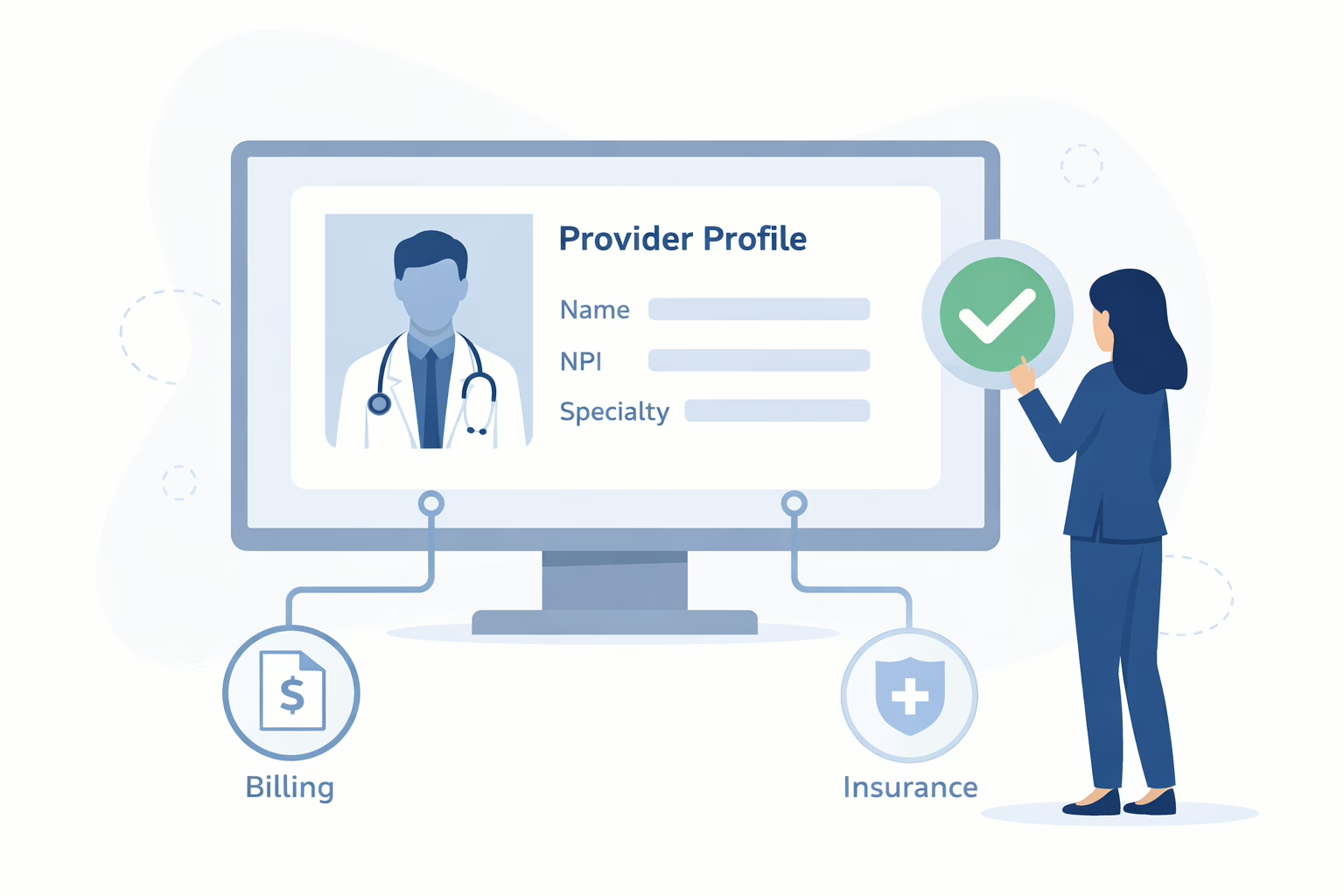
NPPES stores information associated with the provider’s NPI.
This can include:
- Provider name
- Business mailing address
- Practice location
- Taxonomy
- Other provider information
Accurate NPPES information helps other healthcare systems identify the provider correctly.
For HIPAA-covered healthcare providers, CMS requires changes to required NPPES information to be reported within 30 days of the change.
Does a Provider Need a New NPI After Moving?
Usually, no.
CMS states that an NPI remains the same even when a provider changes:
- Name
- Address
- Practice location
- Other associated information
Instead of applying for a new NPI simply because an address changes, the provider updates the existing NPPES record.
Why Is Taxonomy Important in NPPES?
A Healthcare Provider Taxonomy Code describes the provider’s classification or specialization.
CMS requires an applicant to select a taxonomy when applying for an NPI.
A provider can report more than one taxonomy but must designate a primary taxonomy.
Taxonomy can also matter in payer enrollment workflows.
For example, CMS states that a provider seeking Medicare enrollment must have an NPI and an appropriate taxonomy associated with the provider.
However, taxonomy itself is not proof of specialty certification, licensure, credentialing, or payer participation.
Should NPPES, CAQH, and Payer Records Match?
They should be accurate and consistent where the same information is being represented, but they should not be treated as identical databases.
Each system has a different purpose.
| System | Primary Role |
|---|---|
| NPPES | Assigns NPIs and maintains associated provider information |
| CAQH Provider Data Portal | Supports provider data collection and sharing for participating organizations |
| PECOS | Manages Medicare enrollment information |
| Commercial payer system | Maintains payer-specific credentialing, enrollment, contracting, and billing relationships |
A practice should investigate meaningful discrepancies rather than assuming every field must be copied identically from one system to another.
How Does the NPI Affect Credentialing?
Credentialing organizations may use the NPI as one identifier when managing a provider file.
But credentialing requires much more than an NPI.
The credentialing review may include:
- License verification
- Education and training
- Work history
- Professional liability coverage
- Board certification where applicable
- Sanctions
- Malpractice history
The NPI helps identify the provider. It does not establish that the provider has passed credentialing.
See our provider credentialing documents guide for the broader documentation requirements.
How Does the NPI Affect Medicare Enrollment?
An NPI is an important prerequisite for Medicare enrollment.
CMS directs providers and suppliers to obtain an NPI before completing the applicable Medicare enrollment process.
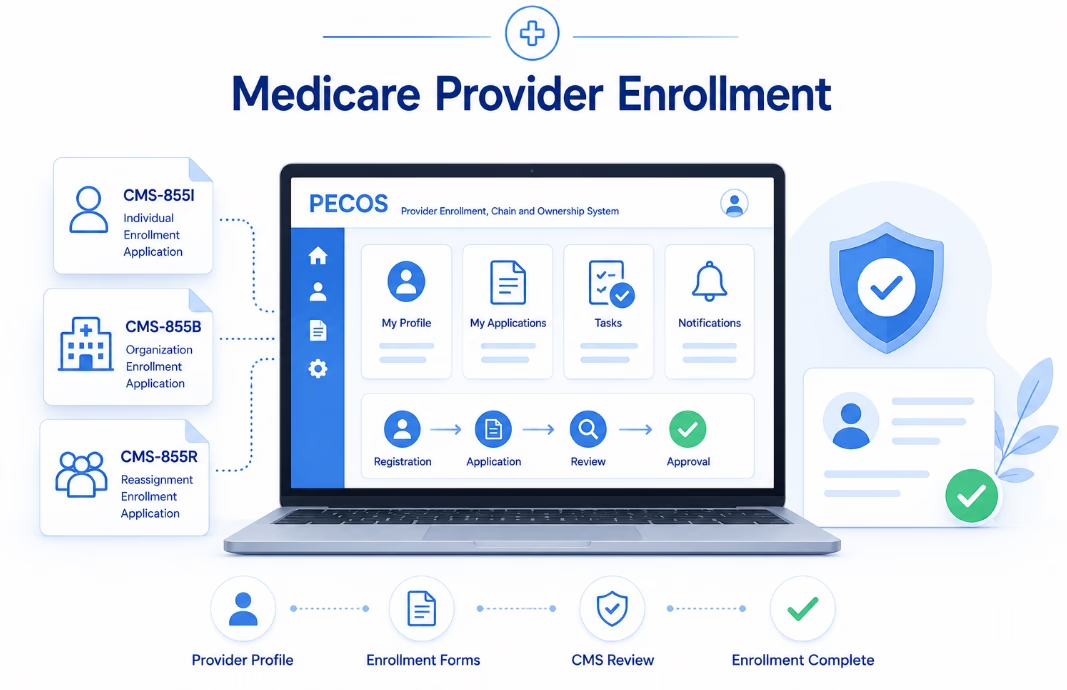
Medicare enrollment is then managed separately through CMS enrollment systems, including PECOS.
Medicare may evaluate:
- NPI
- Provider type
- Enrollment eligibility
- Practice locations
- Ownership
- Reassignments
- Other program requirements
An active NPI should therefore not be mistaken for active Medicare enrollment.
How Is the NPI Used in MIPS?
The NPI is also used in CMS quality-program administration.
For 2026, clinicians can use their NPI on the Quality Payment Program website to check MIPS participation status.
CMS determines MIPS eligibility using Medicare Part B claims and PECOS data over defined determination periods.
The current Traditional MIPS performance categories are:
- Quality
- Cost
- Improvement Activities
- Promoting Interoperability
An NPI is therefore an important identifier within the program, but the NPI itself does not make a clinician MIPS eligible.
Is “Meaningful Use” Still the Current Medicare Program?
No.
“Meaningful Use” is legacy terminology.
For eligible clinicians participating in MIPS, the current performance category is called Promoting Interoperability.
Practices should use current CMS terminology when evaluating quality-reporting requirements.
Can Incorrect NPI Information Cause Claim Problems?
It can, depending on the error and payer.
For example, a claim may encounter problems if:
- The wrong rendering-provider NPI is submitted
- The wrong billing-provider NPI is submitted
- The payer does not recognize the provider under the submitted group
- The payer has not loaded the provider’s applicable relationship
- The provider information does not support the billing arrangement
However, not every provider-related claim denial is caused by NPPES.
Billing teams should review the exact denial or rejection before deciding which system needs correction.
Can an NPI Problem Be a Credentialing Problem?
Sometimes, but the two should not be automatically combined.
For example:
- An incorrect NPI on an application may delay processing.
- An accurate NPI may exist while credentialing remains incomplete.
- The provider may be credentialed but not affiliated with the correct group.
- NPPES may be current while the payer’s internal provider record is outdated.
Each issue requires a different correction.
Hypothetical Example: NPI Data and Payer Enrollment
Consider a provider joining a new medical group.
The provider already has a Type 1 NPI, but the practice discovers that the NPPES record contains an old practice location and an outdated primary taxonomy.
The practice should not apply for a new NPI simply because the provider changed employers.
Instead, the team should:
- Review the existing NPPES record.
- Update information that is no longer accurate.
- Confirm the appropriate taxonomy.
- Review the payer application separately.
- Confirm the provider’s group affiliation and effective date with the payer.
This keeps NPI maintenance separate from credentialing and enrollment while ensuring the information used in each workflow is accurate.
NPI Registration and Maintenance Checklist
| Item | What to Check |
|---|---|
| NPI type | Confirm whether the record should be Type 1 or Type 2 |
| Provider name | Confirm current professional or legal information |
| Practice address | Update required NPPES information when locations change |
| Taxonomy | Confirm current classification and primary taxonomy |
| Payer enrollment | Confirm the payer recognizes the correct NPI and billing arrangement |
| Medicare | Confirm PECOS enrollment separately from NPPES |
| CAQH | Review provider data separately and resolve meaningful discrepancies |
| Claims | Confirm rendering and billing NPIs are used correctly |
Frequently Asked Questions
What is the importance of NPI registration?
NPI registration provides the standard provider identifier used in HIPAA transactions and supports payer enrollment, Medicare enrollment, claims processing, provider-data management, and other administrative workflows.
Does an NPI prove a provider is licensed?
No. CMS specifically states that NPI issuance does not validate professional licensure or credentialing.
Does an NPI mean a provider is enrolled with Medicare?
No. A provider generally needs an NPI before Medicare enrollment, but Medicare enrollment is a separate process managed through CMS and PECOS.
Does a provider need a new NPI after changing practices?
Usually not for an individual provider. A Type 1 NPI generally remains with the provider, while associated NPPES information should be updated when required.
How quickly must NPPES information be updated?
HIPAA-covered healthcare providers must report changes to required NPPES information within 30 days of the change.
Does an NPI guarantee insurance reimbursement?
No. The NPI identifies the provider but does not guarantee network participation, enrollment, claim coverage, or payment.
Is taxonomy part of the NPI?
The taxonomy code is reported in the NPPES record when applying for or maintaining an NPI, but the 10-digit NPI itself does not encode the provider’s specialty.
Is MIPS eligibility based only on NPI?
No. CMS uses the NPI to identify the clinician, but MIPS eligibility is determined using Medicare Part B claims and PECOS data during defined eligibility periods.
Keep NPI Data Accurate, but Know What the NPI Does Not Do
Understanding NPI registration importance helps healthcare organizations manage provider data more accurately.
The NPI is the standard identifier used across many healthcare administrative transactions, but it is not a professional license, credentialing approval, payer contract, Medicare enrollment, or guarantee of reimbursement.
Practices should maintain accurate NPPES records while separately tracking:
- Professional licensing
- Credentialing
- Commercial payer enrollment
- Medicare and Medicaid enrollment
- Group affiliations
- Effective dates
eClinicAssist supports healthcare organizations with NPI and provider-data administration, credentialing, payer enrollment, CAQH management, Medicare and Medicaid enrollment administration, document tracking, and related workflows.
Contact eClinicAssist to discuss provider credentialing and enrollment support for your organization.
This article provides general administrative information and is not legal, billing, regulatory, or payer-specific advice. NPI, enrollment, credentialing, and quality-program requirements may vary by provider type and program. Verify current requirements with CMS, the applicable payer, or other responsible authority.