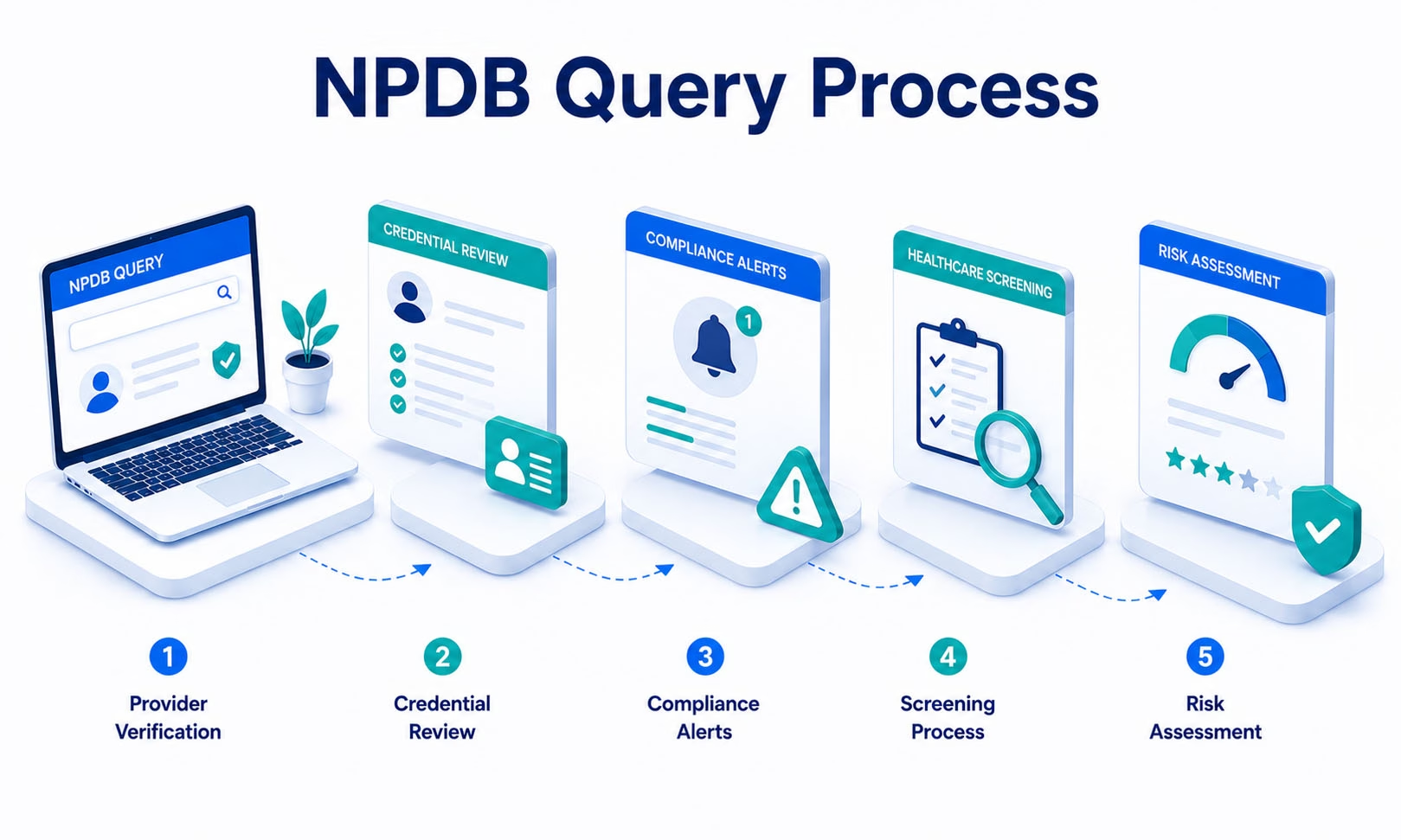
The NPDB query process allows eligible healthcare organizations to obtain report information from the National Practitioner Data Bank when authorized by federal law. Hospitals must query when practitioners apply for medical staff appointment or clinical privileges and every two years thereafter. Other eligible entities may query for specific authorized purposes. An NPDB report should be reviewed in context, not treated as an automatic credentialing denial.
The National Practitioner Data Bank, or NPDB, is an important source used in healthcare credentialing, privileging, licensing, and professional review.
However, the NPDB is not a public background-check database, and not every healthcare organization has unrestricted access.
Understanding who may query, when a query is required, what the response means, and how the information should be reviewed is essential for accurate credentialing operations.
What Is the National Practitioner Data Bank?
The NPDB is a federal information clearinghouse created to support healthcare quality, protect the public, and reduce healthcare fraud and abuse.
Authorized organizations report certain qualifying actions involving healthcare practitioners, providers, suppliers, and healthcare entities.
The NPDB maintains reports involving areas such as:
- Medical malpractice payments
- Federal and state licensure and certification actions
- Adverse clinical privilege actions
- Adverse professional society membership actions
- Negative findings by certain peer review organizations
- Negative findings by certain private accreditation organizations
- Healthcare-related criminal convictions
- Healthcare-related civil judgments
- Exclusions from federal or state healthcare programs
- DEA controlled-substance registration actions
- Other qualifying adjudicated actions or decisions
The exact information available in a query depends on the type of organization querying and the legal authority under which it is permitted to access the NPDB.
What Is the NPDB Query Process?
The NPDB query process is the method an eligible organization uses to request information about a practitioner, provider, supplier, or healthcare organization when permitted by NPDB law and regulations. Organizations can also review strategies for staying informed about healthcare regulations.
An eligible organization submits identifying information through the NPDB system.
The resulting query response contains the NPDB reports the organization is legally authorized to receive.
This information can then become one component of a broader credentialing, privileging, licensing, hiring, or professional-review process.
Who Can Query the NPDB?
NPDB access is limited.
Depending on statutory authority and purpose, authorized queriers can include:
- Hospitals
- Healthcare entities with formal peer-review processes
- Professional societies with formal peer review
- State licensing boards
- Certain federal and state agencies
- Health plans
- Practitioners requesting their own information through a Self-Query
- Other parties specifically authorized under NPDB rules
Eligibility does not mean an organization may query anyone for any reason.
The query must fall within the purpose authorized for that organization.
Are Hospitals Required to Query the NPDB?
Yes.
Hospitals are the only healthcare entities federally mandated to query the NPDB.
Hospitals must request NPDB information when a physician, dentist, or other healthcare practitioner:
- Applies for medical staff appointment
- Applies for clinical privileges
- Applies for temporary clinical privileges
Hospitals must also query every two years for practitioners who remain on the medical staff or continue to hold clinical privileges.
This applies to applicable medical staff appointments regardless of whether the appointment is described as courtesy or another qualifying staff category.
Does a Hospital Have to Query Every Year?
No.
The federal NPDB requirement is generally every two years for practitioners continuously on the hospital’s medical staff or holding clinical privileges.
A hospital may query more frequently if its policies, accreditation requirements, medical staff bylaws, or professional-review activities call for additional checks.
What Information Is Submitted for an NPDB Query?
The NPDB uses practitioner identifying information to search for reports associated with the subject.
Information may include:
- Name
- Other names used
- Date of birth
- Social Security Number where applicable
- NPI
- Professional license information
- Other identifying information requested by the NPDB
Accurate identifiers are important because the response is based on the information submitted.
What Does an NPDB Query Show?
A query response may contain qualifying NPDB reports associated with the subject.
Depending on the querier’s legal authority, these may include:
- Medical malpractice payment reports
- Professional licensure actions
- Clinical privilege actions
- Professional society actions
- Program exclusions
- DEA actions
- Healthcare-related criminal convictions
- Healthcare-related civil judgments
- Other adjudicated actions or decisions
The presence of a report does not automatically determine what action a credentialing organization should take.
What Does “No Reports Found” Mean?
A response stating “No Reports Found” means that the NPDB found no reports based on the subject information submitted for that query.
It should not be interpreted as a federal certification that the provider:
- Has never had a complaint
- Has never been sued
- Has no malpractice history of any kind
- Has never faced an employer investigation
- Has no adverse information outside the NPDB
Only certain actions meet NPDB reporting requirements.
The query result should therefore be used as one source within a broader credentialing verification process.
Does an NPDB Report Automatically Disqualify a Provider?
No.
Finding an NPDB report is not the same as determining that a practitioner is unqualified.
The credentialing organization may need to evaluate:
- Type of report
- Date of the underlying event
- Severity
- Pattern of similar events
- Current license status
- Provider explanation
- Corrective action
- Subsequent professional history
- Organization-specific credentialing criteria
The appropriate review depends on the organization and the nature of the report.
How Are Medical Malpractice Payments Reported?
The NPDB receives qualifying medical malpractice payment reports when a payment is made for the benefit of a healthcare practitioner in response to a written claim or judgment and the applicable reporting requirements are met.
The existence of a malpractice payment report does not, by itself, establish negligence or require automatic denial of credentialing.
Credentialing organizations should evaluate the report according to their policies and applicable standards.
What Licensure Actions Can Appear in the NPDB?
The NPDB receives qualifying state and federal licensure and certification actions.
Depending on the circumstances, reports can involve actions such as:
- Suspension
- Revocation
- Probation
- Reprimand
- Voluntary surrender while under investigation or to avoid investigation where reportable
- Other qualifying actions
The reporting rules determine whether a specific action must be submitted to the NPDB.
What Clinical Privilege Actions Are Reported?
Not every change in clinical privileges is reportable.
Federal NPDB rules identify specific adverse clinical privilege actions that hospitals and other eligible healthcare entities must report when the reporting criteria are met.
A credentialing team should therefore avoid assuming that every restriction, modification, or lapse in privileges automatically appears in the NPDB.
Does the NPDB Include Medicare and Medicaid Exclusions?
Yes.
The NPDB receives reports involving exclusions from federal and state healthcare programs, including Medicare and Medicaid, when the applicable reporting requirements are met.
However, an NPDB query should not replace other exclusion-screening obligations that may apply to an organization.
The NPDB is one credentialing and compliance information source, not a substitute for every other federal or state database.
Does the NPDB Include DEA Actions?
Yes.
Qualifying Drug Enforcement Administration controlled-substance registration actions can be reported to the NPDB.
This is different from simply checking whether a provider currently has an active DEA registration.
An organization may need to verify the provider’s current registration directly through the appropriate source as part of its credentialing process.
What Is a One-Time NPDB Query?
A One-Time Query requests the information currently available from the NPDB about the subject at the time the query is processed.
The organization receives the reports it is authorized to receive.
If another report is added later, a previous One-Time Query does not automatically update itself.
What Is NPDB Continuous Query?
Continuous Query is an official NPDB monitoring service.
An eligible organization can enroll a practitioner for a 12-month period.
At enrollment, the organization receives:
- Confirmation of enrollment
- The practitioner’s current NPDB query response
During the enrollment period, the NPDB notifies the organization of new reports generally within 24 hours after receiving them.
Continuous Query therefore provides more ongoing visibility than relying only on periodic One-Time Queries.
Does Continuous Query Satisfy a Hospital’s Two-Year Requirement?
Yes.
The NPDB states that hospitals enrolling practitioners in Continuous Query satisfy the mandatory hospital querying requirements for those enrolled practitioners.
The Continuous Query enrollment itself must still be maintained appropriately.
Is Continuous Query the Same as Credentialing Software Monitoring?
No.
Continuous Query is an NPDB service.
A credentialing software platform may help an organization:
- Track which practitioners require NPDB queries
- Track query dates
- Assign review tasks
- Record completion status
- Manage recredentialing deadlines
Some external applications may connect with authorized NPDB querying workflows.
However, software does not independently create access to NPDB data or change the legal rules governing who may query and how the information may be used.
Can a Provider Query Their Own NPDB Record?
Yes.
Healthcare practitioners can request their own information through an NPDB Self-Query.
A Self-Query can help a practitioner review information associated with their own record.
A practitioner cannot use the Self-Query process to obtain another person’s NPDB information.
Can a Provider Respond to an NPDB Report?
Yes.
NPDB procedures allow a subject to add a statement to a report explaining their perspective.
There are also NPDB processes for disputing certain report information.
The existence of a subject statement does not automatically remove or invalidate the underlying report.
Credentialing reviewers should examine the information available with the report according to their organization’s policies.
How Should a Credentialing Team Review an NPDB Report?
A structured review may include:
- Confirm the report belongs to the correct practitioner.
- Identify the type of reported action.
- Review the dates and reporting organization.
- Determine whether additional primary-source verification is needed.
- Review any practitioner statement or explanation.
- Apply the organization’s credentialing criteria.
- Document the review and resulting decision.
The NPDB should provide information for credentialing review, not act as an automatic approval or denial algorithm.
How Does the NPDB Fit Into Primary Source Verification?
The NPDB is an important authorized information source, but credentialing generally involves multiple verification sources.
Depending on the provider and organization, credentialing may also involve:
- State licensing boards
- Education and training sources
- Certification organizations
- Professional liability information
- DEA verification where applicable
- Other recognized credentialing sources
See our primary source verification guide for the broader verification framework.
How Does the NPDB Fit Into Recredentialing?
NPDB information can also be relevant after initial credentialing.
An organization may query during:
- Recredentialing
- Hospital reappointment
- Clinical privilege renewal
- Professional review activity
- Other authorized circumstances
Hospitals have the specific federal requirement to query practitioners on their medical staff or holding clinical privileges every two years.
Is NPDB Information Confidential?
Yes.
NPDB information is subject to federal confidentiality requirements.
Organizations should not treat an NPDB response like ordinary public provider information.
Access, use, storage, and disclosure should follow:
- NPDB statutes and regulations
- The organization’s authorized querying purpose
- Applicable credentialing and peer-review procedures
- Appropriate information-security controls
NPDB information generally may be disclosed only as permitted by the applicable federal rules.
Common NPDB Query Process Mistakes
Assuming every medical practice can query the NPDB
NPDB querying authority depends on the organization’s eligibility and legal purpose.
Treating “No Reports Found” as a complete background clearance
The response only addresses information reportable to and found in the NPDB based on the identifying information submitted.
Automatically rejecting anyone with an NPDB report
A report should be evaluated according to its facts and the organization’s credentialing criteria.
Assuming every malpractice claim appears in the NPDB
The NPDB receives qualifying malpractice payment reports, not every allegation or lawsuit.
Confusing Continuous Query with ordinary software alerts
Continuous Query is a specific NPDB service with defined enrollment and notification rules.
Sharing NPDB reports too broadly
NPDB information is confidential and subject to federal disclosure restrictions.
NPDB Query Process Checklist
| Step | What to Confirm |
|---|---|
| Eligibility | Organization is authorized to query the NPDB for the intended purpose |
| Subject | Correct practitioner or organization identified |
| Identifiers | Required identifying information is complete and accurate |
| Query type | One-Time Query or Continuous Query selected as appropriate |
| Response | Query response reviewed for applicable reports |
| Verification | Additional source verification completed when necessary |
| Provider response | Relevant explanation or statement reviewed where applicable |
| Decision | Credentialing or privileging decision documented under organizational policy |
| Confidentiality | NPDB information stored and disclosed only as permitted |
| Ongoing review | Required re-query or Continuous Query activity tracked |
Frequently Asked Questions
What is the NPDB query process?
The NPDB query process allows eligible organizations to request report information about healthcare practitioners, providers, suppliers, or organizations when authorized by federal NPDB rules.
Are hospitals required to query the NPDB?
Yes. Hospitals must query when practitioners apply for medical staff appointment or clinical privileges and every two years thereafter for practitioners who remain on staff or hold privileges.
Do private physician practices have to query the NPDB?
Not under the same federal mandatory-query rule that applies to hospitals. An organization must also be eligible and authorized under NPDB rules before it can query.
What does “No Reports Found” mean?
It means the NPDB found no reports based on the subject information submitted. It does not establish that the practitioner has no adverse professional history outside the NPDB.
Does an NPDB report automatically prevent credentialing?
No. Credentialing organizations generally evaluate the report in context under their credentialing policies and applicable standards.
What is NPDB Continuous Query?
Continuous Query enrolls a practitioner for 12 months, provides the current NPDB response, and notifies the eligible organization of new reports generally within 24 hours after the NPDB receives them.
Can a practitioner see their own NPDB record?
Yes. Practitioners can request their own information through an NPDB Self-Query.
Is NPDB information public?
Identifiable NPDB report information is confidential and subject to federal restrictions. The NPDB separately provides de-identified public-use data for research.
Does the NPDB replace license verification?
No. Credentialing organizations may still need to verify current professional licensure and other credentials through the appropriate authoritative sources.
Use the NPDB as One Part of a Complete Credentialing Review
The NPDB query process is an important part of healthcare credentialing and privileging, but it should be used correctly.
Organizations should understand:
- Whether they are authorized to query
- When a query is legally required
- What information the NPDB actually contains
- What “No Reports Found” means
- How adverse reports should be evaluated
- When Continuous Query may be appropriate
- How NPDB confidentiality rules apply
eClinicAssist supports healthcare organizations with credentialing workflows, provider-document management, primary source verification tracking, payer enrollment administration, recredentialing, task management, and related provider-data processes.
eClinicAssist does not operate the NPDB, determine an organization’s legal eligibility to query, make credentialing committee decisions, or provide legal interpretations of NPDB reporting or disclosure requirements.
Contact eClinicAssist to discuss provider credentialing and enrollment workflow support for your organization.
This article provides general administrative information and is not legal, regulatory, peer-review, accreditation, or credentialing committee advice. NPDB querying, reporting, confidentiality, and disclosure requirements depend on federal law, organization type, and the purpose of the query. Organizations should follow current NPDB guidance and obtain appropriate professional advice when needed.