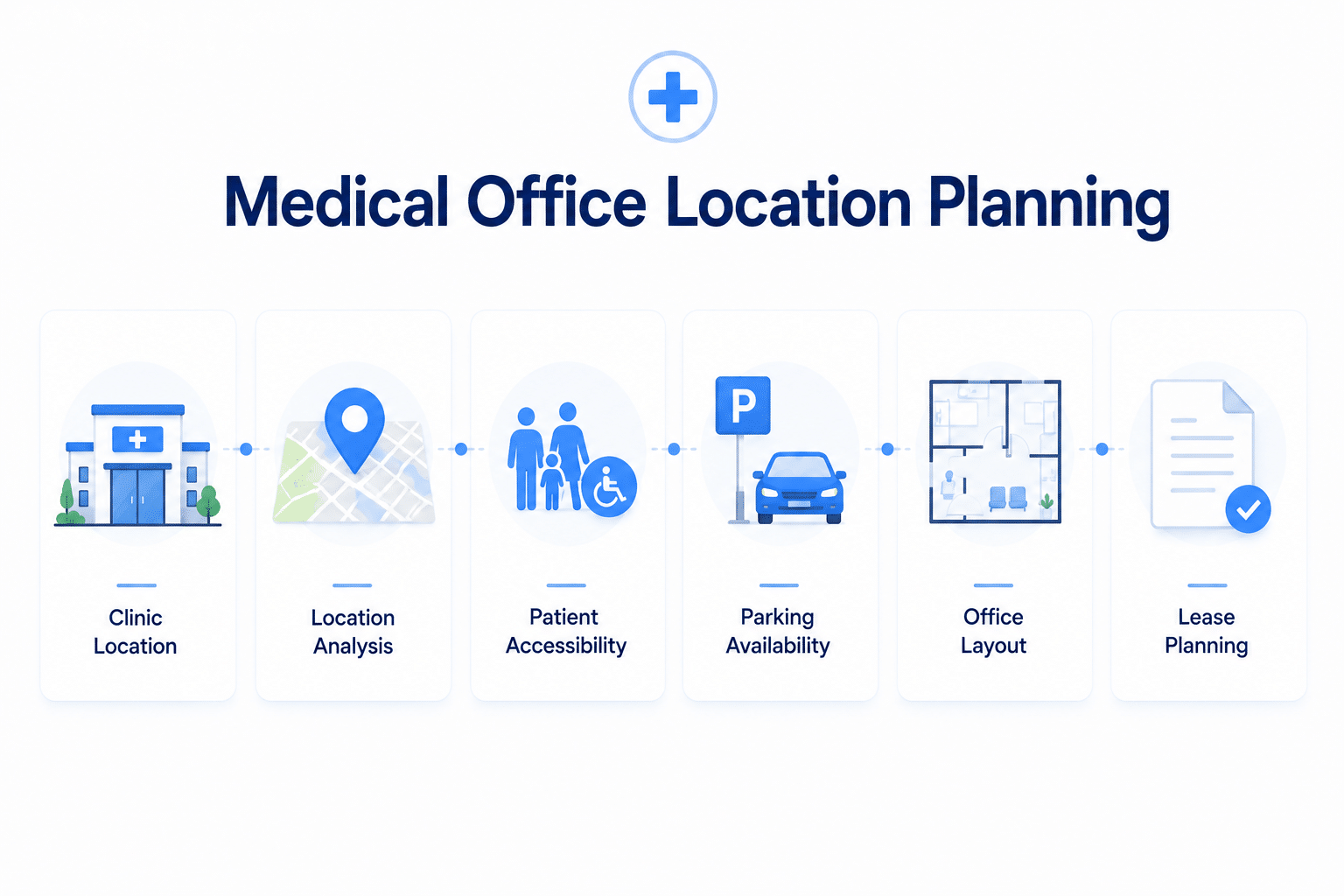
Medical office location planning should evaluate more than rent and visibility. Before committing to a site, a healthcare practice should review patient access, zoning, permitted use, ADA accessibility, parking, clinical layout, build-out requirements, lease terms, payer and enrollment implications, staffing, competition, and whether the space can support the services the practice actually intends to provide.
Choosing a medical office is one of the most difficult decisions in starting or expanding a healthcare practice.
A location may look ideal from the street but still create problems with:
- Zoning
- Parking
- Accessibility
- Clinical workflow
- Construction costs
- Payer enrollment
- Future expansion
The safest approach is to evaluate the property as a healthcare operating site, not simply as commercial real estate.
What Is Medical Office Location Planning?
Medical office location planning is the process of selecting and evaluating a site for a healthcare practice based on clinical, operational, financial, regulatory, and patient-access needs.
The process should answer three basic questions:
- Can the practice legally operate here?
- Can the intended clinical services function efficiently here?
- Does the location make business sense over the expected lease or ownership period?
What Should You Check Before Signing a Medical Office Lease?
At minimum, review:
- Zoning and permitted use
- Certificate-of-occupancy requirements
- ADA accessibility
- Parking
- Building access
- Exam-room capacity
- Plumbing and electrical capacity
- HVAC
- Clinical equipment requirements
- Build-out costs
- Signage rights
- Lease restrictions
- Payer and enrollment implications
- Expansion potential
A lease should not be signed simply because the landlord says the space is suitable for medical use.
Start With the Services the Practice Will Actually Provide
The right office depends heavily on the clinical model.
A primary care clinic has different space requirements from:
- Urgent care
- Behavioral health
- Endocrinology
- Physical therapy
- Pain management
- Imaging
- Laboratory services
- Infusion services
- Office-based procedures
Before touring properties, define:
- Expected patient volume
- Number of providers
- Number of exam rooms
- Procedure rooms
- Laboratory needs
- Medication storage
- Imaging equipment
- Staff workstations
- Patient waiting space
- Storage
How Should a Practice Choose the Right Geographic Area?
Start by defining the patient population the practice intends to serve.
Useful factors can include:
- Population size
- Age distribution
- Population growth
- Household characteristics
- Major employers
- Insurance mix
- Existing competitors
- Hospitals and referral sources
- Driving patterns
- Public transportation
Do not assume that high population density automatically means high demand.
A dense market may also have substantial competition.
Does Specialty Change the Best Location?
Yes.
Different medical specialties can have different site-selection priorities.
Primary Care
Primary care may benefit from convenient access to residential areas, major roads, employers, pharmacies, and other community services.
Urgent Care
Urgent care may place greater emphasis on:
- Visibility
- Easy vehicle access
- Parking
- Extended-hours access
- Population density
Specialty Practices
Specialists may place greater value on proximity to:
- Referral sources
- Hospitals
- Imaging centers
- Surgery centers
- Related specialties
Behavioral Health
Behavioral health practices may prioritize privacy, sound control, easy access, and a setting appropriate for longer visits.
How Should Competition Be Evaluated?
Competition analysis should go deeper than counting nearby medical offices.
Ask:
- Which specialties are already represented?
- Which payer networks do competitors participate in?
- What hours do they operate?
- How far are patients currently traveling for care?
- Are there obvious service gaps?
- Are major health systems dominating the area?
Competition can indicate either oversupply or meaningful demand.
Why Zoning Must Be Confirmed Before Signing
Commercial space is not automatically approved for every healthcare use.
Before signing a lease, confirm whether the intended services are permitted under local zoning and land-use rules.
Depending on the jurisdiction and clinical services, the practice may need to investigate:
- Medical-office use
- Conditional-use approval
- Certificate of occupancy
- Building permits
- Fire inspection
- Sign permits
- Laboratory requirements
- Imaging requirements
- Medical-gas requirements
- Waste handling
The requirements vary substantially by city, county, state, building, and service type.
What Does ADA Accessibility Mean for a Medical Office?
Medical offices are generally places of public accommodation under ADA Title III.
Healthcare providers should evaluate whether patients with disabilities can access and use the services offered.
This can involve:
- Accessible parking
- Accessible routes
- Entrances
- Door clearances
- Reception areas
- Restrooms
- Exam rooms
- Medical equipment
Is the Landlord Responsible for ADA Compliance?
Do not assume the landlord is solely responsible.
For privately operated medical offices covered by Title III, both landlords and tenants can have ADA responsibilities.
The lease may allocate responsibility for particular improvements between them, but that private allocation does not necessarily eliminate legal responsibility to patients.
Accessibility should therefore be reviewed during lease negotiations.
How Important Is Parking for a Medical Practice?
Parking should be evaluated both operationally and for accessibility.
Consider:
- Total parking supply
- Peak-hour demand
- Shared parking with neighboring businesses
- Accessible parking spaces
- Van-accessible parking
- Distance to the entrance
- Patient drop-off
- Staff parking
Accessible parking spaces generally need to connect to an accessible entrance through an accessible route.
Do Medical Offices Have Different Accessible Parking Requirements?
Some healthcare facilities do.
ADA requirements contain higher accessible-parking ratios for certain outpatient facilities and facilities specializing in services for people with mobility impairments.
The exact requirement depends on the facility type and parking arrangement.
A healthcare practice should verify the applicable requirement instead of assuming the same parking formula applies to every office building.
What Should You Look for Inside the Medical Office?
Evaluate the full patient journey.
Walk through the space as though a patient is moving from arrival to departure.
Ask whether the layout supports:
- Check-in
- Waiting
- Triage
- Exam rooms
- Procedures
- Specimen collection
- Provider work
- Staff communication
- Checkout
How Many Exam Rooms Does the Practice Need?
There is no universal number.
The answer depends on:
- Number of simultaneous providers
- Visit duration
- Patient volume
- Room turnover
- Specialty
- Procedures performed
- Staffing model
The practice should model realistic patient flow rather than simply maximizing the number of rooms that fit.
Why Build-Out Due Diligence Matters
A space that looks inexpensive can become expensive once healthcare-specific construction begins.
Potential requirements can include:
- Additional plumbing
- Electrical upgrades
- Data cabling
- HVAC modifications
- Soundproofing
- Accessible alterations
- Imaging shielding
- Medical-gas infrastructure
- Emergency power
- Clinical sinks
- Specialized storage
Not every medical office needs these features.
The build-out should match the actual services planned.
What Should a Medical Office Lease Address?
A healthcare lease should be reviewed carefully because clinical operations are more difficult to relocate than many ordinary businesses.
Important terms can include:
- Permitted use
- Lease term
- Renewal options
- Base rent
- Operating expenses
- Rent escalation
- Tenant improvement allowance
- Build-out responsibility
- Construction deadlines
- Signage
- Parking rights
- Exclusivity
- Assignment and subletting
- Relocation clauses
- Expansion rights
- Restoration obligations
Why Is the Permitted-Use Clause Important?
The permitted-use clause should be broad enough to cover the services the practice expects to provide.
An overly narrow clause can become a problem if the practice later adds:
- Laboratory testing
- Imaging
- Infusion
- Physical therapy
- Behavioral health
- Additional specialties
The lease language should be reviewed against the practice’s actual growth plan.
What Is an Exclusivity Clause?
An exclusivity provision may restrict the landlord from leasing nearby space to certain competing healthcare businesses.
Whether this is useful depends on the property, specialty, negotiating leverage, and local market.
The definition should be reviewed carefully because an overly broad or vague restriction can create disputes.
Watch for Landlord Relocation Rights
Some commercial leases allow the landlord to relocate the tenant within the property.
That can be especially disruptive for a medical practice because changing suites can affect:
- Construction
- Signage
- Patient communication
- Payer records
- Licensing records
- Medicare enrollment
A medical practice should understand any relocation provision before signing.
Should a New Medical Practice Lease or Buy?
There is no universally better option.
| Leasing May Be Attractive When | Buying May Be Attractive When |
|---|---|
| Capital needs to remain available for operations | The practice expects to remain long term |
| Future space needs are uncertain | The property supports expansion |
| The practice wants easier relocation flexibility | Ownership fits the broader financial strategy |
| The landlord is funding substantial build-out | The organization can absorb ownership and maintenance responsibilities |
The analysis should include more than the monthly payment.
How Does Location Affect Payer Enrollment?
A practice address can become an important part of payer and government-program enrollment.
Depending on the payer or program, a practice may need to report:
- Physical practice location
- Billing address
- Mailing address
- Pay-to address
- Service location
- Group affiliations
This is one reason a practice should avoid submitting speculative addresses before the site is sufficiently finalized.
See our provider enrollment process guide for the broader payer setup workflow.
How Does a Practice Location Affect Medicare Enrollment?
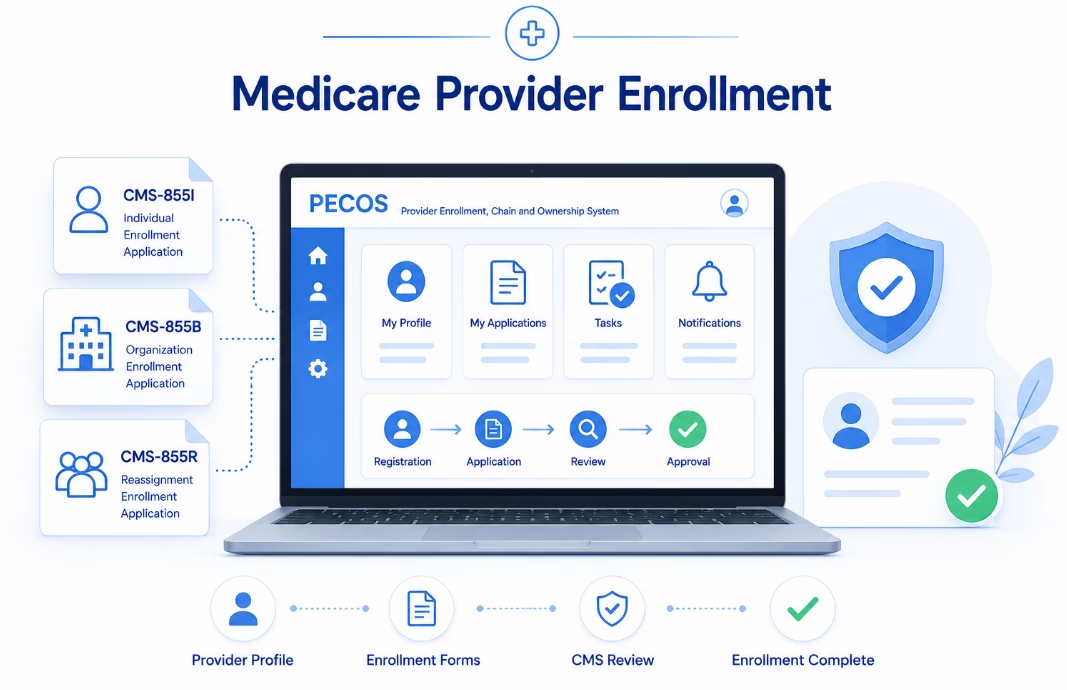
Medicare enrollment records include practice-location information.
CMS currently requires physicians, non-physician practitioners, and physician or NPP organizations to report a change in practice location within 30 days.
Other changes generally have separate reporting requirements.
Depending on provider or supplier type and the nature of the location, additional enrollment review or a site visit may also apply.
Should the Practice Sign the Lease Before Credentialing Starts?
There is no single answer for every payer or practice.
Some enrollment applications require a firm practice address and supporting facility details.
At the same time, signing a long-term lease before zoning, build-out, and regulatory due diligence is complete can create significant risk.
A coordinated startup timeline should therefore align:
- Lease negotiations
- Zoning review
- Construction
- Licensing
- NPI records
- Payer enrollment
- Medicare or Medicaid enrollment where applicable
- Opening date
How Important Is Visibility?
Visibility can matter, but its importance depends on the practice model.
A walk-in urgent care center may benefit more from road visibility than a specialist whose patients primarily arrive through physician referrals.
Evaluate:
- Road exposure
- Signage rights
- Building identification
- Wayfinding
- Search-map accuracy
- Referral patterns
Visibility should be treated as one factor rather than a guarantee of patient growth.
How Important Is Proximity to Hospitals?
It depends on specialty and referral strategy.
Proximity may be useful for:
- Hospital-based specialists
- Providers with admitting or procedural relationships
- Referral-heavy specialties
- Clinics frequently coordinating with hospital services
For other practice models, residential access or major-road convenience may matter more.
Evaluate Staff Access Too
Patient convenience matters, but staffing should also be considered.
Review:
- Commute patterns
- Staff parking
- Public transportation
- Building access outside normal hours
- Security
- Break-room and workspace capacity
A location that is difficult to staff can create operational problems even if it appears attractive to patients.
Plan for Growth Before the Office Opens
Ask what happens if the practice adds:
- Another physician
- A nurse practitioner
- More exam rooms
- A new service line
- Laboratory services
- Imaging
- Additional staff
Expansion may be much more expensive after the practice is operational.
Medical Office Location Due-Diligence Checklist
| Area | What to Confirm |
|---|---|
| Clinical model | Space supports intended services and provider count |
| Zoning | Intended medical use permitted |
| Occupancy | Required occupancy approvals identified |
| Accessibility | Parking, routes, entrances, rooms, and services reviewed |
| Parking | Patient, accessible, staff, and peak-hour needs assessed |
| Build-out | Construction scope and budget reviewed |
| Utilities | Electrical, plumbing, HVAC, internet, and specialty needs confirmed |
| Workflow | Patient and staff movement tested against floor plan |
| Lease | Use, options, costs, assignment, relocation, signage, and expansion reviewed |
| Payer setup | Address dependencies identified |
| Growth | Future provider and service expansion considered |
Frequently Asked Questions
What should I look for when choosing a medical office location?
Evaluate zoning, permitted use, patient access, parking, ADA accessibility, clinical layout, build-out needs, lease terms, staffing, competition, payer address requirements, and future expansion.
Should I sign a medical office lease before confirming zoning?
Generally, the intended healthcare use should be confirmed before making an unconditional long-term commitment. Local zoning and approval requirements vary.
Does a doctor’s office have to comply with the ADA?
Private doctors’ offices are generally places of public accommodation under ADA Title III. Accessibility obligations can apply to parking, routes, entrances, facilities, services, and medical care access.
Is the landlord responsible for ADA compliance?
Both landlord and tenant can have ADA responsibilities. A lease may allocate costs and responsibilities between them, but that does not necessarily eliminate obligations under the ADA.
Does every medical office need the same number of accessible parking spaces?
No. Requirements depend on the number of spaces and facility type, and certain healthcare facilities have enhanced accessible-parking requirements.
Should a medical practice lease or buy its office?
There is no universal answer. Compare capital requirements, expected tenure, financing, build-out costs, flexibility, maintenance, and long-term real-estate strategy.
Does changing a medical office address affect Medicare?
Yes. CMS currently requires physicians, non-physician practitioners, and their organizations to report practice-location changes within 30 days.
Does choosing a visible location guarantee more patients?
No. Visibility can help certain practice types, but patient demand also depends on competition, referral patterns, payer participation, reputation, services, marketing, and local demographics. For practical ways to build local patient demand, see our healthcare practice marketing guide.
When should payer enrollment begin during practice setup?
The timing depends on the payer and practice. Many enrollment processes require accurate practice and group information, so location planning should be coordinated with credentialing and payer enrollment rather than handled independently.
Choose a Healthcare Site, Not Just an Office
The right medical office is not simply the property with the lowest rent or the most visible sign.
A healthcare practice should choose a site that supports:
- The intended clinical services
- Patient accessibility
- Staff operations
- Regulatory requirements
- Reasonable build-out costs
- Payer and enrollment workflows
- Future growth
Completing these checks before signing a lease can prevent the practice from discovering expensive limitations after construction or payer enrollment has already begun.
eClinicAssist supports healthcare organizations during practice setup with provider credentialing, payer enrollment, CAQH administration, provider and facility data management, Medicare and Medicaid enrollment administration, and related operational workflows.
eClinicAssist does not provide commercial real estate brokerage, zoning determinations, architectural services, ADA legal opinions, construction management, or legal review of lease agreements.
Contact eClinicAssist to discuss credentialing and payer enrollment planning for a new practice or location.
This article provides general administrative information and is not legal, real-estate, architectural, accessibility, zoning, construction, financial, or payer-specific advice. Requirements vary by jurisdiction, building, healthcare service, provider type, payer, and government program. Practices should verify requirements with qualified legal, real-estate, design, regulatory, and payer professionals before making a location commitment.