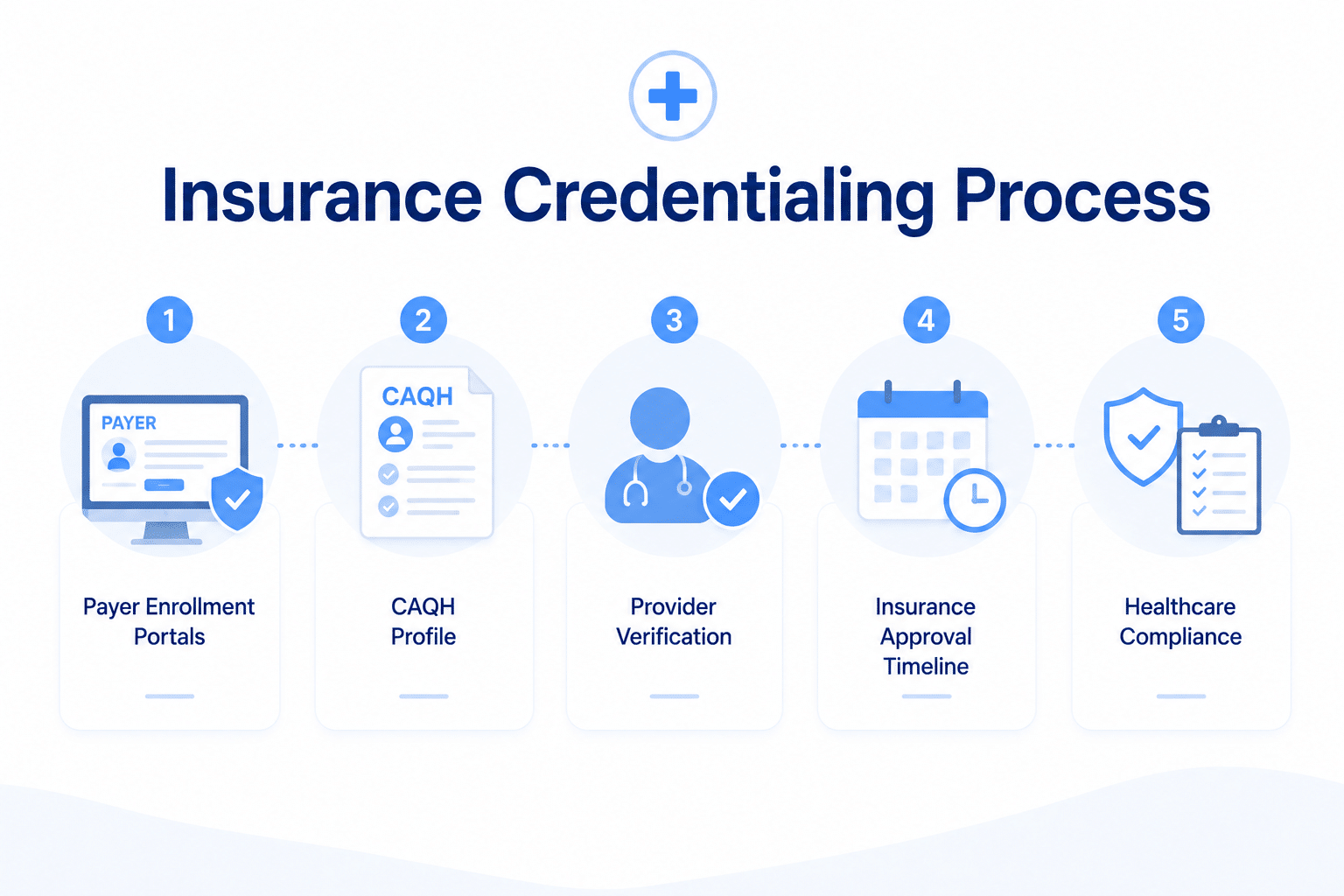
The insurance credentialing process for a new practice involves more than submitting provider documents. Commercial payer participation may require credentialing, contracting, provider and group enrollment, location setup, and a confirmed network effective date. Medicare and Medicaid follow separate enrollment processes. Practices should track each milestone individually before representing a provider as in-network.
Credentialing is one of the most important administrative workstreams when launching a healthcare practice, but it is also one of the most commonly misunderstood.
A payer may verify a provider’s qualifications and still have additional work remaining before claims can be submitted under the intended network arrangement. New practices should therefore build their payer strategy early, prepare provider and business information carefully, and track applications through final participation and effective-date confirmation.
What Is the Insurance Credentialing Process?
Insurance credentialing is the review of a healthcare professional’s qualifications by a health plan or its credentialing organization.
Depending on the provider and payer, the review may include:
- Professional licensure
- Education and training
- Work history
- Board certification when applicable
- Professional liability coverage
- DEA registration when applicable
- Hospital affiliations where relevant
- Professional sanctions or disciplinary history
- Malpractice history
- Other payer-specific qualification criteria
Credentialing is only one part of establishing insurance participation. The provider credentialing process should be distinguished from contracting, enrollment, affiliation, and billing activation.
Credentialing, Contracting, and Enrollment Are Different
New practices should avoid using the word “credentialing” to describe every payer-related task.
| Process | What It Generally Means |
|---|---|
| Credentialing | The payer or credentialing organization reviews the provider’s professional qualifications. |
| Contracting | The provider or organization establishes participation terms with the health plan. |
| Enrollment | The provider, group, location, and other required information are established in the payer’s administrative system. |
| Group affiliation | The individual provider is linked to the appropriate organization or billing arrangement when required. |
| Effective date | The date on which the applicable participation or enrollment status becomes effective according to the payer. |
A practice should not assume that a credentialing approval alone means the provider can immediately see patients as in-network under every plan. For a payer-specific example, see our Aetna credentialing process guide.
When Should a New Practice Start Insurance Credentialing?
Start planning before the intended opening date, but do not rely on one universal lead time for every payer.
The actual sequence depends on factors such as:
- Whether the legal entity has been formed
- Whether the organization and providers have the required NPIs
- Whether professional licenses are active
- Whether the practice location is established
- Whether the payer’s network is open
- Whether the payer accepts applications before the practice opens
- Whether contracting is handled separately
- Provider type and specialty
- State-specific requirements
The practical goal is to complete prerequisites early enough that applications can be submitted when the payer permits them, rather than waiting until patient scheduling has already begun.
New practices can also review our medical practice setup guide for the broader sequence of entity formation, licensing, technology, staffing, credentialing, and operational preparation.
Step 1: Decide Which Insurance Networks to Pursue
Do not automatically apply to every payer in the market.
Build a payer strategy around:
- Local patient demographics
- Employer-sponsored plans in the area
- Medicare and Medicaid population
- Specialty and service mix
- Referral sources
- Network availability
- Contract terms
- Administrative requirements
A network may also be closed to new providers in a particular specialty or geographic area. Credentialing preparation cannot override a payer’s network-availability decision.
Step 2: Complete the Basic Practice Setup
Payer applications often depend on information that should already be established during practice formation.
Depending on the payer and business structure, this may include:
- Legal business name
- Tax Identification Number
- Type 2 organizational NPI where applicable
- Type 1 provider NPIs
- Practice address
- Billing and mailing addresses
- Ownership information
- Banking information for EFT
- Professional licenses
- Professional liability insurance
Our healthcare practice setup document checklist covers the broader records a new clinic should organize.
Step 3: Prepare Provider Credentialing Documents
Credentialing requirements vary, but commonly requested provider information can include:
- Current professional license
- NPI information
- Education and postgraduate training
- Current curriculum vitae or work history
- Professional liability coverage
- DEA registration when applicable
- Board certification when applicable
- Hospital affiliations where relevant
- Professional references when requested
- Disclosure information
Some information will be verified directly from primary sources rather than accepted solely from documents submitted by the provider.
See our provider credentialing documents guide for a more detailed preparation checklist.
Step 4: Prepare and Maintain the CAQH Provider Data Portal
Many commercial health plans use the CAQH Provider Data Portal to obtain provider information for credentialing and related administrative processes.
CAQH is now presented under the DataSpring brand. According to DataSpring, participation in the Provider Data Portal itself is voluntary, although more than 1,000 health plans and other organizations have asked network providers to use it.
A provider profile may contain:
- Provider demographics
- Education and training
- Professional licenses
- Work history
- Practice locations
- Professional liability information
- DEA information when applicable
- Other professional data
Providers should also authorize the appropriate organizations to access the profile and maintain required attestations.
However, a complete CAQH profile does not mean the provider has been approved by an insurance company. The payer must still complete its own process.
Our CAQH Provider Data Portal guide explains this workflow in more detail.
Step 5: Submit the Payer’s Participation or Credentialing Request
Each payer can have a different onboarding pathway.
The process may begin through:
- An online provider portal
- A network participation form
- A credentialing application
- A roster process
- A contracting request
- A payer representative
Before submitting, confirm exactly what is being requested. A “join our network” request may initiate several administrative processes, while another payer may require separate credentialing and contracting steps.
Record the submission date and confirmation or reference number.
Step 6: Track Credentialing and Contracting Separately
Do not reduce every payer application to a single status such as “pending.”
A better tracker may include:
| Milestone | Status to Record |
|---|---|
| Network request | Requested, accepted for review, closed network, or additional information needed |
| Credentialing | Not started, pending, missing information, completed, or other payer status |
| Contracting | Not started, contract received, under review, signed, or executed |
| Enrollment | Provider/group/location setup status |
| Affiliation | Individual linked to the correct group, TIN, or location where required |
| Effective date | Written payer-confirmed participation date |
This structure makes it much easier to determine what is actually holding up a provider.
Step 7: Follow Up on Applications
Payers may request additional information while reviewing an application.
Keep a log containing:
- Submission date
- Application or case number
- Payer contact information
- Date of each follow-up
- Information requested
- Response submitted
- Next follow-up date
- Final determination
Follow-up does not guarantee faster approval, but it helps the practice identify missing information, closed cases, unresolved requests, or applications that require additional action.
Step 8: Review the Participation Agreement
When a commercial payer offers a participation agreement, review it carefully before execution.
Important provisions can include:
- Reimbursement methodology
- Participation obligations
- Covered products or networks
- Claims submission requirements
- Credential-maintenance obligations
- Notice requirements
- Termination provisions
- Amendment provisions
Contract terms vary, and a practice should obtain appropriate legal or financial review when needed.
Step 9: Confirm the Effective Date Before Marketing In-Network Status
One of the most important final steps is obtaining written confirmation of the provider’s participation status and effective date.
Confirm, where applicable:
- Provider name and NPI
- Group or organization
- Tax Identification Number
- Practice location
- Payer product or network
- Effective date
- Payer-assigned provider or group identifiers
Do not advertise a provider as participating solely because credentialing was approved or a contract was signed.
How Is Medicare Enrollment Different?
Medicare enrollment is not simply another commercial insurance credentialing application.
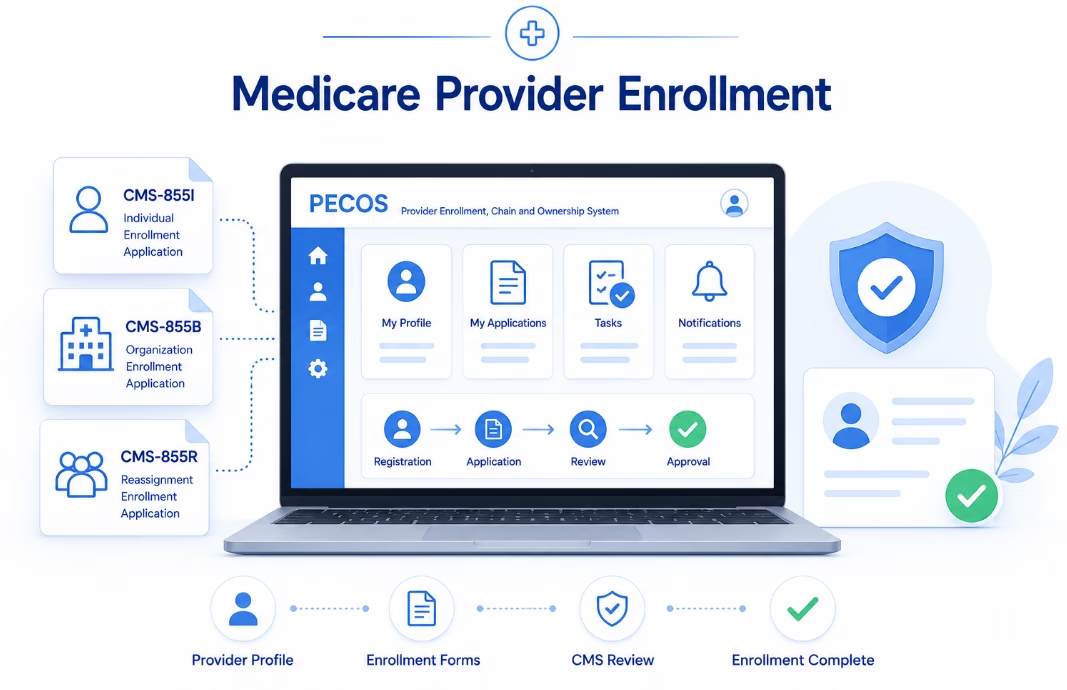
CMS uses the Provider Enrollment, Chain, and Ownership System, or PECOS, for Medicare enrollment management.
According to CMS, PECOS can be used to:
- Enroll as a Medicare provider or supplier
- Review enrollment information
- Upload supporting documents
- Electronically sign and submit applications
- Report enrollment changes
- Complete revalidation
CMS also explains that Medicare Administrative Contractors process enrollment applications for physicians, practitioners, groups, and many other provider and supplier types.
Practices working with Medicare should review our Medicare provider enrollment workflow guide rather than applying commercial credentialing assumptions to PECOS.
How Is Medicaid Enrollment Different?
Medicaid provider enrollment is administered by individual states within federal requirements.
This means that portals, applications, screening procedures, fees, ownership disclosures, fingerprinting requirements, site visits, and other enrollment steps may differ by state and provider type.
A practice enrolled with Medicare or a commercial payer should not assume that Medicaid participation is automatically established.
What About Hospital Credentialing and Privileging?
Hospital credentialing and privileging are separate from payer network participation.
A hospital may review a practitioner’s qualifications and grant specific clinical privileges that determine what services the practitioner may perform within that organization.
Insurance participation, by contrast, determines the provider’s relationship with a health plan.
A provider may therefore be:
- Licensed but not payer credentialed
- Payer credentialed but not yet contracted
- In-network with a payer but without privileges at a particular hospital
- Privileged at a hospital but not participating with a patient’s insurance network
These statuses should be managed independently.
Should a New Practice Outsource Insurance Credentialing?
Some practices manage credentialing internally, while others use an outside credentialing company or software platform.
Outside support may help with:
- Application preparation
- CAQH maintenance
- Document collection
- Payer follow-up
- Status tracking
- Renewal and recredentialing monitoring
Outsourcing does not give a vendor control over payer processing, network availability, credentialing decisions, contract terms, or effective dates.
The decision should therefore be based on internal staff capacity, number of providers, number of payers, complexity of enrollment, cost, and the need for ongoing tracking.
Common Insurance Credentialing Mistakes for New Practices
Applying before prerequisites are ready
Incomplete entity, location, licensing, NPI, banking, or provider information can create avoidable rework.
Assuming CAQH completion equals approval
CAQH stores and shares provider information. The payer still controls credentialing and participation decisions.
Using one status for the entire process
Credentialing approved, contract signed, provider loaded, and network effective are not interchangeable milestones.
Assuming every network is open
A payer may decide not to accept additional providers in a specialty, market, or network.
Scheduling insured patients before verifying effective status
Do not rely on an application submission or verbal assumption. Confirm the provider’s actual participation status and effective date.
Failing to maintain documentation after approval
Licenses, liability coverage, CAQH information, demographics, and other records continue to require maintenance after initial credentialing.
Insurance Credentialing Checklist for New Practices
| Item | What to Confirm |
|---|---|
| Practice entity | Legal name, TIN, ownership, addresses, and organization NPI where applicable |
| Provider file | Licenses, NPI, CV, training, liability insurance, and applicable credentials |
| CAQH | Profile complete, current, attested, and authorized for applicable organizations |
| Network availability | Payer is accepting the relevant provider type and specialty where applicable |
| Credentialing | Review status and unresolved requests |
| Contracting | Participation agreement status and applicable products |
| Enrollment | Provider, group, location, and payer-system setup |
| Affiliation | Provider linked correctly to the group or billing entity where required |
| Effective date | Written confirmation of the applicable network participation date |
Frequently Asked Questions
How long does insurance credentialing take?
There is no universal timeline. Processing depends on the payer, provider type, specialty, network availability, application completeness, contracting workflow, and whether additional verification is required. Practices should obtain payer-specific expectations rather than promise a fixed approval period.
Can a provider bill insurance as soon as credentialing is approved?
Not necessarily. Credentialing may be only one milestone. Contracting, enrollment, group affiliation, payer-system loading, and an applicable effective date may still need to be completed.
Is CAQH required for all insurance credentialing?
No. DataSpring states that participation in the CAQH Provider Data Portal itself is voluntary, although many health plans and healthcare organizations request that network providers use it for credentialing and administrative data.
Is Medicare credentialing done through CAQH?
Medicare enrollment is handled through CMS enrollment processes, primarily PECOS for online submissions. CAQH does not replace Medicare enrollment.
Does being credentialed with one payer mean the provider is approved with other payers?
No. Each payer or network controls its own participation requirements and decisions.
Can a payer refuse to credential a qualified provider?
A provider meeting professional qualification requirements does not automatically have a right to participate in every commercial network. Network availability, contracting criteria, provider need, and other payer requirements can affect participation.
Should a practice start seeing patients before payer enrollment is complete?
The practice should understand the patient’s benefits, the provider’s actual payer status, contractual restrictions, and financial implications before providing services under an assumed in-network arrangement. An application in progress should not be represented as active network participation.
How eClinicAssist Supports New-Practice Credentialing
New-practice payer enrollment can involve multiple providers, networks, documents, applications, contracts, follow-ups, affiliations, and effective dates.
eClinicAssist supports healthcare practices with provider credentialing, payer enrollment, contracting coordination, CAQH management, provider documentation, Medicare and Medicaid enrollment administration, follow-up tracking, and related administrative workflows.
eClinicAssist does not control network availability, payer credentialing decisions, contract terms, enrollment effective dates, or reimbursement.
Contact eClinicAssist to discuss credentialing and payer enrollment support for your new healthcare practice.
This article provides general administrative information and is not legal, financial, billing, or compliance advice. Credentialing, contracting, enrollment, network participation, and reimbursement requirements vary by payer, provider type, state, plan, and service. Verify current requirements directly with the applicable payer or government program.