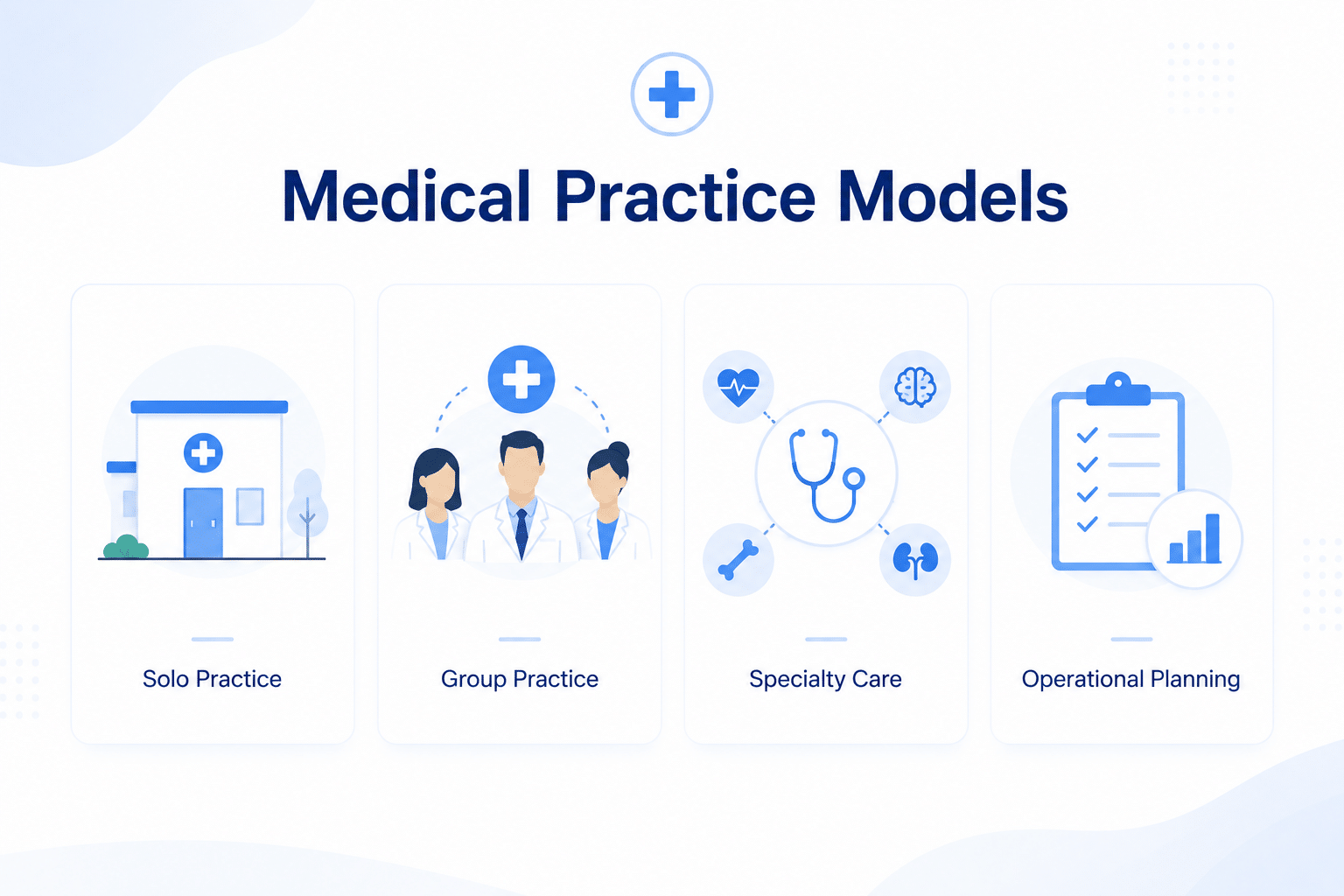
Choosing a medical practice model requires more than deciding between solo and group practice. Providers should evaluate ownership, employment status, specialty, payment model, care-delivery method, payer strategy, staffing, overhead, and long-term growth plans. The right structure is the one that fits the provider’s clinical goals, market, financial capacity, and desired level of business responsibility. For practices planning to attract patients and grow, explore our healthcare practice marketing guide.
A medical practice can combine several models at once. For example, a physician may own a solo primary care clinic, participate with commercial insurance plans, offer some services through telehealth, and eventually add another provider.
Thinking about these decisions separately makes it easier to build a practice structure that can actually support the way you intend to deliver care.
Why Choosing a Medical Practice Model Matters
Your practice model affects far more than the name on the door. It can influence:
- Ownership and decision-making authority
- Startup and ongoing operating costs
- Staffing requirements
- Provider compensation
- Payer credentialing and enrollment
- Billing and collections
- Technology requirements
- Office space
- Scheduling and patient capacity
- Expansion into additional providers or locations
Providers who are still working through the overall launch process should also review our guide to starting a medical practice before finalizing the operating model.
Start by Separating the Different Practice Decisions
One of the easiest mistakes is treating every practice characteristic as the same type of decision.
| Decision | Examples |
|---|---|
| Ownership or employment | Solo owner, group owner, employed physician, health-system employee |
| Clinical focus | Primary care, urgent care, behavioral health, cardiology, dermatology, other specialties |
| Payment model | Insurance-based fee-for-service, direct primary care, concierge, cash-pay, or a permitted combination |
| Care delivery | Office-based, facility-based, home-based, telehealth, mobile, or hybrid |
| Payer strategy | Commercial insurance, Medicare, Medicaid, self-pay, or selected payer participation |
A practice may combine choices from several rows. That is why there is no single list of practice models that fits every healthcare organization.
Solo Practice: Maximum Ownership Control
In a solo practice, one provider typically owns or controls the practice rather than sharing ownership with other clinicians.
This model can provide substantial control over:
- Clinical scheduling
- Hiring decisions
- Technology choices
- Office policies
- Payer participation strategy
- Growth decisions
The tradeoff is that ownership responsibility is concentrated. The owner must ensure that billing, payroll, compliance, credentialing, patient access, staffing, technology, and vendor management are handled effectively, whether personally, by employees, or through outside vendors.
Who may prefer a solo practice?
Solo ownership may appeal to a provider who places a high value on independent decision-making and is comfortable assuming responsibility for the business side of the practice.
Before launching, calculate the cost of staff, rent, technology, professional services, insurance, supplies, and the period before insurance collections become consistent.
Group Practice: Shared Ownership or Shared Infrastructure
A group practice generally brings multiple providers together within one organization. Groups can be single-specialty or multispecialty, and providers may be owners, employees, or a combination of both.
The American Medical Association identifies solo ownership, equity ownership in a group, and employment by a group, hospital, health system, or academic institution as distinct physician practice options.
Potential advantages of a group structure can include shared administrative resources, broader scheduling coverage, shared overhead, and greater capacity. However, those benefits depend on how the group is structured.
Before entering a group ownership arrangement, clarify:
- Ownership percentages
- Voting and governance rights
- Provider compensation methodology
- Responsibility for expenses
- Hiring authority
- Admission of new owners
- Departure or buyout provisions
- Allocation of shared staff and resources
These are legal and financial matters, so appropriate legal and accounting advice should be obtained when establishing the entity and ownership agreements.
Employed Practice: Less Ownership Responsibility
A provider does not have to own a practice to choose a practice setting.
Physicians and other healthcare professionals may work as employees of:
- Independent medical groups
- Hospitals
- Health systems
- Academic medical centers
- Community health organizations
- Other healthcare organizations
Employment can reduce direct responsibility for certain business functions, but it also generally gives the provider less control over organizational policies, compensation structures, scheduling, staffing, and strategic decisions.
Employment agreements should be reviewed based on the actual compensation structure, productivity expectations, restrictive provisions, benefits, scheduling requirements, malpractice arrangements, and termination terms.
Primary Care or Specialty Practice?
Clinical focus is a separate decision from ownership.
A solo practice can provide primary or specialty care. A group can also be single-specialty or multispecialty.
Primary care considerations
Primary care practices may provide family medicine, internal medicine, pediatric, geriatric, or other longitudinal care services depending on provider qualifications.
Planning considerations may include:
- Expected patient panel
- Preventive and chronic-care workload
- Same-day appointment capacity
- Local payer mix
- Staffing requirements
- Care coordination needs
Specialty practice considerations
Specialty practices should evaluate factors such as:
- Referral sources
- Procedure mix
- Equipment requirements
- Facility relationships
- Prior authorization workload
- Specialty-specific payer networks
- Local demand and competition
Do not choose a specialty business model based solely on assumed reimbursement. Revenue potential must be considered together with overhead, payer contracts, procedure costs, staffing, utilization, and patient demand.
Insurance-Based Practice
Many practices participate with Medicare, Medicaid, commercial insurers, or a combination of payer types.
An insurance-based model introduces important administrative work before opening, including provider credentialing, payer enrollment, contracting, demographic setup, and confirmation of network effective dates.
Practices should begin evaluating their payer strategy early. Our guide to insurance credentialing for new practices explains the enrollment work that often accompanies a new clinic launch.
Do not assume that submitting an application means a provider is immediately in-network. Credentialing, contracting, enrollment, and effective dates can be separate milestones.
Direct Primary Care
Direct primary care, or DPC, is a primary care practice and payment model in which patients or their employers generally pay the practice a recurring fee for a defined range of primary care services.
The American Academy of Family Physicians describes DPC as an alternative to traditional fee-for-service insurance billing, typically using monthly, quarterly, or annual payments.
DPC practices should clearly define:
- Services included in the membership
- Services charged separately
- Membership termination terms
- After-hours access
- Laboratory and medication arrangements
- How services outside the practice are handled
State laws governing direct-care arrangements vary. Providers considering DPC should evaluate state insurance laws, Medicare implications when applicable, contracts, and other legal requirements before adopting the model.
Concierge Medicine
Concierge medicine and direct primary care should not automatically be treated as the same model.
Concierge practices generally charge a membership or retainer for enhanced access or specified services and may continue participating with insurance plans for separately covered medical services, depending on how the practice is structured.
A provider considering concierge medicine should carefully define what the membership purchases and ensure that fees and covered services are structured consistently with applicable payer contracts and government-program requirements.
What About FQHCs and Community Health Centers?
A Federally Qualified Health Center is not simply another private-practice ownership option.
Organizations seeking Health Center Program funding or FQHC Look-Alike designation must satisfy extensive Health Resources and Services Administration requirements. Eligible organizations generally must be public agencies or private nonprofit entities and meet requirements involving governance, underserved populations, services, sliding fee discounts, and other program standards.
A provider can work for an FQHC, but creating an FQHC involves a fundamentally different organizational and regulatory pathway from opening a conventional independent medical practice.
Is Telehealth a Medical Practice Model?
Telehealth is better viewed as a method of delivering care than as an ownership structure.
A solo practice, group practice, hospital-employed practice, behavioral health clinic, or DPC practice can all potentially use telehealth.
A practice operating across state lines must also consider professional licensing requirements. HHS explains that interstate telehealth authority varies by state and may involve full licensure, temporary-practice provisions, reciprocity, interstate compacts, or telehealth registrations.
Telehealth practices should also evaluate professional liability coverage, payer reimbursement, technology, privacy, and prescribing requirements applicable to their services.
Compare Common Practice Structures
| Model | Potential Advantage | Important Consideration |
|---|---|---|
| Solo owner | High degree of business control | Owner carries substantial operational responsibility |
| Group ownership | Shared infrastructure and resources | Governance and compensation must be clearly defined |
| Employed provider | Less direct responsibility for practice operations | Less control over organizational decisions |
| Insurance-based | Access to patients using participating health plans | Credentialing, contracting, billing, and payer administration |
| Direct primary care | Recurring direct-payment structure for defined primary care services | Membership design and state-specific legal requirements |
| Concierge | Membership-based enhanced access or services | Membership services and insurance billing must be clearly separated where applicable |
| Telehealth or hybrid | Ability to deliver some services remotely | Licensing, technology, payer, privacy, and state requirements |
How Should You Choose a Medical Practice Model?
1. Define how much ownership responsibility you want
Decide whether you want to control business operations yourself, share ownership with partners, or work within an established organization.
2. Define your patient population and services
Identify the services you intend to provide and the patient population you expect to serve. That decision affects staffing, space, technology, licenses, equipment, and payer strategy.
3. Study the local market
Evaluate local demographics, competing practices, referral patterns, payer mix, network availability, and demand for your services.
A market with a large population does not automatically guarantee sufficient demand for a particular practice.
4. Build a realistic operating budget
Estimate both startup and ongoing expenses, including:
- Rent and buildout
- Staffing and payroll
- EHR and practice-management technology
- Medical equipment and supplies
- Professional liability coverage
- Licensing and credentialing expenses
- Accounting and legal services
- Marketing
- Billing and revenue-cycle expenses
- Working capital
A practice should have a plan for operating while payer enrollment and early collections are still developing.
5. Plan staffing around the actual workflow
Do not hire based only on what similar clinics appear to have. Map patient scheduling, registration, clinical support, referrals, authorizations, billing, phone coverage, and administrative tasks first.
Our healthcare practice staffing guide explains how staffing decisions fit into a new-practice launch.
6. Plan technology before opening
Your EHR, practice-management system, clearinghouse, patient communications, telehealth tools, cybersecurity controls, payment systems, and other technology should fit the practice you are building.
See our healthcare technology systems guide for the major systems a new practice should evaluate.
7. Decide which payers you actually want to pursue
Being contracted with every available payer is not automatically the right strategy.
Consider:
- Patient demographics
- Local employer plans
- Medicare and Medicaid population
- Whether networks are open
- Contract terms
- Administrative requirements
- Expected utilization
Your payer strategy should support the patient population and services you intend to build around.
Questions to Ask Before Finalizing the Model
- Do I want to own the practice or work within an existing organization?
- Will I practice alone or add providers?
- Which clinical services will the practice provide?
- Who is the target patient population?
- Will the practice participate with insurance?
- Does a membership or direct-payment model make sense for the services offered?
- Will care be office-based, telehealth, home-based, facility-based, or hybrid?
- What staffing level can the practice support?
- How much working capital is available?
- Do I want additional locations later?
- Could additional owners join the practice?
- What administrative responsibilities will be handled internally or outsourced?
Frequently Asked Questions
Is a solo practice better than a group practice?
Neither model is universally better. Solo ownership can provide greater control, while a group may allow providers to share infrastructure and responsibilities. The better choice depends on finances, governance preferences, specialty, workload, and long-term goals.
Is direct primary care the same as concierge medicine?
No. Both can involve recurring patient fees, but direct primary care generally uses the fee to cover a defined set of primary care services and typically operates outside traditional fee-for-service insurance billing. Concierge practices may continue billing insurance for covered services while charging a separate membership fee for additional access or services.
Can a medical practice use both insurance and self-pay?
Potentially, yes, but the arrangement must account for payer contracts, government-program rules, patient financial policies, and applicable state and federal requirements. The model should be reviewed before implementation rather than assuming every combination is permitted.
Is telehealth considered a separate practice model?
Telehealth is primarily a care-delivery method. It can be incorporated into solo, group, employed, insurance-based, membership, and other practice structures.
Should payer credentialing begin before the practice opens?
Usually, payer enrollment planning should begin well before the intended launch because credentialing, contracting, enrollment, and effective-date processes can take time. The exact sequence depends on the payer and whether the business entity, locations, licenses, NPIs, and other prerequisites are ready. Our medical office location planning guide covers another important part of preparing for launch.
Can a for-profit private practice become an FQHC?
HRSA Health Center Program applicants and organizations seeking Look-Alike designation generally must be public agencies or private nonprofit entities and must meet additional federal program requirements. A conventional for-profit medical practice should not assume FQHC status is simply another reimbursement model it can elect.
Build the Model Before Building the Workflow
Choosing a medical practice model is ultimately a series of connected decisions about ownership, clinical services, payment, care delivery, staffing, technology, and payer participation.
Making those decisions early gives the practice a clearer foundation for licensing, credentialing, payer enrollment, staffing, and technology implementation.
eClinicAssist supports healthcare practices with professional licensing administration, provider credentialing, payer enrollment, CAQH management, documentation, and related practice-setup workflows.
Contact eClinicAssist to discuss credentialing and payer enrollment support for a new or expanding healthcare practice.
This article provides general business and administrative information and is not legal, tax, accounting, financial, or clinical advice. Ownership structures, corporate-practice rules, membership models, licensing requirements, and payer obligations vary by state and circumstance. Consult qualified legal, tax, accounting, and regulatory professionals when establishing a medical practice.