
Telehealth credentialing for multi-state medical groups is not one credentialing application repeated across several states. It requires coordinated tracking of each provider’s legal authority to practice, patient-state requirements, payer credentialing, network participation, group affiliation, practice locations, products, and effective dates. The safest operational model is a provider-state-payer matrix rather than a single “credentialed” status. For related steps, review our telehealth credentialing requirements and multi-state credentialing process guides.
A medical group with one provider in one state may be manageable with a basic credentialing tracker.
A medical group with 15 providers treating telehealth patients in six states is a completely different operation.
The number of relationships grows quickly because every provider can have a different combination of:
- State licenses
- Telehealth registrations
- Professional scope requirements
- Payer networks
- Group affiliations
- Practice locations
- Network products
- Effective dates
This is why multi-state telehealth groups need a credentialing architecture, not just a checklist.
What Makes Multi-State Telehealth Credentialing Different?
Traditional credentialing often starts with one provider, one organization, and a defined geographic service area.
Multi-state telehealth adds another dimension: the patient’s location at the time of care.
HHS identifies several possible pathways for legal cross-state practice, including:
- Full state licensure
- Temporary-practice laws
- Licensure reciprocity
- Interstate licensure compacts
- Telehealth registration
The available pathway depends on the state and provider profession.
Why Patient Location Matters in Telehealth
For interstate telehealth, the patient’s physical location is a critical licensing question.
Before the encounter, the group should know:
- Where the patient is physically located
- Whether the provider has legal authority to practice there
- Whether any state-specific telehealth requirements apply
- Whether the payer covers the service under the intended arrangement
A patient traveling to another state can therefore create a different licensure situation even when the provider and medical group have not changed locations.
Build a Provider-State Matrix Before You Build a Payer Matrix
The first operational layer should answer one question:
Where can each provider legally furnish telehealth services?
| Provider | Texas | Florida | Arizona | Colorado |
|---|---|---|---|---|
| Provider A | Licensed | Licensed | Not authorized | Registration pending |
| Provider B | Licensed | Not authorized | Licensed | Not authorized |
| Provider C | Licensed | Application pending | Not authorized | Licensed |
The actual tracker should also record:
- License or registration number
- Issue date
- Expiration date
- Renewal requirement
- Controlled-substance authority where applicable
- Any practice restrictions
Can Interstate Compacts Simplify Multi-State Telehealth?
Yes, for eligible providers and participating states.
However, a compact should not be interpreted as one universal license for every profession.
Compacts are profession-specific and operate under their own eligibility rules.
How the IMLC Works for Physicians
The Interstate Medical Licensure Compact provides an expedited licensing pathway for eligible physicians.
It does not issue one national physician license.
An eligible physician uses the Compact process and receives separate licenses from the participating states selected by the physician.
Those licenses remain state licenses and remain subject to the rules of the issuing states.
Do Multi-State Groups Need Full Licenses in Every State?
Not necessarily.
Depending on the profession and jurisdiction, a provider may be able to use:
- A full state license
- An interstate compact
- A telehealth registration
- Reciprocity
- A limited temporary-practice provision
The correct pathway must be determined for the specific provider profession and patient state.
See our telehealth licensure requirements guide for the licensing side of interstate care.
Why One Credentialing Status Is Not Enough
A provider should not simply appear in the group’s tracker as:
Credentialed: Yes
That status is too broad for a multi-state telehealth organization.
The same provider could be:
- Licensed in Texas
- Not licensed in Florida
- Credentialed by a payer nationally
- Active under the payer’s Texas product
- Not affiliated with the group’s Arizona location
- Pending a Medicaid MCO in another state
All of those facts can be true at the same time.
Build a Provider-State-Payer Matrix
After establishing state practice authority, add the payer layer.
| Provider | State | Payer | Credentialing | Group Affiliation | Location | Effective Date |
|---|---|---|---|---|---|---|
| Provider A | Texas | Payer 1 | Approved | Approved | Active | Confirmed |
| Provider A | Florida | Payer 1 | Approved | Pending | Pending | Not confirmed |
| Provider B | Texas | Payer 2 | Pending | Not started | Active | Not confirmed |
This immediately shows why “Payer 1 approved Provider A” is not enough information.
Does a National Payer Credential a Provider Once for Every State?
Not necessarily.
A payer may use centralized credentialing while still maintaining different administrative requirements for:
- State networks
- Products
- Contracts
- Groups
- Practice locations
- Medicaid plans
- Effective dates
A centralized credentialing approval therefore should not automatically be interpreted as nationwide network participation.
Credentialing vs Enrollment vs Group Affiliation in Telehealth
| Process | What It Answers |
|---|---|
| Credentialing | Does the provider meet the organization’s professional qualification requirements? |
| Contracting | What participation terms apply between the payer and organization? |
| Enrollment | Has the provider or organization been administratively established with the payer? |
| Group affiliation | Is the provider linked to the correct group or TIN? |
| Location activation | Is the correct service location recognized by the payer? |
| Effective date | When does the applicable payer relationship become active? |
See our provider enrollment process guide for a deeper explanation of enrollment.
Why Practice Locations Still Matter for Telehealth Groups
Telehealth does not eliminate practice-location administration.
Payers and government programs may still maintain provider and organization records involving:
- Service locations
- Billing locations
- Mailing addresses
- Group NPIs
- TIN relationships
Location requirements are payer-specific.
Do not assume a provider can simply be moved from one state’s operation to another because the encounter occurs virtually.
How Should Medicaid Be Managed Across States?
State Medicaid should be treated as a separate workstream for each state.
Depending on the state, the group may need to manage:
- Individual provider enrollment
- Group enrollment
- Provider-to-group affiliation
- Location enrollment
- Managed care organization credentialing
- MCO contracting
- MCO effective dates
Enrollment in one state’s Medicaid program does not create participation in another state’s program.
How Should Medicare Be Tracked for Multi-State Telehealth?
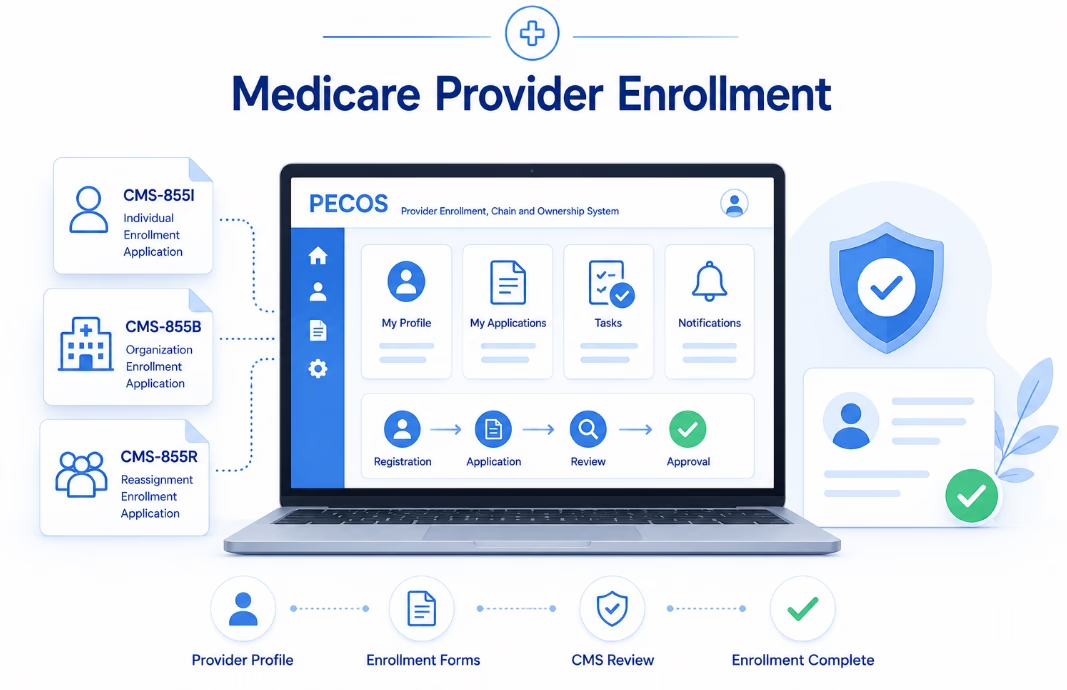
Medicare enrollment should be tracked separately from state licensure and commercial credentialing.
Depending on the organization’s structure, relevant records can include:
- Individual practitioner Medicare enrollment
- Group enrollment
- Reassignment relationships
- Practice locations
- Reportable changes
Do not treat Medicare enrollment as proof that the provider is legally authorized to treat a patient located in every state.
What Should Be Centralized Across the Medical Group?
A multi-state organization benefits from centralizing information that is shared across states and payers.
This can include:
- Provider demographics
- NPI
- Education
- Training
- Board certification
- Work history
- Professional liability information
- CAQH records
- Core provider documents
A centralized provider file reduces repeated document collection.
What Should Remain State-Specific?
Other information should remain tied to the applicable jurisdiction.
Examples include:
- Professional license
- Telehealth registration
- State controlled-substance registration
- State Medicaid enrollment
- State payer network
- State-specific product participation
The goal is centralized management without erasing state-specific differences.
How Should Multi-State Telehealth Groups Manage CAQH?
CAQH can centralize much of the provider’s professional information for commercial payer credentialing.
However, a current CAQH profile does not mean:
- The provider is licensed in every patient state
- Every payer approved credentialing
- The provider is affiliated with every group
- Every practice location is active
- Every payer product is effective
CAQH should therefore be one component of the provider-state-payer workflow.
What Should a Multi-State Telehealth Credentialing Dashboard Show?
A useful dashboard should allow staff to answer four questions quickly.
1. Can the provider legally practice in this state?
Track the applicable license, registration, compact pathway, expiration, and any relevant restrictions.
2. Has the payer credentialed the provider?
Track submission, review, outstanding requests, decision, and recredentialing status.
3. Is the provider connected to the correct group and location?
Track TIN, NPI, group affiliation, service locations, and products separately.
4. When is the payer relationship effective?
Never assume an effective date from the application date or credentialing approval date.
Record the date confirmed by the payer.
What Is the Biggest Scaling Mistake?
The biggest mistake is copying the single-state workflow into additional states without redesigning the tracking structure.
For example:
A group with 20 providers, 5 states, and 8 payers can potentially create hundreds of provider-state-payer relationships.
Even though not every combination will apply, a simple spreadsheet column labeled “credentialing status” quickly becomes inadequate.
Common Multi-State Telehealth Credentialing Mistakes
Assuming One License Covers Every State
Interstate practice authority must be evaluated for each patient jurisdiction.
Calling an IMLC License a National License
The IMLC expedites access to separate state licenses.
Assuming One National Payer Means One National Network Status
State networks, products, groups, locations, and effective dates can differ.
Tracking Only the Provider
Track the provider-state-payer relationship instead.
Ignoring Patient Location
The patient’s physical location at the time of the telehealth encounter is critical for interstate licensure analysis.
Confusing Credentialing With Legal Practice Authority
A payer’s credentialing approval does not replace state licensure or another lawful interstate-practice pathway.
Assuming Group Contracting Automatically Adds New Providers
Providers may still require credentialing, enrollment, affiliation, location setup, or other payer action.
Starting Billing From the Credentialing Approval Date
Use the payer’s confirmed effective date.
Treating Medicaid Like a National Program
Medicaid enrollment and managed care participation remain state-specific.
Multi-State Telehealth Launch Checklist
| Area | What to Confirm |
|---|---|
| Patient states | States where telehealth patients will actually be located |
| Provider authority | License, compact pathway, registration, or other permitted authority |
| Scope | Provider may perform intended services under applicable state rules |
| Payer strategy | Target networks and products identified by state |
| Credentialing | Provider qualification review tracked by payer |
| Contracting | Applicable participation arrangement confirmed |
| Group affiliation | Provider linked to correct organization and TIN |
| Locations | Required payer practice locations active |
| Medicaid | State and MCO relationships handled separately |
| Medicare | Enrollment, reassignment, and location records reviewed where applicable |
| Effective dates | Confirmed for each applicable payer relationship |
| Renewals | Licenses, registrations, credentials, and payer maintenance dates monitored |
Frequently Asked Questions
What is telehealth credentialing for multi-state medical groups?
It is the coordinated management of provider qualifications, state practice authority, payer credentialing, enrollment, group affiliations, locations, products, and effective dates for organizations delivering telehealth across multiple states.
Does a telehealth provider need a license in every patient state?
The provider must have legal authority to practice in the patient’s state. Depending on the jurisdiction and profession, that may involve full licensure, a compact, telehealth registration, reciprocity, or another state-authorized pathway.
Does the IMLC give physicians one multi-state license?
No. Eligible physicians use the IMLC as an expedited pathway to obtain separate licenses from participating states.
Does one payer credentialing approval cover every state?
Not necessarily. Credentialing may be centralized while state networks, products, contracts, affiliations, locations, and effective dates remain separate.
Does CAQH replace multi-state credentialing?
No. CAQH can centralize provider professional information, but state licensure, payer review, enrollment, affiliation, and effective dates remain separate.
Does Medicare enrollment allow a provider to practice telehealth in every state?
No. Medicare enrollment and state practice authority are separate issues.
Does Medicaid enrollment transfer between states?
No. Medicaid enrollment is state-specific, and Medicaid managed care plans may add separate requirements.
What is the best way to track multi-state telehealth credentialing?
Use a provider-state-payer matrix that separately tracks legal practice authority, credentialing, contracting, group affiliation, location status, products, and effective dates.
Scale Multi-State Telehealth With a Provider-State-Payer Model
The central challenge in multi-state telehealth credentialing is not collecting more documents.
It is maintaining control over hundreds of relationships that do not all move together.
A scalable medical group should know, for every relevant provider-state-payer combination:
- Whether the provider may legally practice in the state
- Whether payer credentialing is complete
- Whether the appropriate contract or network applies
- Whether the provider is affiliated with the correct group
- Whether the correct location and product are active
- What effective date applies
- Which renewal or maintenance deadline comes next
That structure is far more reliable than labeling a provider simply “credentialed.”
eClinicAssist supports healthcare organizations with multi-state credentialing administration, licensing tracking, CAQH management, payer enrollment, provider and facility relationships, group affiliations, document tracking, application follow-up, and payer effective-date management.
eClinicAssist does not issue professional licenses, determine whether interstate practice is legally permitted, make payer credentialing decisions, or guarantee network participation, approval timelines, or reimbursement.
Contact eClinicAssist to discuss multi-state telehealth credentialing and payer enrollment support for your organization.
This article provides general administrative information and is not legal, licensing, telehealth, billing, clinical, or payer-specific advice. Interstate practice requirements vary by profession, state, patient location, payer, government program, and organization. Verify current requirements with the applicable licensing board, payer, CMS, Medicaid agency, or other responsible authority.