
Pre-Revenue Cycle Management, or Pre-RCM, describes the work performed before a claim reaches the payer. In practice, it can include two connected areas: provider readiness, such as credentialing and payer enrollment, and front-end patient access, such as registration, eligibility verification, benefits review, authorization, and financial clearance. For an example of managing provider readiness, see our guide to outsourcing nurse practitioner credentialing.
Healthcare organizations often focus on denials after claims are submitted. However, many claim problems originate earlier.
A provider may not be active under the correct payer arrangement. A patient’s coverage may be inactive. Prior authorization may be missing. Registration data may be wrong. The billing team may receive an encounter that was never financially cleared correctly.
These upstream processes are why Pre-RCM deserves attention.
What Is Pre-Revenue Cycle Management?
Pre-Revenue Cycle Management is a practical term used to describe administrative work performed before downstream claim processing.
There is no single universal industry definition of Pre-RCM.
HFMA generally describes the front end of the revenue cycle around functions such as:
- Scheduling
- Pre-registration
- Insurance verification
- Authorization
- Financial clearance
- Registration
- Patient financial counseling
- Pre-service collections
For medical practices, it is also useful to recognize a separate upstream provider-readiness layer that can influence whether claims can ultimately be billed correctly.
This includes:
- Professional licensing
- Provider credentialing
- Payer enrollment
- Commercial contracting
- Group affiliation
- Practice-location setup
- Effective-date confirmation
Together, these workflows create the administrative conditions needed for a cleaner transition into billing.
Pre-RCM at a Glance
| Area | Primary Question | Examples |
|---|---|---|
| Provider readiness | Is the provider properly established for the intended payer and billing arrangement? | Credentialing, enrollment, contracting, affiliation, location, effective date |
| Patient access | Is the patient correctly registered and financially cleared before service? | Scheduling, demographics, eligibility, benefits, authorization, referrals |
| Pre-service financial workflow | Are coverage and expected financial responsibilities understood before the encounter? | Benefit review, estimates, financial counseling, patient responsibility |
Why Does Pre-RCM Matter?
The front end of the revenue cycle supplies information used later in claims processing.
HFMA identifies patient access functions such as payer eligibility, insurance verification, pre-registration, authorization, and financial clearance as core revenue-cycle activities.
If those functions are incomplete or inaccurate, downstream teams may face:
- Claim rejections
- Coverage-related denials
- Authorization denials
- Registration corrections
- Provider-enrollment investigations
- Patient billing disputes
- Additional administrative rework
Pre-RCM should therefore be viewed primarily as a way to improve upstream accuracy and readiness, not as a guarantee of payment.
What Is the Difference Between Provider Readiness and Patient Access?
This distinction makes Pre-RCM much easier to manage.
Provider readiness
Provider readiness focuses on whether the practitioner and organization are correctly established before billing begins.
Examples include:
- Professional license status
- Credentialing status
- Commercial payer enrollment
- Medicare enrollment
- Medicaid enrollment
- Group affiliation
- Practice location
- Network effective date
Patient access
Patient access focuses on the individual encounter.
Examples include:
- Correct patient demographics
- Active insurance
- Benefit verification
- Authorization
- Referral requirements
- Registration
- Financial clearance
Both matter, but they solve different problems.
1. Provider Credentialing
Provider credentialing reviews and verifies a healthcare professional’s qualifications.
Depending on the payer or organization, this may include:
- Professional license
- Education
- Training
- Work history
- Board certification where applicable
- Professional liability coverage
- Sanctions and disciplinary history
- DEA registration where applicable
Credentialing alone does not establish every billing relationship.
A provider may still need enrollment, contracting, affiliation, location setup, or an effective date before the intended payer arrangement is active.
See our provider credentialing process guide for the full workflow.
2. Payer Enrollment and Billing Readiness
Provider enrollment establishes the provider or organization within the payer’s administrative system.
Depending on the payer, enrollment may include:
- Individual NPI
- Organizational NPI
- TIN
- Practice locations
- Specialty
- Group relationship
- Ownership information
- Billing relationships
Commercial payer enrollment should not automatically be equated with network contracting.
A provider may also need:
- Credentialing approval
- An executed contract
- Group affiliation
- Network-product participation
- A confirmed effective date
For a deeper explanation, see our provider enrollment process guide.
3. Medicare Enrollment
Medicare enrollment should be managed separately from commercial credentialing.
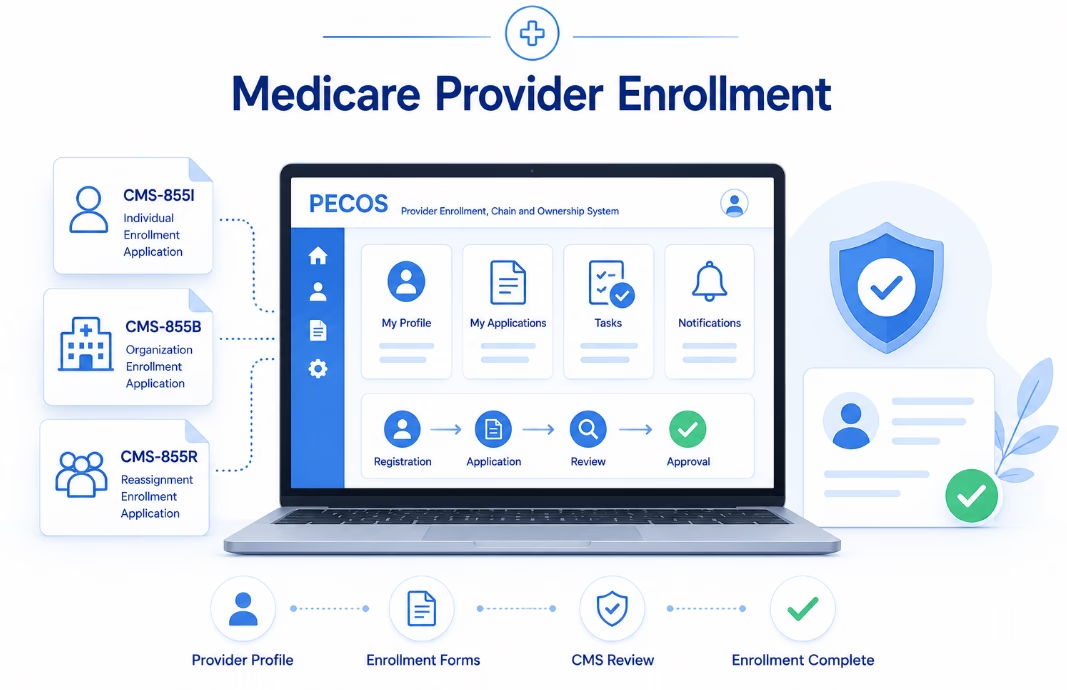
CMS uses PECOS as the online Medicare enrollment management system.
Through PECOS, eligible providers and suppliers can:
- Enroll in Medicare
- Review existing enrollment information
- Submit supporting documentation
- Report enrollment changes
- Complete revalidation
Medicare Administrative Contractors process Medicare enrollment applications for applicable providers and suppliers.
That means commercial credentialing, commercial enrollment, and Medicare enrollment should not be stored as one generic “payer credentialing” status.
4. Licensing and Credential Expiration Management
Professional licensing is another upstream requirement that should be monitored separately.
Depending on the provider, practices may need to track:
- Professional license
- DEA registration where applicable
- Professional liability coverage
- Board certification where applicable
- Other provider-specific credentials
These credentials do not all follow the same renewal schedule or create the same consequences when they lapse.
The appropriate response depends on the credential, provider type, state, payer, and service involved.
See our credential expiration management guide for a structured approach.
5. Patient Registration and Demographic Accuracy
Patient registration is one of the clearest front-end revenue cycle functions.
Important information may include:
- Patient name
- Date of birth
- Address
- Insurance member ID
- Group number
- Subscriber information
- Relationship to subscriber
- Other insurance coverage
Incorrect demographic or insurance data can prevent a claim from matching the payer’s records or create avoidable follow-up.
Registration quality should therefore be treated as a revenue-cycle control, not merely a front-desk clerical task.
6. Eligibility Verification
Eligibility verification confirms whether insurance coverage is active for the relevant date of service.
A useful eligibility workflow may confirm:
- Coverage status
- Plan or product
- Effective dates
- Copayment
- Deductible information
- Coinsurance
- Benefit limitations where available
- Other insurance information
Eligibility should not be confused with authorization.
A patient can be eligible for coverage while a specific service still requires prior authorization.
7. Benefits Verification
Active insurance does not automatically mean a particular service is covered.
Benefit review may involve checking:
- Whether the service is covered
- Network requirements
- Deductible and coinsurance
- Frequency limits
- Visit limits
- Referral requirements
- Authorization requirements
The level of detail available varies by payer and benefit-verification method.
8. Prior Authorization and Referral Management
Authorization is another major front-end function.
HFMA specifically tracks authorization as a revenue-cycle performance area.
Practices should confirm:
- Whether authorization is required
- Requested service
- Approved service
- Units
- Date range
- Provider when applicable
- Location when applicable
- Authorization number
An authorization is not a guarantee of payment, but failure to obtain a required authorization can create an avoidable denial risk.
9. Financial Clearance
Financial clearance brings together important pre-service information so the organization can identify unresolved coverage or financial issues before the encounter.
Depending on the practice, this may include:
- Eligibility verification
- Benefit information
- Authorization status
- Referral status
- Patient financial responsibility
- Insurance coordination issues
The exact process depends on the organization’s services and payer mix.
10. Provider and Payer Data Integrity
Provider data should be accurate across the systems where it is used.
Examples include:
- NPPES
- CAQH Provider Data Portal
- PECOS
- Commercial payer portals
- EHR
- Practice-management system
- Clearinghouse setup
However, these systems do not all serve the same purpose.
The goal should not be to make every field mechanically identical everywhere. The goal is to ensure each system accurately reflects the provider’s current professional, enrollment, and billing arrangement.
What Pre-RCM Problems Can Lead to Claim Denials?
| Pre-RCM Issue | Possible Downstream Problem |
|---|---|
| Inactive patient coverage | Eligibility denial |
| Missing required authorization | Authorization denial |
| Incorrect member information | Claim rejection or eligibility mismatch |
| Provider not linked to group | Enrollment or provider-status denial |
| Incorrect practice location | Provider or network processing issue |
| Wrong insurance sequence | Coordination-of-benefits denial |
| Incomplete registration | Claim rejection or rework |
Not every denial originates in Pre-RCM. Coding, medical necessity, documentation, timely filing, payer edits, and other downstream issues can also cause claims to deny.
How Should Credentialing and Billing Teams Work Together?
Provider-readiness information should reach the billing team before claims are submitted.
The credentialing or enrollment team should communicate:
- Payer approval status
- Group affiliation
- Network product
- Practice location
- Effective date
- Termination or enrollment changes
Billing teams should return information when claims indicate possible provider-status problems.
Examples include:
- Provider not recognized
- Unexpected out-of-network processing
- Claims failing only at one location
- Claims failing after a provider or TIN change
This creates a feedback loop between upstream provider administration and downstream RCM.
How Can Practices Improve Pre-RCM?
1. Separate provider and patient workflows
Do not place credentialing, enrollment, patient eligibility, and authorization into one generic queue.
Define separate ownership for each function.
2. Track provider readiness by payer and location
A provider’s status should be specific enough to answer:
- Which payer?
- Which group?
- Which TIN?
- Which location?
- Which product?
- Which effective date?
3. Verify insurance before the encounter when appropriate
Eligibility and benefit information can change, so verification should be tied to the relevant encounter rather than relying indefinitely on an old result.
4. Track authorization separately
Maintain the authorization number, approved service, units, date range, provider, and location where applicable.
5. Use quality checks before information moves downstream
Review high-risk fields such as:
- Patient member ID
- Subscriber information
- Provider NPI
- Billing NPI
- TIN
- Practice location
- Authorization number
6. Build escalation rules
Teams should know what to do when:
- A provider is not effective before a scheduled start date
- Authorization remains pending
- Coverage cannot be verified
- A payer’s enrollment information is inconsistent
- A required document is expiring
7. Use automation where it is reliable
Technology can support functions such as:
- Eligibility transactions
- Authorization tracking
- Expiration alerts
- Provider-document management
- Task assignment
- Application tracking
- Data-quality checks
Automation should still include exception handling and human review where the result affects patient care, billing readiness, or provider participation.
What Pre-RCM Metrics Should Practices Track?
Useful metrics depend on the practice’s structure, but possible measures include:
- Percentage of scheduled encounters with eligibility verified
- Percentage of required authorizations completed before service
- Registration error rate
- Eligibility-related denial rate
- Authorization-related denial rate
- Providers awaiting payer effective dates
- Applications awaiting internal information
- Credentials approaching expiration
- Provider-status denials reported by billing
HFMA’s MAP Keys similarly use standardized revenue-cycle measures for areas such as authorization and patient access.
Pre-RCM Checklist for Medical Practices
| Area | Before Moving Forward, Confirm |
|---|---|
| Credentialing | Required credentialing activity is complete or accurately tracked |
| Enrollment | Provider and organization are established under the intended payer arrangement |
| Effective date | The applicable date is confirmed rather than assumed |
| Registration | Patient and subscriber demographics are accurate |
| Eligibility | Coverage is active for the relevant date of service |
| Benefits | Relevant coverage and patient-responsibility information reviewed |
| Authorization | Required approval is obtained and documented |
| COB | Primary and secondary insurance order is correct |
| Data integrity | Provider and payer setup accurately reflects the billing arrangement |
Frequently Asked Questions
What is Pre-Revenue Cycle Management?
Pre-Revenue Cycle Management is a practical term for administrative work performed before downstream claims processing. It commonly includes front-end patient access functions and may also include upstream provider-readiness functions such as credentialing and payer enrollment.
Is credentialing part of revenue cycle management?
Credentialing is often treated as an upstream provider-readiness function because it can affect payer participation and billing readiness. Traditional front-end RCM frameworks, however, focus more heavily on scheduling, registration, eligibility, authorization, and financial clearance.
What is the front end of the revenue cycle?
HFMA identifies front-end revenue cycle functions such as scheduling, pre-registration, insurance verification, authorization, financial clearance, registration, and related patient-access activities.
Does eligibility verification guarantee payment?
No. Eligibility confirms coverage information but does not guarantee payment. Authorization, benefits, medical necessity, coding, network status, and other requirements may still apply.
Does payer enrollment mean a provider can bill immediately?
Not always. Credentialing, contracting, group affiliation, location setup, network participation, and an applicable effective date may also need to be completed.
Is PECOS part of commercial credentialing?
No. PECOS is CMS’s Medicare enrollment management system. Medicare enrollment should be tracked separately from commercial payer credentialing and contracting.
Can Pre-RCM prevent all claim denials?
No. Strong front-end processes can reduce some preventable errors, but denials can also arise from coding, medical necessity, documentation, timely filing, payer edits, and other downstream issues.
Can Pre-RCM be automated?
Parts of it can. Eligibility transactions, authorization workflows, reminders, tracking, data validation, and task management can be supported by technology. Exceptions and payer-specific issues still require appropriate review.
Build a Stronger Revenue Cycle Before the Claim Is Submitted
Strong revenue-cycle performance starts before billing, but the upstream workflow should be organized correctly.
Provider credentialing and enrollment establish provider readiness. Registration, eligibility, benefits verification, authorization, and financial clearance establish patient and encounter readiness.
Keeping those functions connected, while still tracking them separately, gives practice managers a clearer view of where a problem actually originates.
eClinicAssist supports healthcare organizations with provider credentialing, payer enrollment, CAQH management, licensing administration, provider-document tracking, effective-date follow-up, and related provider-readiness workflows.
Contact eClinicAssist to discuss credentialing and payer enrollment support for your organization.
This article provides general administrative information and is not legal, billing, coding, contractual, clinical, or payer-specific advice. Revenue-cycle, credentialing, enrollment, eligibility, and authorization requirements vary by payer, plan, provider, service, state, and healthcare organization.