Nurse practitioner credentialing is the process a health plan, hospital, healthcare organization, or other credentialing entity uses to evaluate an NP’s professional qualifications. It commonly involves verifying licensure, education, certification, professional history, and other credentials. Licensing, payer enrollment, contracting, prescribing authority, and Medicare enrollment are related but separate processes.
Nurse practitioner credentialing can become confusing because several different requirements often happen during the same onboarding period.
An NP joining a practice may need to address:
- State RN and APRN licensure or authorization
- National certification
- NPI registration
- Controlled-substance authority where applicable
- DEA registration where applicable
- Commercial payer credentialing
- Payer enrollment
- Medicare or Medicaid enrollment
- Group affiliation
- Facility privileges where applicable
These processes are connected, but they should not be tracked as one generic credentialing task.
What Is Nurse Practitioner Credentialing?
Nurse practitioner credentialing is the review of an NP’s professional qualifications by a payer, healthcare organization, hospital, credentialing organization, or other entity.
Depending on the organization, the review may include:
- Professional license
- Graduate or postgraduate NP education
- National certification
- Work history
- Professional liability coverage
- Sanctions or disciplinary history
- Malpractice history
- DEA registration where applicable
- Other organization-specific criteria
The objective is to determine whether the NP satisfies that organization’s credentialing standards.
Is NP Credentialing the Same as NP Licensing?
No.
Licensing and credentialing answer different questions.
| Process | Main Question | Who Controls It? |
|---|---|---|
| Licensing | Is the NP legally authorized to practice in this jurisdiction? | State nursing or other applicable regulatory authority |
| Credentialing | Does the NP meet this organization’s professional qualification standards? | Payer, hospital, health system, CVO, or other credentialing organization |
| Enrollment | How is the NP established within a payer or government program? | Commercial payer, CMS, state Medicaid program, or other payer |
An NP may hold an active professional license while still waiting for payer credentialing or enrollment.
What Education Is Required for Nurse Practitioners?
Modern APRN standards generally require graduate or postgraduate education appropriate to the APRN role and population focus.
NCSBN’s APRN Consensus Model identifies postgraduate education and national certification among the core components of APRN regulation.
NP education can include pathways such as:
- Master’s-level NP programs
- Doctor of Nursing Practice programs
- Postgraduate NP certificate programs
The applicable state board and certification body determine the requirements that apply to a particular NP.
Does an NP Need National Certification?
National certification is a major component of modern APRN regulation and credentialing.
Under the APRN Consensus Model, APRNs are educated and certified in an APRN role and population focus.
Population areas can include:
- Family or individual across the lifespan
- Adult-gerontology
- Pediatrics
- Women’s health or gender-related care
- Neonatal care
- Psychiatric and mental health
Certification requirements should be verified with the applicable state board and certification organization.
What Is Verified During NP Credentialing?
The exact credentialing checklist varies, but organizations may review:
- Identity and demographic information
- RN and APRN licensing status
- Education
- National certification
- Professional history
- Professional liability coverage
- Sanctions
- Adverse professional actions
- Malpractice information
- DEA registration when relevant
Some information may be verified directly with primary or recognized sources rather than relying only on documents supplied by the provider.
See our primary source verification guide for more detail.
What Documents Are Commonly Needed for NP Credentialing?
Depending on the payer or organization, an NP file may include:
- Current CV or work history
- State professional license information
- National certification information
- NPI
- Education information
- Professional liability insurance
- DEA registration where applicable
- Practice locations
- CAQH information for participating commercial payers
- Explanations for relevant professional-history gaps where requested
Not every payer asks for the same documents.
Our provider credentialing documents guide provides a broader checklist.
Does an NP Need an NPI?
An NP who is a covered healthcare provider and participates in applicable HIPAA standard transactions needs an individual Type 1 NPI.
The NPI identifies the practitioner administratively.
It does not prove that the NP is:
- Licensed
- Nationally certified
- Credentialed by a payer
- Enrolled with Medicare
- Contracted with an insurance network
See our NPI registration guide for that distinction.
Does Every Nurse Practitioner Need a DEA Registration?
No.
DEA registration is relevant when the NP handles controlled substances and has the required authority under applicable state law.
DEA states that practitioners who do not plan to administer, dispense, or prescribe controlled substances do not need DEA registration solely for that reason.
For an NP who does prescribe controlled substances, DEA registration depends in part on state authorization.
State law may determine:
- Whether the NP may prescribe controlled substances
- Which schedules may be prescribed
- Whether additional state controlled-substance registration is required
- Whether a collaborative or supervisory arrangement applies
A DEA registration therefore should not be listed as a universal NP credentialing requirement.
Do Nurse Practitioners Need Physician Supervision?
There is no single nationwide rule.
NP practice authority remains state-specific.
NCSBN notes that states have not adopted all elements of the APRN Consensus Model uniformly. Requirements can therefore differ when an NP moves between jurisdictions or provides care to patients located in another state.
Depending on state law, an NP may have:
- Independent practice authority
- Collaborative requirements
- Supervisory requirements
- Specific prescribing restrictions
Practices should review the current nursing-board and prescribing rules for the jurisdiction where the patient is located and care is provided.
Does an NP Need a Background Check for Credentialing?
Not universally.
A background check may be required by:
- A state licensing authority
- An employer
- A healthcare facility
- A state Medicaid program
- A specific credentialing organization
It should not be presented as a mandatory step in every commercial payer credentialing application.
What Is the NP Payer Enrollment Process?
Payer enrollment establishes the NP within an insurance company’s administrative system.
Commercial payer onboarding may involve:
- Credentialing
- Network participation review
- Contracting
- Provider enrollment
- Group affiliation
- Practice-location setup
- Effective-date confirmation
These activities may overlap, but they are not interchangeable.
See our provider enrollment process guide for the broader workflow.
Can a Credentialed NP Bill Insurance Immediately?
Not necessarily.
Credentialing approval does not automatically mean the NP is ready to bill under the intended practice arrangement.
The practice may still need to confirm:
- Commercial payer contract status
- Group affiliation
- TIN relationship
- Practice location
- Network product
- Effective date
A provider should not be treated as payer-ready based only on the word “credentialed.”
How Does Medicare Enrollment Work for Nurse Practitioners?
CMS recognizes nurse practitioners as non-physician practitioners for Medicare enrollment and payment purposes.
For an NP who will furnish covered services to Medicare patients under an applicable Medicare billing arrangement, CMS directs the practitioner to:
- Obtain an individual NPI through NPPES.
- Establish the necessary Medicare system access.
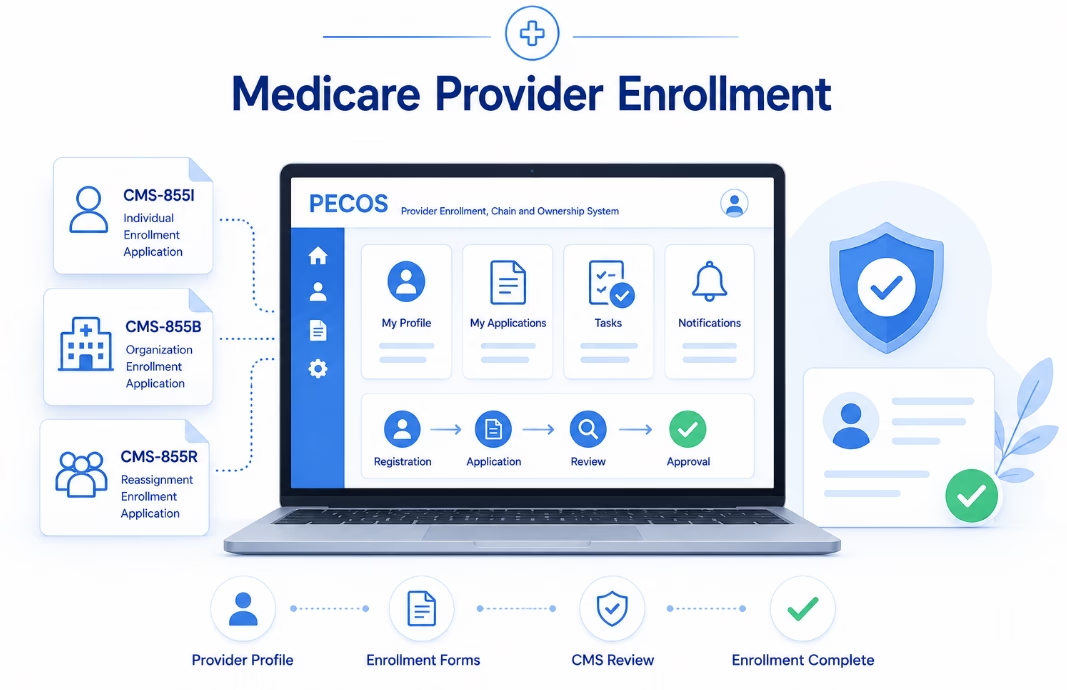
- Complete Medicare enrollment through PECOS or the appropriate CMS-855 application.
- Work with the applicable Medicare Administrative Contractor during processing.
CMS uses PECOS to manage Medicare enrollment information.
Medicare enrollment should therefore be tracked separately from commercial payer credentialing.
Can Nurse Practitioners Order and Certify Medicare Services?
CMS includes nurse practitioners among eligible non-physician practitioner specialty types that may order or certify certain Medicare items and services when program requirements are satisfied.
The specific services an NP may order or certify depend on Medicare requirements and the practitioner’s specialty and authority.
Enrollment status is important because Medicare uses its enrollment system to determine whether applicable ordering and certifying practitioners are eligible.
What About Medicaid Credentialing for Nurse Practitioners?
Medicaid enrollment is state-specific.
An NP may need to complete:
- State Medicaid enrollment
- Provider screening
- Managed care credentialing
- Managed care contracting
- Group affiliation
The exact workflow depends on the state, provider type, Medicaid program, and managed care plan.
An NP who is enrolled in the state Medicaid program should not automatically be assumed to participate with every Medicaid managed care organization.
How Does CAQH Fit Into NP Credentialing?
Many commercial health plans use the CAQH Provider Data Portal as a source of provider professional information.
An NP’s CAQH profile may include:
- Professional licenses
- Certification
- Education
- Work history
- Practice locations
- Professional liability information
- DEA information where applicable
A complete or attested CAQH profile does not mean the payer has approved credentialing or enrollment.
How Long Does Nurse Practitioner Credentialing Take?
There is no universal NP credentialing timeline.
Processing time can depend on:
- Payer
- State
- Provider type
- Network availability
- Application completeness
- Credential verification
- Contracting
- Group affiliation
- Licensure issues
Practices should avoid promising that an NP will be approved within a fixed 90-day or 120-day period.
Can NP Credentialing Start Before Every Other Step Is Complete?
Sometimes.
Provider onboarding does not always happen in a perfectly linear sequence.
For example, a practice can often begin:
- Collecting provider documents
- Building the credentialing file
- Reviewing CAQH
- Identifying payer requirements
- Preparing applications
while another prerequisite is still being completed.
However, final credentialing or enrollment approval may depend on active licensure, certification, or other required credentials.
Common Nurse Practitioner Credentialing Delays
Licensure is not ready
The NP may still be waiting for state APRN authorization or another state-required credential.
Certification information is incomplete
The credentialing organization may need current certification information or direct verification.
Practice locations are unclear
Payers may need to know exactly where the NP will provide services.
CAQH requires attention
Documents, professional history, locations, or attestations may need updating.
Professional history requires clarification
Unexplained gaps or incomplete dates can generate additional questions.
Controlled-substance information is incorrect
DEA or state controlled-substance information should reflect the NP’s actual prescribing authority.
The payer network is closed
An NP may meet professional credentialing standards while the payer declines new participation because of network availability.
Group affiliation remains pending
The NP may already have an individual payer relationship but still need to be linked to the new practice.
Best Practices for NP Credentialing
Review state requirements first
Confirm the NP’s licensing, practice-authority, and prescribing requirements before building the payer workflow.
Build one organized provider file
Maintain current documents and professional information in a centralized record.
Separate each payer and program
Do not treat commercial credentialing, Medicare, Medicaid, and facility privileging as one application.
Track each milestone separately
Useful statuses include:
- Documents complete
- Credentialing submitted
- Credentialing approved
- Contract pending
- Enrollment pending
- Group affiliation pending
- Effective date confirmed
Use a documented follow-up process
Record payer correspondence, reference numbers, outstanding requirements, and next-action dates.
Do not assume approval means billing readiness
Confirm the final payer relationship and effective date before relying on network participation.
Nurse Practitioner Credentialing Checklist
| Area | What to Confirm |
|---|---|
| State authority | RN/APRN licensing or authorization appropriate to the jurisdiction |
| Education | Applicable graduate or postgraduate NP education completed |
| Certification | Current national certification where required |
| NPI | Individual Type 1 NPI obtained and information maintained |
| DEA | Current registration only where controlled-substance practice requires it |
| Liability coverage | Current policy information available where required |
| CAQH | Current professional information for payers that use the portal |
| Commercial payers | Credentialing, contracting, enrollment, and affiliation tracked separately |
| Medicare | PECOS enrollment and applicable billing relationship confirmed |
| Medicaid | State and applicable managed care enrollment confirmed |
| Effective dates | Confirmed for each payer, product, group, and location where applicable |
Frequently Asked Questions
What is nurse practitioner credentialing?
Nurse practitioner credentialing is the process a payer or healthcare organization uses to verify and evaluate an NP’s professional qualifications before approving the practitioner under its credentialing standards.
Does an NP need both a license and national certification?
NP regulatory requirements vary by state. The APRN Consensus Model includes graduate or postgraduate education, licensure, and national certification, but states have not adopted every element identically.
Does every NP need a DEA number?
No. DEA registration is required when the practitioner handles controlled substances and has the necessary state authority. An NP who does not prescribe, administer, or dispense controlled substances does not need a DEA registration solely for credentialing.
Does an NP need physician supervision?
It depends on state law. Practice and prescribing authority vary by jurisdiction, and some states may impose collaborative or supervisory requirements.
Can an NP have an NPI before payer credentialing?
Yes. The NPI is an identifier and does not mean the NP has completed payer credentialing or enrollment.
Can an NP see patients before payer credentialing is complete?
Credentialing itself does not determine the NP’s legal authority to practice. Whether an NP can see patients depends on state licensure, employer or facility requirements, practice authority, payer arrangements, and how services will be billed.
Can a credentialed NP bill insurance immediately?
Not necessarily. Enrollment, contracting, group affiliation, location setup, network participation, and a confirmed effective date may still be required.
How does an NP enroll with Medicare?
CMS directs eligible nurse practitioners to obtain an NPI and complete Medicare enrollment through PECOS or the applicable CMS-855 enrollment application.
How long does NP credentialing take?
There is no universal timeframe. Processing varies by payer, network, state, application completeness, credential verification, contracting, and other requirements. For nurse practitioners, our NP application process guide explains common sources of onboarding delays.
Manage NP Credentialing as More Than One Process
Nurse practitioner credentialing works best when practices separate professional qualifications from licensing, prescribing authority, payer enrollment, contracting, and billing activation.
An organized NP onboarding workflow should answer:
- Is the NP legally authorized to practice?
- Is required certification current?
- Does controlled-substance authority apply?
- Has each payer completed credentialing?
- Is enrollment complete?
- Is the NP linked to the correct group and location?
- What is the confirmed effective date?
eClinicAssist supports healthcare organizations with nurse practitioner credentialing administration, payer enrollment, CAQH management, provider-document tracking, Medicare and Medicaid enrollment administration, payer follow-up, group affiliation, and effective-date tracking.
eClinicAssist does not issue professional licenses, determine NP scope of practice, grant prescribing authority, make payer credentialing decisions, or guarantee network approval.
Contact eClinicAssist to discuss nurse practitioner credentialing and payer enrollment support for your practice.
This article provides general administrative information and is not legal, clinical, licensing, prescribing, billing, or payer-specific advice. Nurse practitioner licensing, scope-of-practice, prescribing, credentialing, and enrollment requirements vary by state, payer, provider, healthcare organization, and government program. Verify current requirements with the applicable state board, payer, CMS, Medicaid agency, DEA, or other responsible authority.