The NP credentialing process verifies a nurse practitioner’s professional qualifications for a payer, healthcare organization, or credentialing entity. It is separate from state APRN licensure, payer enrollment, Medicare enrollment, contracting, and group affiliation. The best way to reduce avoidable delays is to track each of these workflows separately while coordinating them from the start. Our guides to reducing credentialing delays and avoiding NP application delays cover common issues in these workflows.
Nurse practitioner onboarding can involve several different administrative processes at the same time. For an overview of the complete onboarding process, see our nurse practitioner credentialing guide.
That is why one status such as “NP credentialing pending” is often not enough.
A newly hired NP may separately need:
- State APRN authority
- National certification
- NPI registration
- DEA registration where applicable
- CAQH profile maintenance
- Commercial payer credentialing
- Commercial payer enrollment
- Medicare enrollment
- Medicaid enrollment
- Group affiliation
- Practice-location activation
- Confirmed payer effective dates
These steps are connected, but they are not the same process.
What Is the NP Credentialing Process?
The NP credentialing process is the review of a nurse practitioner’s professional qualifications by a payer, hospital, healthcare organization, or credentialing entity.
Depending on the organization, credentialing may review:
- Licensure
- National certification
- Education and training
- Work history
- Professional liability coverage
- DEA information where applicable
- Sanctions
- Malpractice history
- Other payer-specific criteria
Credentialing does not itself issue the NP’s license or create legal practice authority.
What Is the Difference Between NP Licensing and Credentialing?
| Licensing | Credentialing |
|---|---|
| Establishes legal authority to practice under state law | Evaluates professional qualifications for an organization or payer |
| Controlled by the applicable state nursing regulatory body | Controlled by the payer, healthcare organization, CVO, or credentialing entity |
| Includes state-specific APRN requirements | May verify the license as part of the credentialing file |
| Does not create insurance network participation | Does not itself establish legal authority to practice |
NCSBN notes that APRN requirements are still not uniform across all U.S. jurisdictions.
Practices should therefore verify the applicable Board of Nursing requirements for each NP.
Does Every NP Have the Same Practice Authority?
No.
NP practice authority varies by state.
Depending on the jurisdiction, requirements may affect:
- Independent practice
- Physician collaboration
- Supervision
- Prescribing
- Controlled substances
- Telehealth
Do not build one nationwide NP credentialing checklist that assumes every state uses the same practice rules.
Step 1: Confirm State APRN Licensure and Practice Authority
Before relying on the provider’s credentialing status, confirm that the NP has the legal authority required for the intended practice location and scope.
Track:
- RN license
- APRN or NP license or authorization
- Population focus
- Prescribing authority
- Collaborative requirements where applicable
- Controlled-substance authority where applicable
If the NP will practice across state lines or by telehealth, evaluate the rules of the state where the patient is located.
Step 2: Verify National Certification
National certification is an important APRN qualification and should match the NP’s role and population focus.
Track:
- Certification organization
- Certification type
- Population focus
- Expiration date
- Renewal status
Step 3: Verify the NPI
The NP generally uses an individual Type 1 NPI for healthcare transactions and payer enrollment.
An NPI does not mean the provider is:
- Licensed
- Credentialed
- Enrolled with Medicare
- In-network
- Affiliated with a particular group
Step 4: Determine Whether DEA Registration Is Required
Not every NP needs DEA registration.
DEA registration is relevant when the NP will handle controlled substances and has the appropriate state authority.
Before treating DEA as a required credential, confirm:
- State prescribing authority
- Controlled-substance authority
- Applicable supervision or collaboration requirements
- Whether the payer or organization requires the information
Step 5: Build the NP Credentialing File
Collect the provider information before payer applications begin.
Depending on the NP and payer, the file may include:
- RN license
- APRN license or authorization
- National certification
- NPI
- Education and training
- Work history
- Professional liability information
- DEA registration where applicable
- State controlled-substance information where applicable
- Practice locations
- Other payer-specific documents
See our provider credentialing documents guide for a broader checklist.
Step 6: Prepare and Maintain CAQH
Many commercial health plans use the CAQH Provider Data Portal as a source of provider professional information.
The NP’s profile may include:
- Licenses
- Certification
- Education
- Work history
- Professional liability information
- Practice locations
- DEA information where applicable
Does a Complete CAQH Profile Mean the NP Is Credentialed?
No.
A completed and attested CAQH profile makes provider information available to authorized organizations.
The individual payer or credentialing organization still completes its own review and determines the provider’s status.
How Often Should CAQH Be Re-Attested?
CAQH currently requires providers to keep their profiles attested generally every 120 days, or every 180 days for providers whose primary practice state is Illinois.
Providers should also update important information when it changes rather than waiting for the next scheduled re-attestation.
Step 7: Start Commercial Payer Credentialing
Commercial payer credentialing may include review of:
- Professional qualifications
- Licensure
- Certification
- Work history
- Professional liability coverage
- Sanctions
- Malpractice history
Requirements vary by payer.
The same NP may move through different workflows with different health plans.
Step 8: Track Payer Enrollment Separately
Credentialing and payer enrollment should be coordinated but separately tracked.
Depending on the payer, the NP may also need:
- Group affiliation
- TIN linkage
- Location setup
- Product participation
- Contract activation
- Effective-date confirmation
See our provider enrollment process guide for the difference between credentialing and enrollment.
Does Credentialing Approval Mean the NP Can Bill the Payer?
Not necessarily.
Credentialing approval may be only one part of the payer relationship.
Before treating the NP as billing-ready, confirm:
- Credentialing status
- Contract status where applicable
- Enrollment status
- Group affiliation
- Location status
- Network product
- Effective date
Step 9: Complete Medicare Enrollment Where Applicable
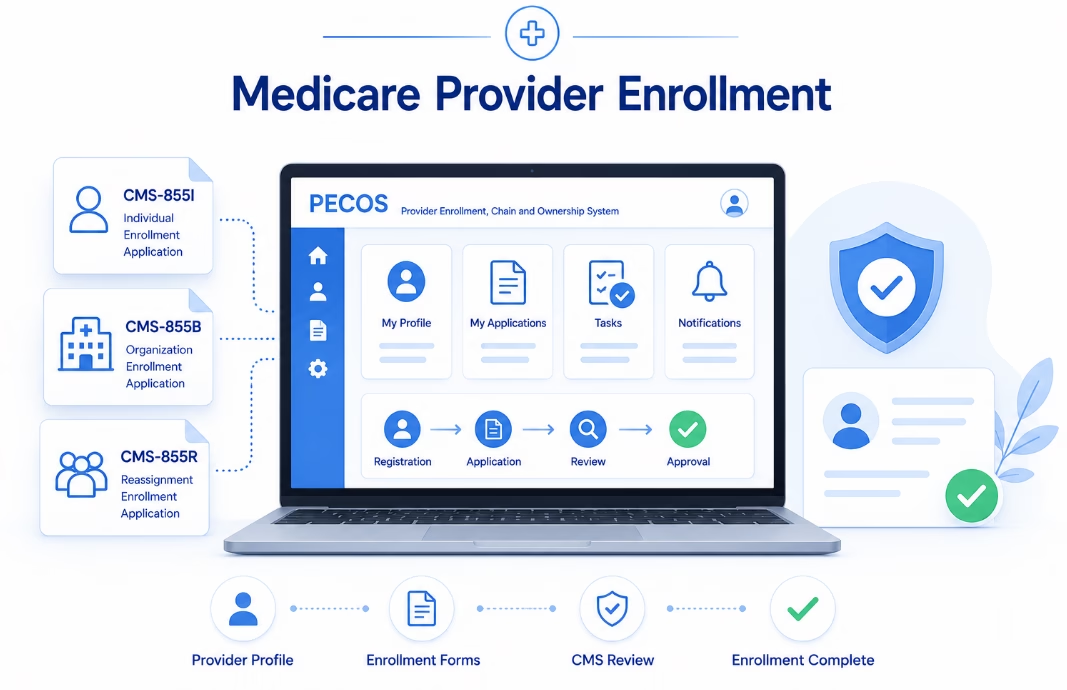
Medicare enrollment is separate from commercial payer credentialing.
CMS currently instructs participating non-physician practitioners, including NPs, to:
- Establish CMS system access.
- Obtain an NPI.
- Enroll in Medicare through PECOS or the applicable CMS-855 application.
An NP billing through a group may also require the appropriate reassignment relationship.
Step 10: Complete Medicaid Enrollment Where Applicable
Medicaid enrollment is administered at the state level.
An NP may separately need:
- State Medicaid enrollment
- Provider screening
- Group affiliation
- Practice-location enrollment
- Medicaid managed care credentialing
- MCO contracting
Do not assume commercial credentialing or Medicare enrollment completes Medicaid participation.
What Common Mistakes Delay NP Credentialing?
Starting Too Late
Waiting until the NP’s first scheduled patient day to begin administrative work leaves little time to resolve requests for additional information.
Begin preparation as soon as enough reliable provider and employment information is available.
Missing or Incorrect Provider Information
Incorrect names, dates, locations, identifiers, or incomplete professional history can generate correction requests.
Review applications before submission.
Confusing State Licensure With Payer Credentialing
An active APRN license does not mean a commercial payer has credentialed the NP.
Assuming Every NP Needs DEA Registration
DEA should be tracked when applicable, not inserted into every file as a universal requirement.
Assuming Every State Requires a Collaborating Physician
State APRN practice rules vary.
Using Outdated CAQH Data
Payers using CAQH may request updated information when the profile or documents are stale or incomplete.
Confusing CAQH Completion With Payer Approval
CAQH provides data. The payer makes the credentialing decision.
Failing to Track Payer Requests
If a payer requests clarification or additional documentation, record:
- Date received
- Requested information
- Response deadline
- Date completed
Failing to Confirm Group Affiliation
An individually credentialed provider is not always automatically affiliated with the new practice.
Assuming Credentialing Approval Equals Effective Date
Always confirm the payer’s actual effective date before relying on the relationship for billing.
How Should NP Credentialing Follow-Up Be Managed?
Each open application should have a documented next action.
Track:
- Payer
- Application type
- Submission date
- Reference number
- Current status
- Outstanding items
- Last follow-up date
- Next follow-up date
- Assigned staff member
The correct follow-up interval depends on the payer and current stage.
There is no single universal follow-up schedule that guarantees faster approval.
How Long Does NP Credentialing Take?
There is no universal NP credentialing timeline.
Timing can depend on:
- Payer
- Network availability
- State
- Provider type
- Application completeness
- Credential verification
- Committee schedule
- Contracting
- Group affiliation
- Location setup
Practices should use the payer’s actual status and requirements instead of assuming every NP will be completed within 60, 90, or 120 days.
Can an NP See Patients While Credentialing Is Pending?
Credentialing does not determine the NP’s legal authority to practice.
Whether the NP can begin seeing patients depends on factors such as:
- State licensure
- Scope of practice
- Employer policy
- Facility requirements
- Payer participation
- How the service will be billed
A pending commercial payer application should not automatically be interpreted as a legal prohibition on patient care.
Can Claims Be Submitted While NP Credentialing Is Pending?
The answer is payer-specific.
Practices should not assume that claims can be held indefinitely or billed under another provider without confirming applicable billing rules.
Before submitting claims, determine:
- Provider enrollment status
- Effective date
- Group relationship
- Applicable supervision or incident-to rules where relevant
- Payer policy
Should Credentialing and Billing Teams Communicate?
Yes.
The billing team should receive verified payer-status information such as:
- Payer
- Product
- Group
- Location
- Effective date
- Termination date where applicable
This reduces reliance on assumptions such as “credentialing approved” when other payer setup remains incomplete.
NP Credentialing Process Checklist
| Area | What to Confirm |
|---|---|
| State authority | RN and APRN licensure or authorization appropriate to the state |
| Certification | Current national certification and correct population focus |
| NPI | Individual Type 1 NPI verified |
| DEA | Tracked only when applicable |
| Documents | Required provider file complete and current |
| CAQH | Profile current and attested where payer uses CAQH |
| Commercial credentialing | Payer review tracked separately |
| Enrollment | Provider, group, product, and location setup confirmed |
| Medicare | PECOS enrollment and reassignment confirmed where applicable |
| Medicaid | State and managed care enrollment requirements reviewed |
| Effective date | Confirmed rather than assumed |
| Follow-up | Every open application has a next action |
Frequently Asked Questions
What is the NP credentialing process?
The NP credentialing process is the review of a nurse practitioner’s professional qualifications by a payer, healthcare organization, or credentialing entity.
Is NP credentialing the same as state licensure?
No. State licensure establishes legal practice authority. Credentialing evaluates qualifications for a payer or healthcare organization.
Does every NP need a DEA registration?
No. DEA registration is relevant when the NP will handle controlled substances and has the required state authority.
Does every NP need a collaborating physician?
No. Collaboration and supervision requirements vary by state and can also depend on prescribing or controlled-substance activities.
Does completing CAQH mean the NP is credentialed?
No. CAQH provides professional information to authorized organizations. Each payer or credentialing entity makes its own credentialing decision.
How often should CAQH be attested?
CAQH currently requires Provider Data Portal profiles to be re-attested generally every 120 days, or every 180 days for Illinois providers.
How does an NP enroll in Medicare?
CMS instructs eligible NPs to obtain an NPI and enroll through PECOS or the applicable CMS-855 Medicare enrollment application.
Does credentialing approval mean the NP can bill?
Not necessarily. Payer enrollment, contracting, group affiliation, location setup, product participation, and an effective date may still be required.
How long does NP credentialing take?
There is no universal timeline. Timing varies by payer, network, state, provider file, verification process, contracting, and affiliation requirements.
Can an NP see patients before payer credentialing is complete?
Payer credentialing does not itself establish legal authority to practice. Whether the NP can see patients depends on licensure, scope of practice, employer or facility rules, payer arrangements, and the intended billing method.
Track NP Credentialing as One Part of Provider Onboarding
The most reliable NP credentialing process separates professional credentialing from every other onboarding requirement.
Practices should know the status of:
- Licensure
- Certification
- NPI
- DEA where applicable
- CAQH
- Commercial credentialing
- Commercial enrollment
- Medicare enrollment
- Medicaid enrollment
- Group affiliation
- Practice locations
- Effective dates
This makes it easier to identify the real source of a delay instead of labeling every incomplete step as “credentialing.”
eClinicAssist supports healthcare organizations with NP credentialing administration, CAQH management, provider-document tracking, commercial payer enrollment, Medicare and Medicaid enrollment administration, payer follow-up, group affiliation, and effective-date tracking.
eClinicAssist does not issue NP licenses, determine scope of practice, grant prescribing authority, make payer credentialing decisions, or guarantee payer approval or reimbursement.
Contact eClinicAssist to discuss NP credentialing and payer enrollment support for your organization.
This article provides general administrative information and is not legal, licensing, clinical, prescribing, billing, or payer-specific advice. Nurse practitioner credentialing, scope of practice, licensing, prescribing, and enrollment requirements vary by state, payer, organization, and government program. Verify current requirements with the applicable Board of Nursing, payer, CMS, Medicaid agency, or other responsible authority.