
Credentialing deadlines are not one universal date or payer timeline. Practices should track several separate deadlines, including payer requests, document expirations, recredentialing, Medicare revalidation, licensing renewals, NPPES updates, follow-up dates, and confirmed effective dates. Missing some deadlines can affect enrollment or billing, while others create administrative delays rather than automatic termination. Our credentialing document checklist helps teams organize required records, while our recredentialing management guide covers recurring payer reviews.
Healthcare practices often talk about “the credentialing deadline” as though every payer follows the same schedule.
That is not how credentialing works.
Some deadlines are imposed by government programs or licensing authorities. Others are set by payers. Some are internal target dates created by the practice to keep an application moving.
The first step is knowing which type of deadline you are dealing with.
What Are Credentialing Deadlines?
Credentialing deadlines are dates or time-sensitive requirements connected to provider credentialing, enrollment, recredentialing, licensing, document maintenance, or payer follow-up.
They can include:
- Payer requests for missing information
- Credentialing application due dates
- Professional license expiration dates
- Professional liability policy expirations
- DEA registration expirations where applicable
- Recredentialing deadlines
- Medicare revalidation due dates
- NPPES update requirements
- CAQH attestation requirements
- Internal follow-up dates
- Payer contract or enrollment milestones
These should not be combined into one generic credentialing calendar.
Which Credentialing Deadlines Are Hard Deadlines?
Some deadlines are imposed externally and can carry specific consequences if missed.
| Deadline Type | Who Controls It? | Possible Consequence |
|---|---|---|
| Professional license renewal | State licensing authority | License lapse or inability to practice, depending on applicable law |
| Medicare revalidation | CMS / Medicare Administrative Contractor | Payment hold or deactivation of billing privileges |
| NPPES update requirement | CMS / HIPAA Administrative Simplification | Provider information remains inaccurate or out of date |
| Payer response deadline | Commercial payer or credentialing organization | Application delay, closure, or additional review depending on payer policy |
| Recredentialing request | Payer or healthcare organization | Participation consequences depend on the organization’s policy |
Which Credentialing Dates Are Internal Target Dates?
Other dates are not regulatory deadlines at all.
Practices often create internal target dates for:
- Document collection
- Application quality review
- Submission
- Payer follow-up
- Escalation
- Provider outreach
- Effective-date confirmation
These are still important because they prevent cases from sitting untouched, but they should not be described as payer or regulatory deadlines unless the payer actually imposed them.
Is There a Standard Credentialing Timeline?
No.
There is no single credentialing timeline that applies to every payer.
Processing can depend on:
- Provider type
- Payer
- Network
- Application completeness
- Primary source verification
- Credentialing committee review
- Contracting
- Network availability
- Provider-data corrections
For that reason, practices should use payer-specific information whenever available rather than promising a standard number of days.
See our credentialing timeline guide for a more detailed explanation.
1. Track Professional License Expiration Dates
Professional licenses are separate from payer credentialing, but they are commonly reviewed during credentialing and recredentialing.
Practices should track:
- License number
- State
- Expiration date
- Renewal status
- Any required supporting documents
Do not assume every board follows the same renewal schedule.
The provider’s licensing authority determines the actual requirements.
2. Track Professional Liability Coverage
Professional liability coverage is another common credentialing document.
Practices should monitor:
- Policy number
- Carrier
- Coverage period
- Applicable limits
- Renewal status
An expired certificate does not automatically mean every payer will immediately terminate the provider, but it may create a documentation problem that needs prompt correction.
3. Track DEA Registration Where Applicable
DEA registration is separate from professional licensure and payer credentialing.
Where it is required for the provider’s practice, monitor:
- DEA number
- Expiration date
- Registration state where applicable
- Renewal status
Not every healthcare professional requires DEA registration, so it should not be treated as a universal credentialing document.
4. Track Payer Requests for Additional Information
Many credentialing applications require follow-up after submission.
A payer may request:
- Missing documents
- Updated licenses
- Work-history clarification
- Ownership information
- Professional liability documentation
- Application corrections
- Signed forms or attestations
The payer may provide a specific response deadline.
That date should be recorded exactly rather than replaced by a generic follow-up schedule.
5. Track Recredentialing Separately From Initial Credentialing
Initial credentialing and recredentialing are different workflows.
NCQA Credentialing Accreditation standards include:
- Initial credential verification
- Recredentialing
- Ongoing monitoring between formal review cycles
Practices should track payer recredentialing requests separately from initial applications.
See our provider recredentialing guide for more detail.
6. Monitor Ongoing Credentialing Events
Credentialing is not only an initial application followed by a later recredentialing date.
NCQA standards also address monitoring between recredentialing cycles, including sanctions, complaints, and quality issues.
Organizations subject to these requirements should maintain an appropriate monitoring process rather than waiting until the next formal credentialing review.
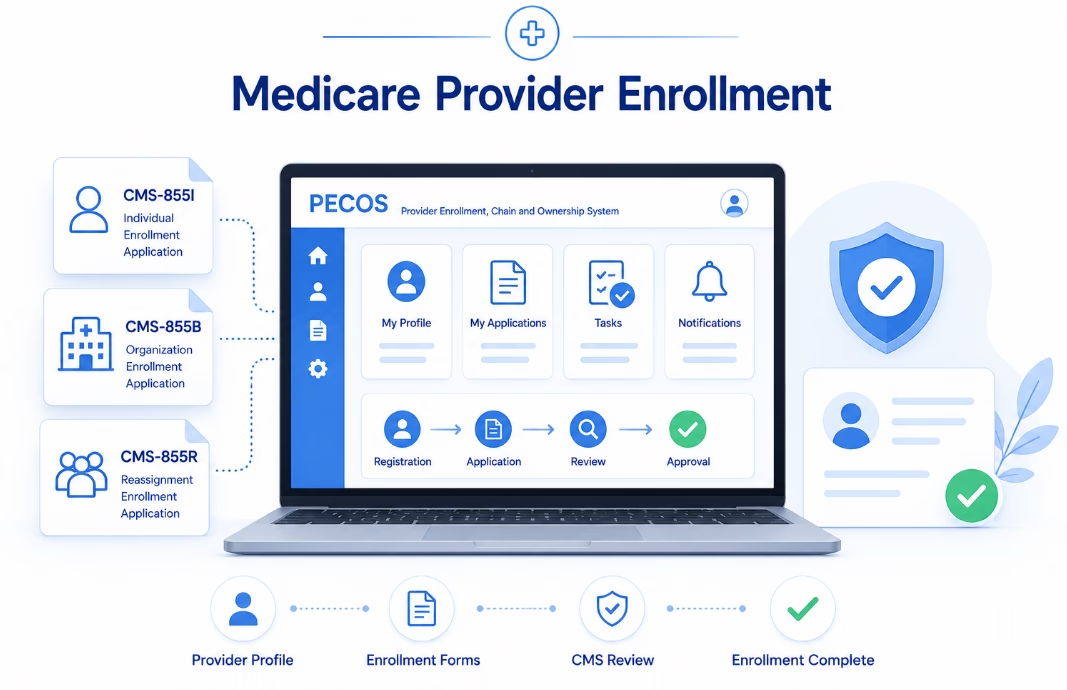
7. Track Medicare Revalidation Due Dates
Medicare revalidation is one of the clearest examples of a formal enrollment deadline.
CMS currently states that:
- Most Medicare providers and suppliers generally revalidate every five years.
- DMEPOS suppliers generally revalidate every three years.
- CMS may request off-cycle revalidation.
CMS posts revalidation due dates in the Medicare Revalidation List.
Due dates are generally displayed up to seven months in advance.
Medicare Administrative Contractors also send revalidation notices before the due date.
What Happens if Medicare Revalidation Is Late?
CMS states that failure to revalidate on time may result in:
- A hold on Medicare reimbursement
- Deactivation of Medicare billing privileges
If billing privileges are deactivated, the provider or supplier may need to submit a complete enrollment application to reactivate them.
CMS also states that Medicare will not reimburse services furnished during the period of deactivation.
This is why Medicare revalidation should be tracked separately from commercial payer recredentialing.
Should You Submit Medicare Revalidation Early?
Not too early.
CMS specifically instructs providers not to submit unsolicited revalidation when the due date is more than seven months away unless CMS or the Medicare Administrative Contractor requested it.
If the provider is within three months of the listed due date and has not received a notice, CMS says the revalidation should still be submitted.
8. Track NPPES Updates Within the Required Timeframe
NPPES maintenance is separate from credentialing, but provider-data accuracy can support enrollment and other administrative workflows.
CMS states that HIPAA-covered healthcare providers must report required changes to NPPES within 30 days.
This may include applicable changes to:
- Practice information
- Provider taxonomy
- Addresses
- Other required NPPES data
See our NPI registration and NPPES guide for more detail.
9. Track CAQH Activity Separately
Many commercial payer workflows use information in the CAQH Provider Data Portal.
Practices should monitor:
- Provider profile completeness
- Required attestations
- Expired documents
- Practice locations
- Professional liability information
- Authorized organizations
A current CAQH profile does not itself mean payer credentialing or enrollment has been completed.
10. Track Internal Follow-Up Dates
Every application should have a next action date.
A useful application record may include:
- Submission date
- Payer reference number
- Last follow-up date
- Current status
- Outstanding requirement
- Responsible staff member
- Next follow-up date
This does not force the payer to make a faster decision.
It prevents the practice from losing track of the application.
For a structured process, see our credentialing follow-up guide.
11. Track Effective Dates, Not Just Approval Dates
One of the most important credentialing and enrollment milestones is the payer effective date.
Do not assume that:
- Application submission date
- Credentialing approval date
- Contract execution date
- Enrollment completion date
- Network effective date
are all the same.
Before treating a provider as active under a payer arrangement, confirm the applicable effective date and billing relationship.
12. Track Group and Location Additions
A provider may already participate with a payer but still need to be established under:
- A new group
- A new TIN
- A new practice location
- A different payer product
Each of these may have its own administrative workflow.
Do not treat a provider’s general network status as proof that every group or location relationship is already active.
How Early Should Credentialing Start?
Start as early as reasonably possible once the practice has enough accurate information to begin the applicable process.
However, “start early” does not mean submitting incomplete applications or inventing placeholder information.
Before submission, confirm:
- Provider information is complete
- Required documents are current
- Applicable licenses are available or their status is understood
- The correct group and location are known
- Payer-specific requirements have been reviewed
For the full document set, see our provider credentialing documents guide.
How Should Practices Prioritize Credentialing Deadlines?
Not every date carries the same risk.
A useful prioritization method is:
Priority 1: Legal or government deadlines
Examples:
- Professional license renewal
- Medicare revalidation
- Required NPPES updates
Priority 2: Payer-imposed response deadlines
Examples:
- Requests for additional information
- Recredentialing response dates
- Application corrections
Priority 3: Expiring professional credentials
Examples:
- Professional liability coverage
- DEA registration where applicable
- Board certification where applicable
Priority 4: Internal operational targets
Examples:
- Follow-up dates
- QA review dates
- Escalation dates
- Provider outreach dates
Credentialing Deadline Tracker
| Item | What to Track |
|---|---|
| Professional license | Expiration date, renewal status, licensing authority |
| Professional liability | Coverage dates and renewal documentation |
| DEA | Expiration and renewal status where applicable |
| Payer application | Submission date, payer reference, outstanding items |
| Payer request | Required response and exact due date |
| Recredentialing | Payer request date, due date, completion status |
| Medicare revalidation | CMS due date and PECOS submission status |
| NPPES | Required provider-data changes and update date |
| Follow-up | Last action and next action date |
| Effective date | Confirmed payer, group, location, product, and effective date |
Common Credentialing Deadline Mistakes
Using one generic renewal calendar
License renewal, recredentialing, Medicare revalidation, CAQH activity, and professional liability renewal are different processes.
Assuming every payer follows the same timeline
Credentialing timelines and requirements vary by payer and network.
Tracking submission but not follow-up
An application can remain pending after submission. Record the next action.
Tracking approval but not effective date
Approval does not always equal billing readiness.
Assuming the payer will always remind you
Practices should maintain their own deadline system even when a payer or government program sends notices.
Waiting until expiration to start renewal work
Internal advance reminders provide time to collect documents and resolve issues before a hard deadline arrives.
Frequently Asked Questions
What are credentialing deadlines?
Credentialing deadlines include payer response dates, credential expirations, recredentialing requests, Medicare revalidation, provider-data updates, and internal follow-up dates used to keep applications moving.
Is there a standard 90-day credentialing deadline?
No. Commercial payer credentialing timelines vary. Practices should use payer-specific guidance instead of assuming one universal turnaround time.
How often is Medicare revalidation required?
CMS states that most Medicare providers and suppliers generally revalidate every five years, while DMEPOS suppliers generally revalidate every three years. CMS can also request off-cycle revalidation.
What happens if Medicare revalidation is missed?
CMS states that late revalidation can result in a Medicare payment hold or deactivation of billing privileges.
How far in advance does CMS publish Medicare revalidation due dates?
CMS currently posts due dates up to seven months in advance in the Medicare Revalidation List.
How often should credentialing applications be followed up?
There is no universal follow-up interval. Follow the payer’s instructions and create a reasonable internal schedule based on the application’s status and outstanding requirements.
Does missing a recredentialing deadline automatically terminate a provider?
Not necessarily. The consequence depends on the payer or organization’s policy and what actually happens to the provider’s credentialing or participation status.
Does credentialing approval mean billing can begin?
Not always. Contracting, enrollment, group affiliation, location setup, network participation, and a confirmed effective date may still be required.
Manage Credentialing Deadlines by Risk, Not Guesswork
The most effective credentialing deadline system separates true external deadlines from internal target dates.
Practices should know which items are controlled by:
- Licensing authorities
- CMS
- Commercial payers
- Credentialing organizations
- The practice’s own internal workflow
That makes it easier to prioritize urgent work, prevent avoidable lapses, and understand exactly what is still pending.
eClinicAssist supports healthcare organizations with provider credentialing, payer enrollment, provider-document tracking, follow-up management, renewals, Medicare and Medicaid enrollment administration, CAQH management, and effective-date tracking.
Contact eClinicAssist to discuss credentialing and payer enrollment support for your organization.
This article provides general administrative information and is not legal, contractual, licensing, accreditation, billing, or payer-specific advice. Deadlines and requirements vary by payer, provider type, state, credentialing organization, and government program. Verify current requirements with the applicable authority.