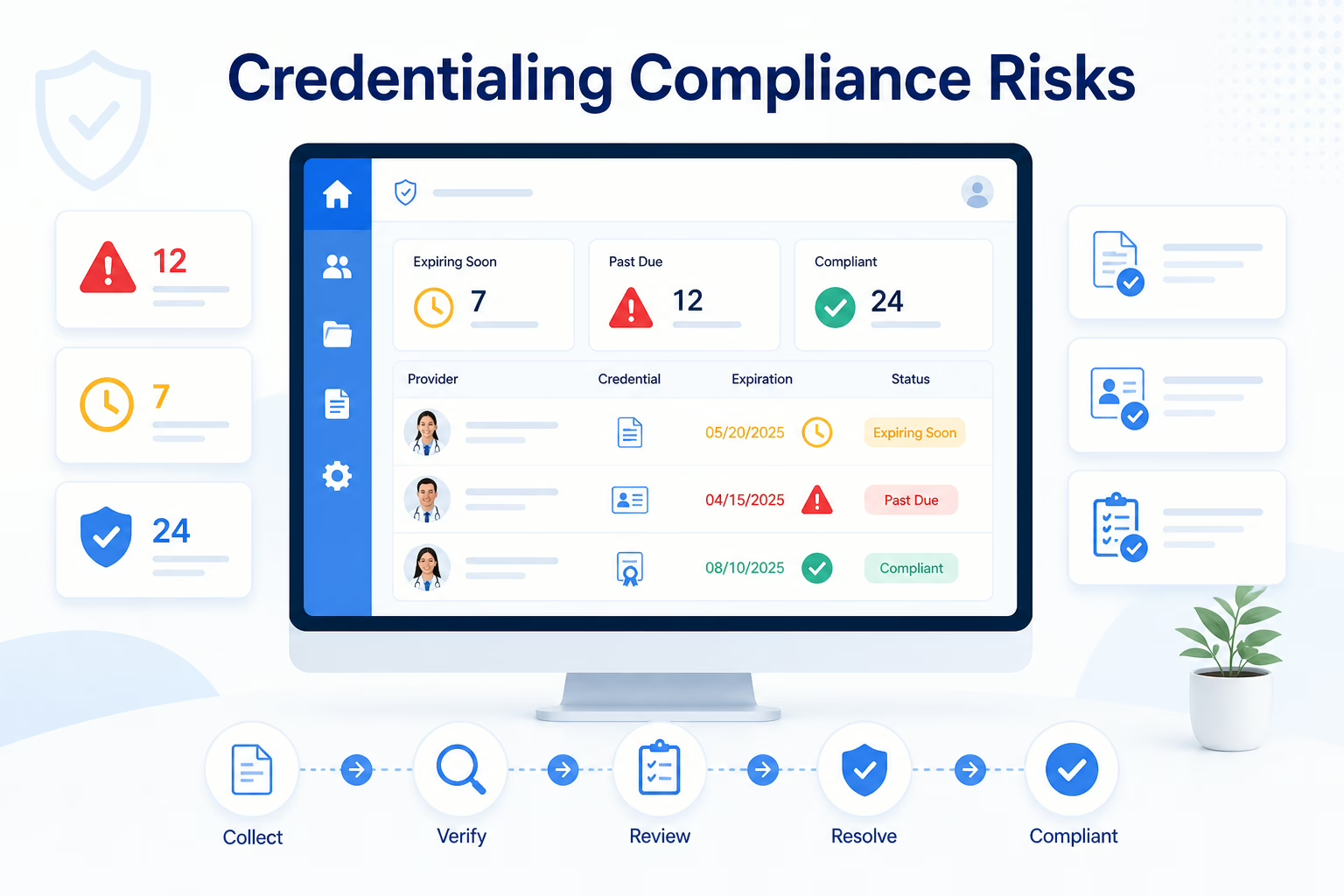
Credentialing compliance risks arise when provider qualifications, licenses, payer relationships, enrollment records, recredentialing requirements, or monitoring processes are not maintained correctly. The consequences vary by situation and may include application delays, participation problems, Medicare deactivation, additional administrative work, or patient-access issues. Credentialing, licensing, enrollment, and billing readiness should be tracked separately. For examples of ongoing compliance obligations, review TMHP account deactivation rules and recredentialing management for multi-provider practices.
Credentialing compliance is often treated as a one-time onboarding project.
That is one of the biggest operational mistakes a healthcare organization can make.
Provider information changes. Licenses expire. Payers request recredentialing. Medicare assigns revalidation dates. Practice locations change. Providers move between groups. Sanctions or other professional actions may require review.
A strong compliance process therefore focuses not only on getting a provider approved, but also on keeping the underlying information and relationships current.
What Are Credentialing Compliance Risks?
Credentialing compliance risks are problems created when provider qualification, credentialing, enrollment, monitoring, or related administrative requirements are missed, inaccurate, expired, or poorly documented.
Common areas of risk include:
- Expired professional licenses
- Missed payer recredentialing
- Missed Medicare revalidation
- Outdated professional liability information
- Unresolved sanctions or adverse-action information
- Incorrect payer affiliations
- Outdated practice locations
- Incomplete credentialing files
- Failure to respond to payer requests
- Poor documentation of credentialing decisions
The significance of each issue depends on the provider, payer, organization, program, and applicable requirement.
Credentialing Compliance Is Not the Same as Billing Authorization
Credentialing evaluates a provider’s professional qualifications.
That does not automatically establish every requirement needed to bill an insurance company.
Depending on the payer, billing readiness may also require:
- Payer enrollment
- Network approval
- An executed contract
- Group or TIN affiliation
- Practice-location enrollment
- Product participation
- A confirmed effective date
This distinction matters when practices investigate provider-related claim problems.
See our credentialing vs privileging vs enrollment guide for a clearer comparison.
Risk 1: Expired or Inactive Professional Licenses
Professional licensing is separate from credentialing, but active licensure is one of the most important qualifications reviewed during provider credentialing.
Practices should track:
- Licensing jurisdiction
- License number
- Status
- Expiration date
- Renewal status
- Restrictions or disciplinary actions where relevant
An expired license can create much more serious consequences than an expired administrative document because licensure determines legal authority to practice within the applicable jurisdiction.
The exact consequence of a lapse depends on state law, provider type, and services furnished.
Risk 2: Missing Payer Recredentialing Requirements
Commercial payer credentialing does not necessarily end after initial approval.
Health plans and credentialing organizations may periodically reevaluate participating practitioners.
Recredentialing can involve updated review of:
- Licensure
- Professional liability coverage
- Sanctions
- Malpractice information
- Certification where applicable
- Practice information
- Other payer-specific criteria
The timing and consequences of missing recredentialing vary by organization.
Do not assume that every missed request results in immediate termination, but do not ignore the request either.
See our provider recredentialing guide for the separate workflow.
Risk 3: Missing Medicare Revalidation
Medicare revalidation is not commercial credentialing.
It is a CMS provider enrollment requirement.
CMS currently states that:
- Most Medicare providers and suppliers generally revalidate every five years.
- DMEPOS suppliers generally revalidate every three years.
- CMS can request off-cycle revalidation.
CMS assigns specific revalidation due dates and publishes them through the Medicare Revalidation List.
What Happens if Medicare Revalidation Is Missed?
CMS states that failing to revalidate on time may result in:
- A hold on Medicare reimbursement
- Deactivation of Medicare billing privileges
If billing privileges are deactivated, a complete Medicare enrollment application may be required to reactivate the enrollment.
CMS also states that Medicare does not reimburse services furnished during the period of deactivation.
This makes Medicare revalidation one of the highest-priority enrollment compliance dates for practices serving Medicare beneficiaries.
Risk 4: Treating Provider Data as a One-Time Setup
Provider information changes throughout the provider’s relationship with a practice.
Examples include:
- New practice locations
- Address changes
- Taxonomy changes
- Group changes
- New licenses
- Ownership changes
- New payer relationships
- Termination from old locations
These changes may affect different systems in different ways.
Practices may need to update:
- NPPES
- PECOS
- CAQH Provider Data Portal
- Commercial payer systems
- State Medicaid records
- Internal practice-management systems
The information should be accurate, but the systems should not be treated as identical databases.
Risk 5: Incomplete Credentialing Documentation
Incomplete provider files make credentialing, recredentialing, audits, and payer requests harder to manage.
A provider file may need information such as:
- Professional licenses
- Education and training
- Work history
- National certification where applicable
- Professional liability coverage
- DEA registration where applicable
- Practice locations
- Payer correspondence
Not every document applies to every provider.
See our provider credentialing documents guide for a broader checklist.
Risk 6: Failing to Monitor Sanctions and Other Professional Actions
Credentialing compliance is not always limited to checking provider qualifications once every few years.
For organizations subject to applicable credentialing standards, ongoing monitoring can include review of:
- Sanctions
- Complaints
- License status
- Quality issues
- Other defined professional actions
NCQA’s current Credentialing Accreditation standards specifically include monitoring sanctions, complaints, and quality issues between formal recredentialing cycles for organizations within the program’s scope.
This should not be converted into a blanket statement that every private medical office must follow NCQA Credentialing Accreditation requirements.
Risk 7: Confusing Credentialing With Privileging
Credentialing and privileging are closely related but different.
Credentialing evaluates the provider’s qualifications.
Privileging determines what specific clinical activities the practitioner may perform within a healthcare organization.
This distinction is especially important for:
- Hospitals
- Health systems
- Surgical facilities
- Other organizations that grant clinical privileges
The Joint Commission’s current guidance for organizations subject to its medical staff standards continues to emphasize evaluation of education, training, and current competence when privileges are granted.
Not every outpatient medical practice operates under hospital-style privileging requirements.
Risk 8: Assuming Every Payer Approval Applies to Every Location
A provider may participate with an insurance company and still have an incomplete relationship for a particular:
- Group
- TIN
- Location
- Network
- Product
For example, a provider’s participation with a payer under one employer does not automatically establish participation under a newly joined practice.
Practices should verify the provider’s actual billing relationship rather than relying solely on general network status.
Risk 9: Tracking “Approved” Without Tracking What Was Approved
A single status labeled “approved” creates unnecessary ambiguity.
Instead, practices should separately track:
- Credentialing approval
- Contract status
- Enrollment status
- Group affiliation
- Location status
- Network product
- Effective date
This makes it easier for credentialing and billing teams to determine whether the provider is actually ready under the intended payer arrangement.
Risk 10: Missing Payer Requests and Deadlines
Payers may request additional information while an application or recredentialing file is being reviewed.
Examples include:
- Updated license information
- Professional liability documents
- Work-history explanations
- Application corrections
- Ownership information
- Signed attestations
If the payer provides a deadline, record the actual deadline rather than replacing it with a generic follow-up interval.
A missed response can result in additional delay or administrative closure, depending on payer policy.
Risk 11: Poor Communication Between Credentialing and Billing
Credentialing and enrollment information should reach the billing team before claims are submitted under a new payer relationship.
The billing team may need to know:
- Provider NPI
- Group relationship
- Payer product
- Practice location
- Effective date
- Termination date where applicable
Billing should also send provider-status denials back to the credentialing or enrollment team when they suggest a payer-setup issue.
This creates a feedback loop rather than treating every provider-related denial as a coding problem.
Risk 12: Weak Access Controls for Credentialing Information
Credentialing files can contain sensitive professional and personal information.
Organizations should define:
- Who may view provider records
- Who may edit them
- Who approves changes
- How supporting documents are stored
- How audit history is retained
NCQA’s current credentialing standards specifically include protection of credentialing information for organizations operating within its Credentialing Accreditation program.
Can Credentialing Problems Affect Patient Access?
Yes, but the effect depends on the situation.
A payer participation problem may lead a practice to:
- Delay scheduling insured patients under that network
- Provide additional financial disclosures
- Reassign patients to another participating provider
- Resolve affiliation or enrollment issues before billing
That does not mean an incomplete payer credentialing application automatically makes the practitioner legally unable to provide care.
Licensure, employment, facility rules, scope of practice, and payer arrangements should be evaluated separately.
Can Credentialing Compliance Problems Create Legal Risk?
Potentially.
Credentialing, licensing, privileging, and professional review can become relevant in litigation or regulatory matters depending on the circumstances.
However, an administrative credentialing error does not automatically establish negligence or legal liability.
Legal consequences depend on factors such as:
- Applicable state law
- The organization’s duty
- The provider’s qualifications
- The nature of the alleged harm
- Facility policies
- Accreditation requirements
- The facts of the specific case
Practices should avoid making legal conclusions based solely on an administrative credentialing status.
Do All Practices Have to Follow NCQA Credentialing Standards?
No.
NCQA Credentialing Accreditation applies to eligible organizations providing full-scope credentialing services.
Current NCQA requirements for those organizations address areas such as:
- Credential verification
- Credentialing policies
- Credentialing committee activity
- Recredentialing
- Ongoing monitoring
- Credentialing information protection
- Delegation
- Practitioner appeal rights
A medical practice should first determine whether an accreditation standard actually applies before calling it a compliance requirement.
Does Every Practice Have to Follow Joint Commission Credentialing Standards?
No.
The Joint Commission establishes credentialing and privileging standards for healthcare organizations participating in applicable Joint Commission accreditation programs.
Those standards should not be presented as universal federal requirements for every independent clinic or physician office.
How Can Practices Reduce Credentialing Compliance Risks?
Maintain a centralized provider record
Keep licensing, credentialing, payer, location, and renewal information organized in one structured system.
Separate different processes
Track:
- Licensing
- Credentialing
- Commercial enrollment
- Medicare enrollment
- Medicaid enrollment
- Contracting
- Privileging
as distinct workflows.
Assign an owner to each deadline
A deadline should have:
- A responsible person
- A due date
- A current status
- A next action
Use advance expiration alerts
Monitor provider documents before their expiration date rather than waiting until a payer requests an updated copy.
Audit active payer relationships
Periodically confirm that provider records accurately identify:
- Payer
- Group
- TIN
- Location
- Product
- Effective date
Document credentialing activity
Maintain records of:
- Applications
- Submissions
- Payer correspondence
- Requests for information
- Verification activity
- Approvals
- Effective dates
- Recredentialing activity
A structured credentialing audit checklist can help identify gaps before they become larger operational problems.
Credentialing Compliance Risk Checklist
| Risk Area | What to Monitor |
|---|---|
| Licensure | Status, expiration, restrictions, renewal |
| Professional liability | Coverage dates and updated evidence where required |
| Commercial credentialing | Initial approval, recredentialing, payer requests |
| Medicare | PECOS enrollment, reportable changes, revalidation |
| Medicaid | State enrollment and applicable managed care relationships |
| Provider data | NPPES, CAQH, PECOS, payer, and internal records |
| Sanctions monitoring | Applicable ongoing monitoring responsibilities |
| Affiliation | Correct group, TIN, location, and network product |
| Effective dates | Confirmed rather than assumed |
| Documentation | Applications, correspondence, approvals, and review history retained |
Frequently Asked Questions
What are credentialing compliance risks?
Credentialing compliance risks are problems that arise when provider qualifications, credentials, payer relationships, recredentialing requirements, or related records are inaccurate, expired, incomplete, or not properly monitored.
Does credentialing authorize a provider to bill insurance?
Not by itself. Billing readiness may also require payer enrollment, contracting, group affiliation, location setup, network participation, and a confirmed effective date.
Can a provider see patients if payer credentialing is incomplete?
Payer credentialing does not itself determine legal authority to practice. The answer depends on licensure, scope of practice, employment or facility requirements, payer arrangements, and how services will be billed.
What happens if Medicare revalidation is missed?
CMS may hold Medicare reimbursement or deactivate Medicare billing privileges. CMS states that services furnished during a period of deactivation are not reimbursed by Medicare.
How often is Medicare revalidation required?
Most Medicare providers and suppliers generally revalidate every five years. DMEPOS suppliers generally revalidate every three years. CMS may also require off-cycle revalidation.
Does an expired credential automatically cause claim denials?
Not necessarily. The consequence depends on the credential, payer, provider status, applicable policy, and timing. The actual payer relationship should be verified.
Do all medical practices have to follow NCQA Credentialing Accreditation standards?
No. NCQA Credentialing Accreditation has specific eligibility and program requirements and applies to organizations providing full-scope credentialing services.
Do all medical practices have to follow Joint Commission credentialing standards?
No. Joint Commission standards apply to organizations within the applicable accreditation programs.
Can credentialing software guarantee compliance?
No. Software can support tracking, alerts, documentation, and workflow management, but compliance still depends on accurate information, applicable policies, responsible review, and timely action.
Manage Credentialing Compliance as an Ongoing Process
Credentialing compliance does not end when a provider receives an initial approval.
Practices need ongoing visibility into:
- Licenses
- Recredentialing
- Medicare revalidation
- Provider-data changes
- Payer affiliations
- Locations
- Effective dates
- Sanctions or other relevant professional actions
The goal is not to promise uninterrupted reimbursement or eliminate every credentialing problem. The goal is to identify requirements early, maintain reliable provider records, and respond to issues before they create larger operational consequences.
eClinicAssist supports healthcare organizations with provider credentialing administration, payer enrollment, CAQH management, Medicare and Medicaid enrollment administration, document tracking, credential-expiration reminders, recredentialing workflows, payer follow-up, and effective-date tracking.
eClinicAssist does not make payer credentialing decisions, determine legal compliance, grant accreditation, issue licenses, or guarantee reimbursement or network participation.
Contact eClinicAssist to discuss credentialing and payer enrollment support for your organization.
This article provides general administrative information and is not legal, licensing, accreditation, billing, regulatory, or payer-specific advice. Credentialing and enrollment requirements vary by payer, provider type, state, healthcare organization, accreditation program, and government program. Verify current requirements with the applicable authority.