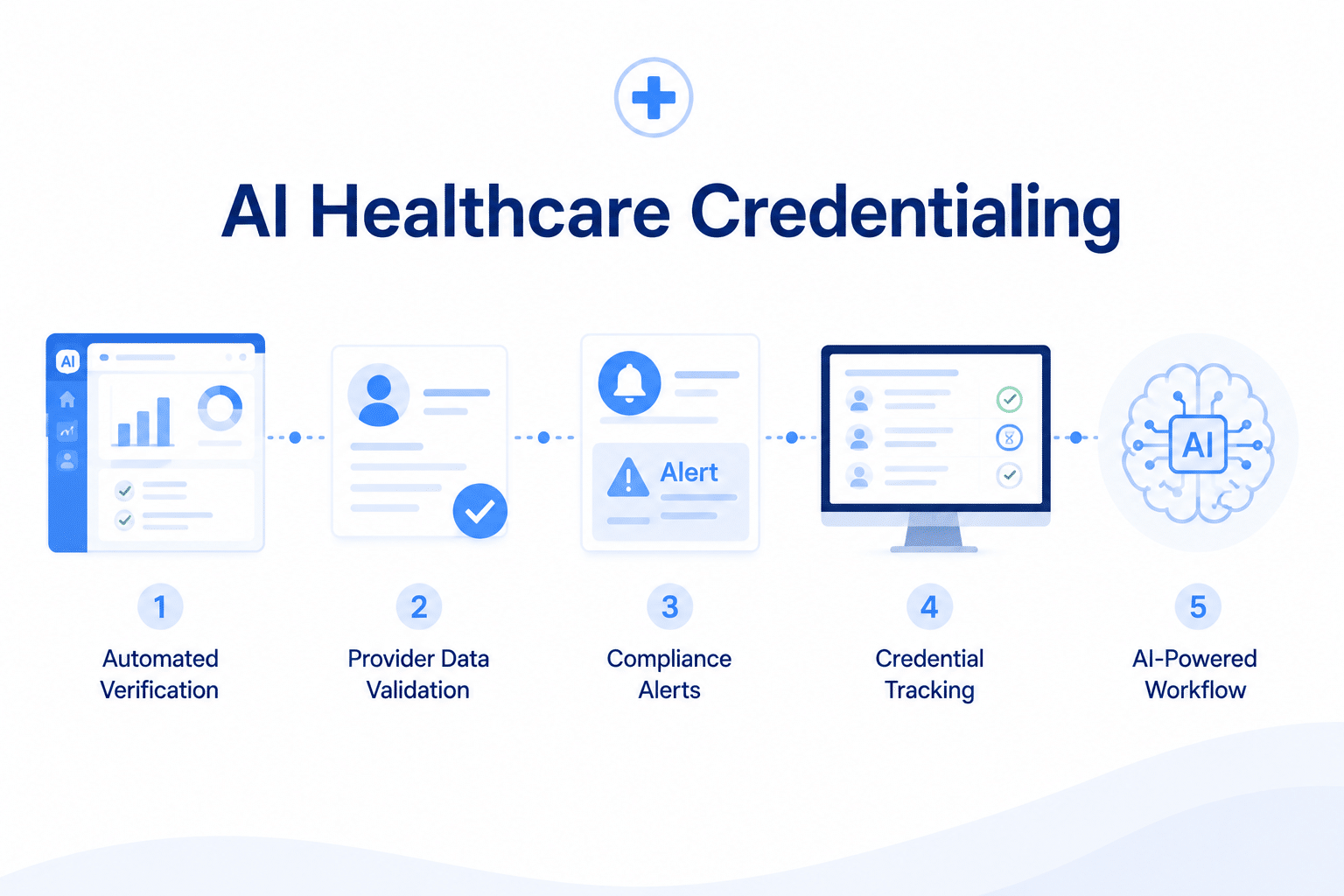
AI healthcare credentialing can help organizations organize provider data, identify missing information, monitor expirations, classify documents, prioritize exceptions, and reduce repetitive administrative work. However, AI does not replace licensing boards, primary sources, payer review, Medicare or Medicaid enrollment systems, or accountable human credentialing decisions. Our guide to AI in healthcare credentialing explains where human oversight remains essential.
Artificial intelligence is becoming more relevant to credentialing as healthcare organizations manage larger provider networks, more data sources, recurring renewals, and increasingly complex enrollment workflows.
The opportunity is significant, but so are the limitations. The most useful question is not whether AI can “do credentialing.” It is which parts of credentialing can be safely automated, which require authoritative verification, and where human review must remain in control.
What Is AI Healthcare Credentialing?
AI healthcare credentialing refers to using artificial intelligence or machine-assisted automation to support administrative tasks involved in provider credentialing, enrollment, provider-data management, recredentialing, licensing, and related workflows.
Depending on the system, technology may help with tasks such as:
- Extracting information from provider documents
- Classifying uploaded files
- Identifying missing fields or documents
- Comparing information across records
- Monitoring credential expiration dates
- Prioritizing applications needing human attention
- Generating reminders and task assignments
- Summarizing application or follow-up history
- Supporting searches of approved external data sources
These functions can improve workflow efficiency, but they should not be confused with a payer, licensing board, hospital, or government agency making an official credentialing or enrollment determination.
Why Is Automation Becoming More Important in Credentialing?
Healthcare credentialing involves dynamic information distributed across many systems.
A credentialing team may need to manage:
- Professional licenses
- Education and training
- Professional liability coverage
- Work history
- DEA information when applicable
- Board certification when applicable
- CAQH records
- Payer applications
- Medicare and Medicaid enrollments
- Recredentialing
- Group affiliations
- Effective dates
The National Committee for Quality Assurance, or NCQA, has recognized the opportunity for greater automation in credentialing. Its current Credentialing Collaborative is exploring primary source verification efficiency, continuous monitoring, exception-based review, trusted data sources, and governance frameworks for technology-enabled credentialing.
You can review NCQA’s discussion of the future of credentialing automation.
The direction is important: automation can reduce repetitive work, but trust in the underlying data remains fundamental.
Where Can AI Help in the Credentialing Process?
1. Document Intake and Classification
Credentialing teams receive large numbers of documents, including licenses, insurance certificates, CVs, board certifications, enrollment letters, and identification records.
AI-assisted document processing may help identify the document type and extract information such as:
- Provider name
- License number
- Issuing state
- Expiration date
- Policy number
- Coverage dates
This can reduce repetitive manual data entry.
However, extracted information should be validated before it becomes part of the provider’s authoritative record, especially when poor image quality, unusual document formats, or ambiguous information is involved.
2. Missing-Information Detection
Rules-based automation and AI can help identify incomplete provider profiles.
For example, a system may flag that:
- A required document has not been uploaded
- An expiration date is missing
- A provider application contains an unanswered field
- A payer case has no next follow-up date
- A credential has expired
This can make internal quality control more consistent.
It does not mean the system knows every requirement of every payer unless those requirements have been accurately configured and maintained.
3. Credential Expiration Monitoring
One of the most practical uses of automation is tracking known dates.
Systems can monitor items such as:
- Professional license expirations
- Professional liability policy dates
- DEA expiration dates where applicable
- Board certification dates
- Recredentialing milestones
- CAQH attestation deadlines
Automated reminders reduce reliance on staff remembering every deadline manually.
They do not complete the renewal or determine whether the provider continues to satisfy the underlying requirements.
4. Application Quality Checks
Automation can review structured information before submission and flag potential issues for human review.
Examples might include:
- Missing required fields
- Unexpected gaps in work history
- Expired supporting documents
- Potentially inconsistent addresses
- Incomplete payer-specific tasks
A flagged difference is not automatically an error. Different systems may legitimately contain different information because they serve different purposes.
The credentialing team should investigate the discrepancy instead of allowing software to overwrite one system simply to make every record identical.
5. Follow-Up Prioritization
AI can also help operational teams decide what needs attention first.
For example, a dashboard might identify:
- Applications with overdue follow-ups
- Cases waiting on the practice
- Providers with credentials expiring soon
- Applications without recent activity
- Payer requests awaiting response
This is particularly useful for organizations managing large credentialing queues.
Our guide to credentialing platforms for healthcare practices explains the underlying workflow features organizations should evaluate before choosing technology.
Can AI Perform Primary Source Verification?
Sometimes it can assist with the process, but the answer depends on what the system actually does.
Primary source verification means confirming a credential with the organization or authoritative source responsible for that credential, or another source recognized under the applicable credentialing standard.
Technology may be able to:
- Query an authoritative online source
- Retrieve structured verification data
- Record the date and result
- Flag changes for review
- Monitor approved sources over time
But a vendor describing a feature as “AI verification” does not automatically establish that the process meets the organization’s credentialing requirements.
Before relying on automated verification, ask:
- What source is being checked?
- Is that source acceptable for the credential being verified?
- When was the information retrieved?
- Can the verification result be audited later?
- What happens when the source is unavailable?
- How are conflicting results handled?
- Does a human review exceptions?
Our primary source verification guide explains why source reliability matters separately from the technology used to retrieve the information.
Can AI Make Credentialing Decisions?
Organizations should be cautious about delegating consequential credentialing decisions entirely to an automated model.
Credentialing files can contain issues that require context and professional judgment, including:
- Malpractice history
- Adverse actions
- Professional discipline
- Gaps in employment
- License restrictions
- Conflicting verification results
- Unusual provider histories
AI can help surface information, summarize a file, or prioritize an exception. The organization should still maintain accountable human oversight over decisions governed by its credentialing policies, contracts, accreditation requirements, or applicable law.
Can AI Make Provider Onboarding Faster?
AI may reduce internal processing time when it successfully eliminates repetitive work.
For example, it may help a team collect information faster, identify missing documents earlier, or route tasks more efficiently.
But provider onboarding also depends on external organizations.
Those may include:
- State licensing boards
- Primary verification sources
- Health plans
- Credentialing committees
- Hospitals
- Medicare Administrative Contractors
- State Medicaid agencies
AI cannot guarantee how quickly these organizations will review or approve an application.
A better measure of automation success is whether it reduces preventable internal delays while giving staff better visibility into external ones.
AI Does Not Replace PECOS, CAQH, or Payer Systems
Credentialing technology should be treated as an operational layer around authoritative external systems, not as a replacement for them.
Medicare and PECOS
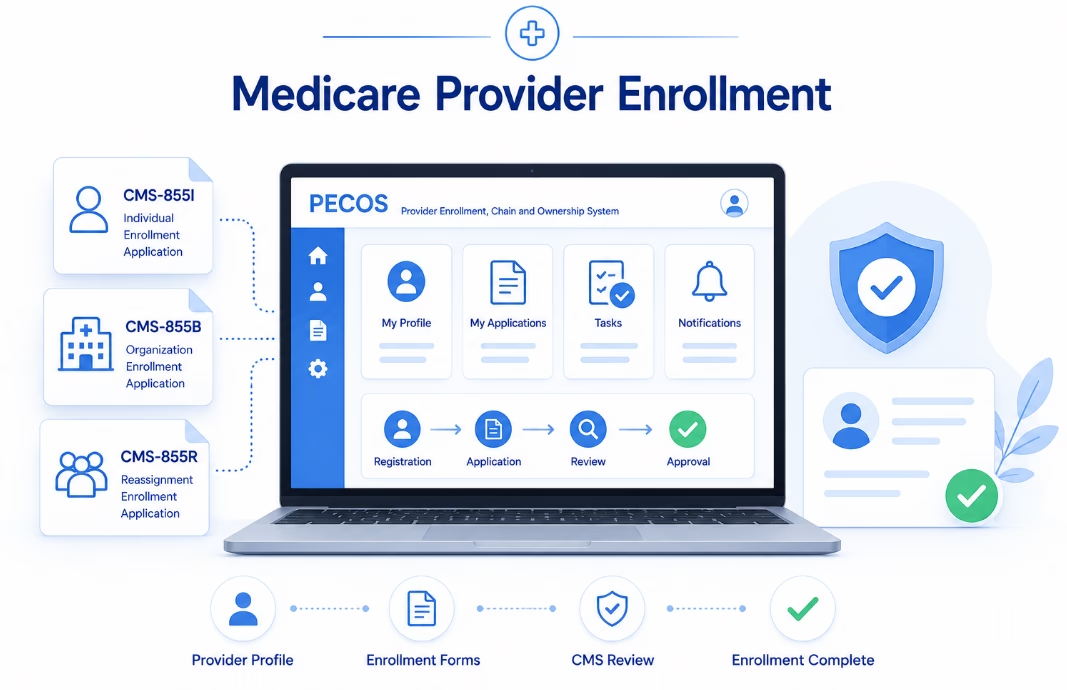
Medicare providers and suppliers still enroll through CMS processes.
CMS explains that PECOS is its online Medicare enrollment management system. Applications are processed by Medicare Administrative Contractors, which can request supporting documentation and make enrollment determinations.
An AI tool can help prepare or organize information, but it cannot independently approve Medicare enrollment.
CAQH Provider Data Portal
Many commercial health plans use provider information maintained through the CAQH Provider Data Portal.
Automation may help a practice organize CAQH information or identify items requiring attention, but the provider or authorized staff remain responsible for maintaining accurate information and completing required attestations.
Commercial payer portals
Commercial payers continue to control their own credentialing, contracting, enrollment, and network decisions.
An internal AI system should never convert “application submitted” into “approved” merely because no new payer message has been received.
What Are the Risks of AI Healthcare Credentialing?
1. Incorrect or Hallucinated Information
Generative AI can produce plausible information that is not supported by an authoritative source.
That creates an obvious risk in credentialing.
An AI-generated statement that a provider is licensed, participating, sanctioned, board certified, or approved should never replace verification from the appropriate authoritative source.
2. False Matches
Provider names are not unique.
An automated system may encounter providers with:
- Identical or similar names
- Name changes
- Multiple NPIs
- Licenses in several states
- Different practice addresses
Matching records without sufficient identifiers can attach the wrong information to the wrong provider.
3. Outdated Data
A correct result from last month may not be correct today.
Licenses, sanctions, insurance policies, payer participation, employment, and other credentialing information can change.
Automated systems should therefore record source and retrieval date rather than presenting old data as permanently valid.
4. Poor Explainability
If a system flags a provider as “high risk” without showing why, the output may be difficult to investigate or defend.
For consequential workflows, organizations should prefer systems that preserve:
- Source information
- Dates
- Underlying records
- Reason for the flag
- User activity
- Final human disposition
5. Automation Bias
Staff may place too much trust in an automated result because it appears authoritative.
A clean dashboard or confident AI-generated summary does not guarantee the underlying data is correct.
Organizations should train users to verify consequential findings instead of treating automation as a substitute for judgment.
Data Security and Privacy Risks
Credentialing records can contain highly sensitive provider information, including:
- Social Security numbers
- Dates of birth
- Government identification information
- Professional license information
- Banking information
- Employment history
- Malpractice information
- Portal credentials
Organizations evaluating an AI credentialing vendor should therefore consider more than the quality of the AI model.
Review areas such as:
- Encryption
- User authentication
- Role-based access
- Audit logging
- Data retention
- Backups
- Incident response
- Vendor access to provider data
- Subprocessors
- How submitted information is used to train or improve models
HIPAA requirements should also be evaluated when protected health information is involved, but not every credentialing-data security question is solely a HIPAA issue.
Why Data Quality Matters So Much
AI cannot reliably fix a credentialing operation built on poor source data.
If the system receives:
- Duplicate providers
- Incorrect license numbers
- Outdated practice locations
- Missing payer records
- Incorrect expiration dates
- Unstructured notes with conflicting information
automation may simply process bad information faster.
Before adding advanced AI features, organizations should establish basic data governance, including:
- Defined fields
- Authoritative sources
- Record ownership
- Change history
- Duplicate-management rules
- Review procedures
Human Oversight Should Be Designed Into the Workflow
The strongest credentialing automation model is generally not “AI versus people.” It is automation for repetitive work combined with human review for exceptions and decisions.
A practical division of responsibility could look like this:
| Task | Potential Role for Automation | Human Responsibility |
|---|---|---|
| Document intake | Classify and extract fields | Review uncertain or consequential information |
| Expiration tracking | Calculate reminders and flag overdue records | Complete renewal and resolve exceptions |
| Application review | Identify missing or inconsistent information | Determine whether a discrepancy is valid |
| Primary source checking | Query approved sources where technically supported | Review source reliability and conflicting results |
| Payer follow-up | Generate tasks, reminders, and summaries | Communicate with payer and interpret response |
| Credentialing decision | Organize evidence and flag exceptions | Apply approved policy and accountable judgment |
How Should Practices Evaluate an AI Credentialing Product?
Ask what is actually AI-powered
“AI credentialing” can refer to very different capabilities. Determine whether the product uses AI for document extraction, matching, summarization, anomaly detection, workflow prioritization, source verification, or another function.
Identify the authoritative data sources
For every important verification feature, ask where the information comes from and how current it is.
Review exception handling
Determine what happens when the system encounters conflicting information or low-confidence results.
Require auditability
Important actions should leave a record showing the source, result, user action, and final decision.
Evaluate integrations carefully
An integration should mean actual data exchange, not merely that the product stores a link or payer name.
Review security before uploading provider information
Understand how the vendor stores, processes, accesses, retains, and protects sensitive information.
Test with real exceptions
A simple provider file may not reveal weaknesses. Test the workflow with missing documents, similar names, multiple licenses, work-history gaps, changed addresses, and other realistic exceptions.
AI Credentialing Implementation Checklist
| Area | Question to Answer |
|---|---|
| Use case | Which specific credentialing problem is the technology supposed to solve? |
| Source | Where does the underlying provider information come from? |
| Accuracy | How are incorrect matches, extraction errors, and uncertain outputs handled? |
| Human review | Which outputs require human approval? |
| Audit trail | Can the organization reconstruct what the system did and why? |
| Security | How are sensitive provider records protected? |
| Integration | Which external systems exchange actual data with the platform? |
| Governance | Who owns configuration, data quality, exceptions, and policy changes? |
| Performance | Is success measured by reduced internal work, fewer missed tasks, better data quality, or another defined metric? |
Frequently Asked Questions
Can AI completely automate healthcare credentialing?
Not reliably across the entire process. AI can automate or support specific administrative tasks, but authoritative verification, payer processing, licensing decisions, complex exceptions, and final credentialing decisions can still require external organizations and human oversight.
Can AI verify a provider’s medical license?
A system may be able to retrieve information from an authoritative licensing source, but practices should confirm the source, retrieval date, matching method, and whether the workflow satisfies the organization’s credentialing requirements.
Does AI reduce payer enrollment time?
AI may reduce internal preparation or follow-up delays, but it cannot guarantee faster payer processing, contracting, network approval, or effective dates.
Can AI submit Medicare enrollment applications?
AI may assist staff in preparing information, but official Medicare enrollment still occurs through CMS processes. PECOS is CMS’s online Medicare enrollment system, and Medicare Administrative Contractors process applications.
Can AI ensure credentialing compliance?
No. Technology can monitor configured requirements, dates, and data points, but compliance depends on accurate rules, reliable sources, organizational policies, appropriate review, and applicable law and accreditation standards.
Is provider credentialing data protected by HIPAA?
Not every credentialing record is automatically protected health information under HIPAA. Credentialing systems may nevertheless contain highly sensitive personal and professional information that requires strong security controls. HIPAA requirements also apply when covered entities or business associates use the system to handle protected health information.
Will AI replace credentialing specialists?
AI is more useful as a tool for reducing repetitive administrative work and surfacing exceptions than as a replacement for experienced staff. Complex histories, source conflicts, payer requirements, and consequential decisions still require accountable human judgment.
How eClinicAssist Approaches Credentialing Technology
eClinicAssist combines credentialing and enrollment administration with a platform designed to organize provider, practice, facility, payer, document, renewal, enrollment, and follow-up information.
Automation can support tasks such as reminders, document organization, status tracking, and workflow visibility while experienced credentialing staff continue to manage payer-specific and provider-specific exceptions.
AI and automation should support a credentialing process, not create unsupported approvals or replace the authoritative systems that control licensure, payer participation, Medicare enrollment, and other external decisions.
Contact eClinicAssist to discuss credentialing, payer enrollment, and provider-data management support for your healthcare organization.
This article provides general administrative and technology information. AI product capabilities, credentialing standards, regulations, data sources, and payer workflows can change. Healthcare organizations should evaluate technology against their own credentialing policies, contractual requirements, applicable law, security obligations, and current authoritative guidance.