
Medicare and Medicaid revalidation is the periodic process of confirming that a provider’s enrollment information remains accurate and that the provider continues to meet program requirements. Most Medicare providers revalidate about every five years, while Medicaid providers must be revalidated by their state at least every five years. Missing a deadline can jeopardize payments and enrollment.
For practice managers and healthcare organizations, revalidation should be treated as an enrollment-management responsibility rather than a last-minute paperwork exercise. Medicare and Medicaid follow different administrative processes, deadlines can vary, and waiting for a notice creates unnecessary risk.
The safest approach is to track due dates, maintain current enrollment data, review supporting records before submission, and respond quickly when Medicare Administrative Contractors or state Medicaid agencies request additional information.
What Is Medicare and Medicaid Revalidation?
Revalidation is a periodic review of an existing provider enrollment record. It allows Medicare or a state Medicaid agency to confirm that information on file remains accurate and that the provider or supplier continues to satisfy applicable enrollment and screening requirements.
Revalidation is different from initial enrollment. It is also different from commercial payer credentialing, CAQH maintenance, and routine demographic updates.
Understanding those distinctions matters because a provider may have several administrative processes occurring at the same time. Our Medicare, Medicaid, and commercial payer enrollment guide explains how the enrollment pathways differ.
How Often Does Medicare Revalidation Occur?
According to CMS Medicare revalidation guidance, most Medicare providers and suppliers generally revalidate every five years. Durable Medical Equipment, Prosthetics, Orthotics, and Supplies (DMEPOS) suppliers generally revalidate every three years.
CMS can also require an off-cycle revalidation, so practices should rely on the provider’s actual Medicare enrollment record rather than calculating the next deadline solely from an earlier approval date.
How do you find a Medicare revalidation due date?
CMS maintains a public Medicare Revalidation List. Practices can search for individual providers and organizations to determine whether CMS has established a revalidation due date.
CMS generally posts due dates several months in advance. A listing of “TBD” means CMS has not yet established the provider’s next due date.
Enrollment contractors also generally send a revalidation notice by email or U.S. postal mail about three to four months before the due date. However, providers remain responsible for tracking their enrollment even if a notice is missed.
How Often Does Medicaid Revalidation Occur?
Medicaid revalidation is administered at the state level. Federal regulations require state Medicaid agencies to revalidate enrolled providers at least every five years, regardless of provider type.
States can impose additional screening procedures and may conduct off-cycle reviews when appropriate. Application portals, documentation, screening requirements, deadlines, and follow-up procedures can therefore differ from one Medicaid program to another.
The CMS Medicaid Provider Enrollment Compendium provides federal guidance on state provider enrollment and revalidation requirements.
For practices enrolled in multiple states, Medicaid revalidation should be tracked separately for each state enrollment rather than treated as one national deadline.
What Happens If You Miss a Medicare Revalidation Deadline?
A missed Medicare deadline is serious, but the consequences are more nuanced than an automatic termination on the due date.
Medicare may place the enrollment in a stay status
CMS has established a “stay of enrollment” process that may be used in certain enrollment noncompliance situations, including failure to respond to revalidation requirements.
During a stay, the provider remains enrolled, but Medicare payments can be held. If the provider corrects the problem within the applicable period and CMS removes the stay, claims for dates of service during the stay may remain eligible for payment.
Continued nonresponse can lead to deactivation
If the problem is not resolved, the Medicare Administrative Contractor may deactivate the provider’s Medicare billing privileges.
CMS states that when billing privileges are deactivated for failure to revalidate, the provider must submit a complete enrollment application to reactivate them. Medicare does not reimburse services furnished during the period in which billing privileges are deactivated.
This distinction is important. A temporary payment hold during a stay is not the same as a completed deactivation.
Practices dealing with broader Medicare enrollment risks should also review our guide to Medicare enrollment compliance and deactivation risks.
What Happens If Medicaid Revalidation Is Missed?
The exact consequence depends on the state Medicaid program and the provider’s circumstances. A state may deactivate, terminate, or otherwise remove an enrollment when revalidation requirements are not completed.
CMS guidance explains that when a provider seeks to reactivate or reenroll after being removed from Medicaid, the state may be required to conduct enrollment and risk-based screening again.
Because Medicaid is state administered, practices should follow the instructions from the applicable Medicaid agency rather than assuming Medicare procedures apply.
Common Medicare and Medicaid Revalidation Problems
1. Waiting for a notice instead of tracking the deadline
Email addresses change. Staff members leave. Letters can be routed to old practice locations.
Maintain an internal revalidation calendar and periodically compare Medicare dates with the official CMS Revalidation List. For Medicaid, use the applicable state portal and state correspondence.
2. Treating revalidation as the time to report old changes
Revalidation does not eliminate separate change-reporting responsibilities.
CMS instructs Medicare providers and suppliers to report certain changes, including changes in ownership, adverse legal actions, and practice locations, within 30 days. Other enrollment changes generally must be reported within 90 days.
If an address, owner, managing individual, banking relationship, or other enrollment item changes, determine whether it requires a separate update rather than waiting years for revalidation.
3. Submitting inaccurate enrollment information
Review the existing enrollment record before certifying it. Confirm legal business information, NPIs, Tax Identification Numbers, practice locations, ownership information, reassignment relationships, contact details, and required supporting documentation.
Not every difference between separate systems automatically causes rejection. However, incorrect enrollment information can trigger requests for clarification, additional documentation, or other processing problems.
For additional examples, see our guide to provider enrollment mistakes that can disrupt reimbursement.
4. Failing to respond to development requests
Submitting the application is not the final step. Medicare Administrative Contractors and Medicaid agencies may request additional information or corrections. For related provider identification requirements, review our NPPES application guide.
CMS advises Medicare providers to respond promptly to requests for additional documentation. Failure to respond can contribute to deactivation or other adverse enrollment action.
5. Assuming Medicare and Medicaid use the same workflow
They do not.
Medicare enrollment is administered through CMS and its Medicare Administrative Contractors. State Medicaid agencies administer Medicaid enrollment within federal requirements.
A Medicare revalidation does not automatically complete a state Medicaid revalidation, and vice versa.
How Should a Practice Prepare for Medicare Revalidation?
1. Check the official CMS due date
Use the Medicare Revalidation List rather than relying solely on a spreadsheet calculated from a previous enrollment date.
CMS specifically advises providers to revalidate when they are within approximately three months of their due date, even if they have not received a notice. CMS also cautions against submitting unsolicited revalidations too early.
2. Review the current PECOS record
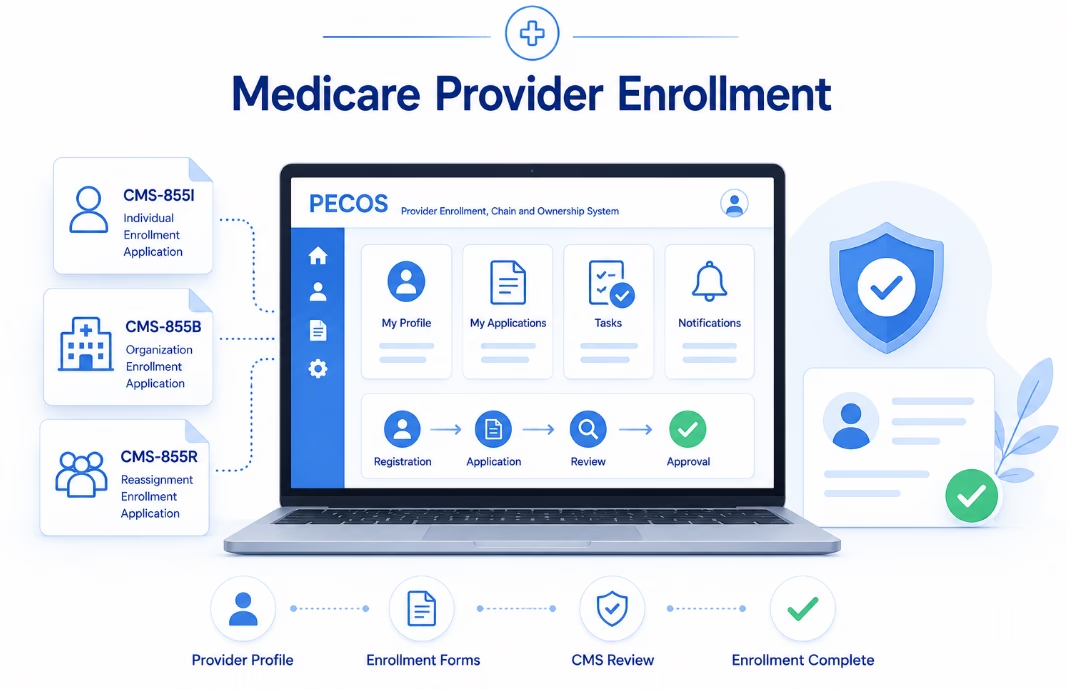
PECOS is CMS’s online Medicare enrollment management system. It allows providers to review existing enrollment information, upload documents, revalidate enrollment, report changes, electronically sign applications, and submit information to Medicare.
Before certification, review every applicable section rather than simply confirming old data.
Our PECOS provider enrollment guide provides additional background on how the system fits into Medicare enrollment.
3. Gather supporting information
The documentation needed depends on the provider type and enrollment record. Potential items can include organizational information, licenses, ownership information, banking documentation, practice locations, reassignment information, and other supporting records requested by CMS.
Do not upload documents simply because they appeared in a previous application. Follow the requirements displayed for the current transaction.
4. Submit and retain confirmation
PECOS is CMS’s preferred electronic method for Medicare revalidation. Retain the submission confirmation, application tracking information, supporting documents, and subsequent contractor correspondence.
5. Monitor the application until completion
Assign responsibility for checking application status and responding to requests. Revalidation should remain an open task until the practice has confirmation that the enrollment transaction has been processed.
How Should Practices Manage Medicaid Revalidation?
Build a state-specific workflow for every Medicaid program in which the practice participates.
- Confirm the provider and group enrollments that require revalidation.
- Track each state’s actual due date.
- Review the state’s current provider enrollment instructions.
- Identify required screening or disclosure information.
- Confirm which individuals or entities must complete separate actions.
- Retain submission and approval records.
- Monitor notices and respond to additional-information requests.
Do not assume that requirements seen in one state, including fingerprinting, application fees, disclosures, signatures, or portal procedures, automatically apply in another state.
Revalidation Tracking Checklist for Practice Managers
| Item | What to Track |
|---|---|
| Program | Medicare or the specific state Medicaid program |
| Enrollment | Individual, organization, location, reassignment, or other applicable record |
| Due date | Official date shown by CMS or the state Medicaid agency |
| Submission | Date submitted, confirmation number, and application reference |
| Development requests | Request date, response deadline, responsible staff member, and completion date |
| Final status | Processed, approved, reactivated, or other official outcome |
| Next review | Internal follow-up date and future revalidation monitoring |
Frequently Asked Questions
Is Medicare revalidation required every five years?
Generally, yes for most Medicare providers and suppliers. DMEPOS suppliers generally revalidate every three years. CMS can also request an off-cycle revalidation, so practices should follow the official CMS due date.
Does Medicaid require revalidation every five years?
Federal rules require state Medicaid agencies to revalidate enrolled providers at least every five years. States may impose additional or more stringent screening procedures and can conduct off-cycle revalidations.
Does missing Medicare revalidation immediately terminate the provider?
No. A missed deadline can lead to a payment hold, a stay of enrollment, or deactivation of billing privileges depending on the circumstances and subsequent response. Practices should address any missed deadline or contractor notice immediately.
Can Medicare revalidation be completed through PECOS?
Yes. PECOS is CMS’s online enrollment system and is the most efficient method for submitting Medicare revalidation information.
Should we wait for CMS to send a revalidation notice?
No. CMS sends notices, but providers are responsible for monitoring their due dates. The Medicare Revalidation List should be part of the practice’s routine enrollment monitoring process.
Does completing Medicare revalidation also revalidate Medicaid?
Not automatically. Medicare and Medicaid are separate enrollment programs. A state Medicaid agency may in some circumstances rely on screening performed by Medicare or another state, but practices must still follow the applicable Medicaid program’s instructions.
How eClinicAssist Supports Revalidation Management
Revalidation is easier to manage when enrollment records, deadlines, supporting documents, payer correspondence, and follow-up responsibilities are maintained in one organized workflow.
eClinicAssist supports healthcare practices with Medicare and Medicaid enrollment administration, revalidation tracking, PECOS submissions, provider documentation, payer enrollment follow-up, renewals, and related administrative processes.
eClinicAssist does not control CMS or state Medicaid approval decisions, enrollment effective dates, or the requirements imposed by government programs.
If your practice needs help organizing upcoming revalidations or resolving an enrollment workflow, contact eClinicAssist to discuss your provider enrollment needs.
This article provides general administrative information and is not legal advice. Medicare and Medicaid requirements can change, and Medicaid procedures vary by state. Always verify current requirements with CMS, your Medicare Administrative Contractor, and the applicable state Medicaid agency.