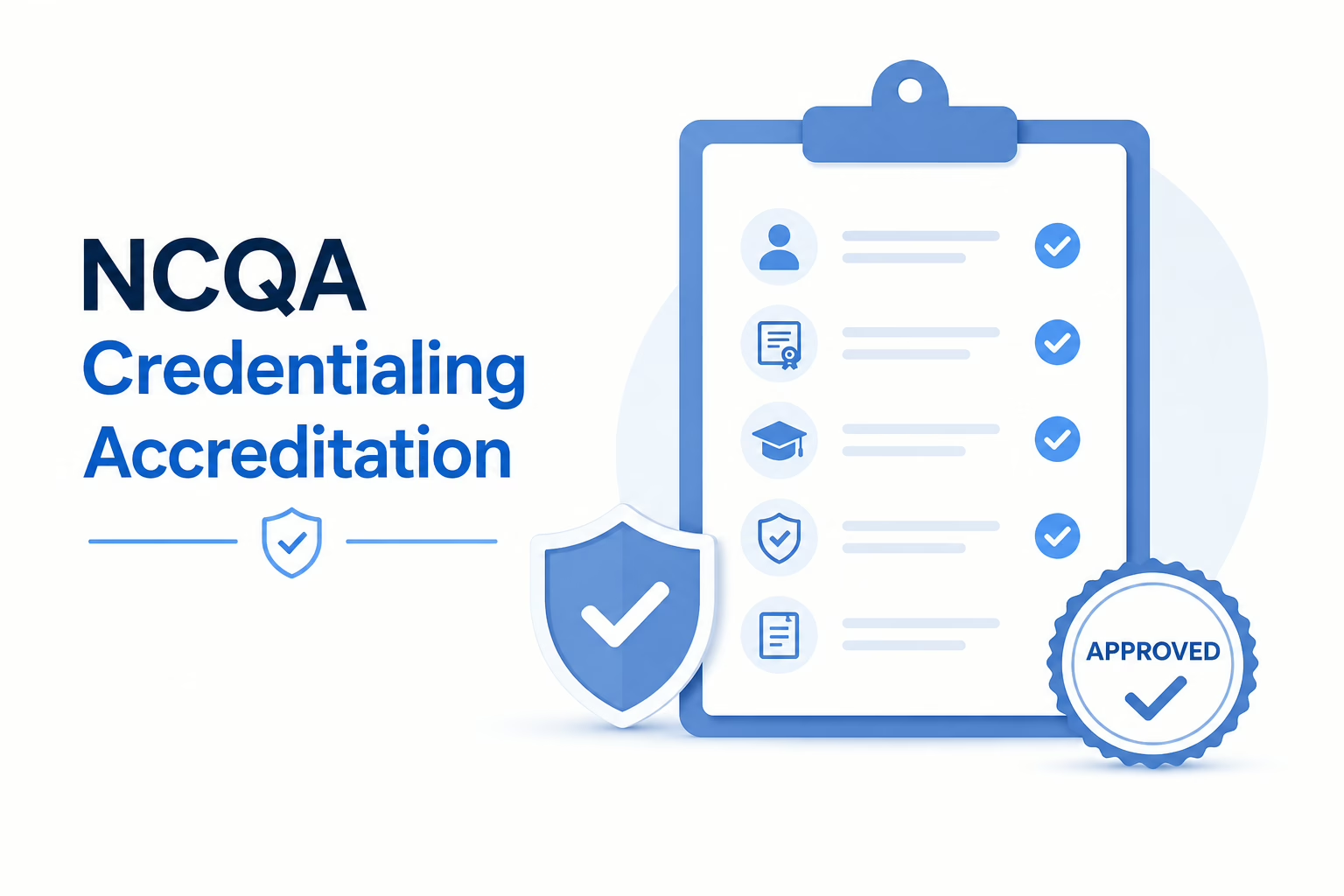
NCQA Credentialing Accreditation evaluates organizations that provide full-scope credentialing services. It reviews functions such as credential verification, credentialing committee oversight, recredentialing, ongoing monitoring, practitioner rights, information protection, delegation, and quality improvement. It is different from NCQA CVO Certification, which focuses primarily on credentials verification services. For additional context, review our guide to the NCQA accreditation process.
NCQA Credentialing Accreditation is often misunderstood as a general accreditation that any healthcare practice can pursue.
It is not.
The program is designed for eligible organizations that perform comprehensive credentialing functions for practitioner networks or contracted clients.
Before preparing for accreditation, an organization should first determine whether it actually meets NCQA’s eligibility criteria.
What Is NCQA Credentialing Accreditation?
NCQA Credentialing Accreditation is an evaluation program for organizations providing full-scope credentialing services.
Full-scope credentialing includes more than checking licenses or collecting documents.
NCQA currently identifies core services such as:
- Verifying practitioner credentials through appropriate sources
- Maintaining a designated credentialing committee
- Reviewing practitioner credentials and making credentialing recommendations
- Monitoring practitioner sanctions, complaints, and quality issues between formal recredentialing cycles
The program also evaluates governance, policies, confidentiality, practitioner rights, delegation, and quality improvement.
Who Is Eligible for NCQA Credentialing Accreditation?
NCQA currently states that eligible organizations must provide full-scope credentialing services.
Among the eligibility requirements, the organization:
- Must not be licensed as an HMO, POS, PPO, or EPO unless it falls within an applicable NCQA exception
- Must not otherwise be eligible for NCQA Health Plan or MBHO Accreditation, subject to applicable program rules
- Must perform credentialing functions directly or through contractual arrangements
- Must perform credentialing activities for at least 50% of the applicable practitioner network
A physician practice that simply credentials its own employees should not assume it qualifies for this program.
What Does “Full-Scope Credentialing” Mean?
Full-scope credentialing involves the organization taking responsibility for the broader credentialing decision process rather than only verifying individual credentials.
That can include:
- Practitioner application management
- Primary source or recognized-source verification
- Credentialing policies
- Credentialing committee review
- Credentialing decisions or recommendations
- Recredentialing
- Ongoing monitoring
- Practitioner rights
- Delegation oversight
What Does NCQA Credentialing Accreditation Evaluate?
NCQA currently identifies the following major requirement areas.
Internal Quality Improvement Process
The organization must maintain a structured process for evaluating and improving the quality of credentialing operations.
This can involve reviewing:
- Operational performance
- Errors
- Timeliness
- Process consistency
- Corrective actions
Agreement and Collaboration With Clients
Organizations providing credentialing services to clients need clearly defined responsibilities.
Agreements should identify which credentialing functions are performed by:
- The credentialing organization
- The client
- Any delegated or contracted entity
Protecting Credentialing Information
Credentialing records contain sensitive professional and personal information.
NCQA evaluates how organizations protect that information from inappropriate access, disclosure, alteration, or loss.
Credentialing Policies
Organizations need written credentialing policies that reflect their actual operations.
Policies may address:
- Initial credentialing
- Recredentialing
- Verification
- Committee review
- Monitoring
- Practitioner rights
- Delegation
Credentialing Committee
Full-scope Credentialing Accreditation includes a designated credentialing committee that reviews practitioner credentials and makes credentialing recommendations.
This is one of the major differences between full-scope Credentialing Accreditation and a verification-only program.
Credentialing Verification
NCQA evaluates whether practitioner credentials are verified using acceptable sources and within applicable requirements.
Verification can involve areas such as:
- Professional licensure
- DEA or controlled-substance registration where applicable
- Education and training
- Board certification
- Work history
- Malpractice history
- Sanctions
Recredentialing Cycle Length
NCQA evaluates whether the organization recredentials practitioners within the required cycle established by the applicable standards.
Recredentialing is a separate process from professional license renewal or Medicare revalidation.
Ongoing Monitoring
Credentialing does not stop between formal recredentialing cycles.
NCQA standards include ongoing monitoring of areas such as:
- Sanctions
- Complaints
- Quality issues
The organization also needs a process for responding appropriately when significant information is identified.
Notification to Authorities and Practitioner Appeal Rights
NCQA Credentialing Accreditation includes requirements related to practitioner rights and applicable notification responsibilities.
Organizations should have defined procedures governing:
- Adverse credentialing decisions
- Practitioner notification
- Appeal rights
- Applicable notification to authorities
Assessment of Organizational Providers
The accreditation framework also addresses assessment of organizational providers where applicable.
This is distinct from credentialing individual practitioners.
Delegation of Credentialing
If credentialing activities are delegated, the organization must maintain appropriate oversight.
Delegating work does not automatically remove the organization’s responsibility for managing the delegated relationship under the applicable standards.
Is NCQA Credentialing Accreditation the Same as CVO Certification?
No.
| Credentialing Accreditation | CVO Certification |
|---|---|
| Designed for full-scope credentialing organizations | Designed for credentials verification organizations |
| Includes credentialing committee functions | Primarily evaluates verification operations |
| Includes recredentialing and ongoing monitoring | Can certify defined credentials verification functions |
| Includes practitioner rights and delegation requirements | Focuses on accurate verification and reporting to clients |
What Is NCQA CVO Certification?
NCQA Credentials Verification Organization Certification evaluates organizations that verify practitioner credentials for clients.
Verification is performed through:
- A primary source
- A recognized source
- A contracted agent of the primary source
The CVO then reports verified information to its clients.
What Does CVO Certification Evaluate?
NCQA currently identifies three broad focus areas:
- Internal quality improvement
- Protection of credentialing information
- Verification of credentials
NCQA currently offers certification options involving areas such as:
- License to practice
- DEA or CDS certification
- Education and training
- Board certification status
- Work history
- Malpractice claims history
- State licensing board sanctions
- Medicare and Medicaid sanctions
- Practitioner application processing
- Application and attestation content
- Ongoing monitoring of sanctions
Who Is Eligible for NCQA CVO Certification?
NCQA currently states that an organization providing credential verification services may apply if it meets requirements including:
- Providing verification services to health plans, MBHOs, physician organizations, or healthcare organizations
- Providing verification services for at least six months before application
- Performing verification activities for at least 50% of contracted practitioners
- Maintaining the documentation, policies, and procedures needed for survey
- Maintaining required errors and omissions insurance
Is Credentialing Accreditation the Same as Health Plan Accreditation?
No.
NCQA Health Plan Accreditation evaluates organizations providing managed healthcare services.
It covers much broader areas such as:
- Quality improvement
- Population health
- Network management
- Utilization management
- Credentialing and recredentialing
- Member rights
- Member experience
Credentialing is only one part of Health Plan Accreditation.
See our NCQA Health Plan Accreditation guide for the broader program.
How Does the NCQA Credentialing Accreditation Process Work?
Step 1: Confirm Eligibility
NCQA recommends beginning with a discussion with a program expert.
This helps determine:
- Whether the organization is eligible
- Which program is appropriate
- Which evaluation areas apply
Step 2: Obtain the Current Standards and Survey Tool
The organization should work from the standards applicable to the actual survey cycle.
Do not rely on old accreditation checklists or unofficial summaries.
Step 3: Conduct a Gap Analysis
Compare current operations against the applicable NCQA requirements.
Potential gaps may involve:
- Policies
- Credentialing committee structure
- Verification procedures
- Recredentialing
- Monitoring
- Information security
- Practitioner rights
- Delegation oversight
- Quality improvement
Step 4: Align Operations With the Requirements
NCQA’s current process guidance recommends working toward full alignment well before survey submission.
This can involve:
- Policy changes
- Workflow changes
- Staff training
- File cleanup
- Committee documentation
- Monitoring-process improvements
Step 5: Submit the Survey Tool
The completed Survey Tool is submitted on the assigned survey start date.
This begins the formal survey process.
Step 6: Complete File Review Where Required
NCQA states that an onsite file review may be scheduled if required by the Credentialing Accreditation program.
Not every survey should therefore be described as an identical onsite audit.
Step 7: Review the Preliminary Report
After review, NCQA provides a preliminary report.
The organization currently has a defined period to review the report and provide comments or additional documentation.
Step 8: Receive the Final Accreditation Decision
The final materials are reviewed through NCQA’s accreditation process before the organization’s accreditation status is determined.
How Long Does NCQA Credentialing Accreditation Take?
NCQA currently states that the typical evaluation timeframe is approximately 12 months from application submission to decision.
The actual timeframe depends on organizational readiness.
NCQA recommends beginning planning well before the desired survey start date.
Does NCQA Accreditation Speed Up Payer Enrollment?
Not automatically.
Credentialing Accreditation evaluates the quality and structure of the credentialing organization’s operations.
It does not control:
- Payer network availability
- Individual payer application processing
- Contract negotiation
- Payer enrollment timelines
- Effective dates
An accredited credentialing organization may use more standardized credentialing processes, but payer enrollment remains a separate process.
Does NCQA Accreditation Reduce Claim Denials?
Not directly.
Claim denials can result from many issues unrelated to credentialing, including:
- Eligibility
- Authorization
- Coding
- Medical necessity
- Timely filing
- Coordination of benefits
- Provider enrollment
- Group affiliation
Credentialing Accreditation should not be marketed as a claim-denial prevention program.
Does NCQA Accreditation Establish Medicare or Medicaid Compliance?
No.
Medicare and Medicaid have separate enrollment, screening, program-integrity, and billing requirements.
NCQA standards may review sanction information related to government programs, but accreditation does not replace:
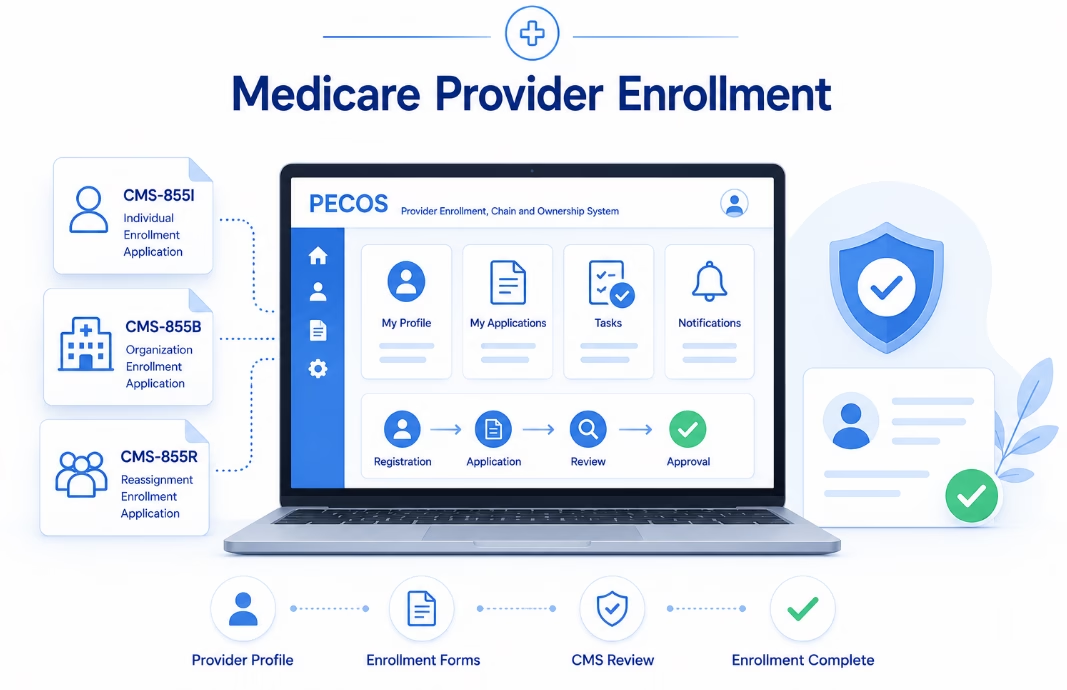
- PECOS enrollment
- Medicare revalidation
- State Medicaid enrollment
- Medicaid screening
- Government program compliance
How Should Organizations Prepare Credentialing Files?
File preparation should begin well before survey submission.
Review:
- Applications
- Required attestations
- Primary source verifications
- Committee activity
- Credentialing decisions
- Recredentialing activity
- Monitoring documentation
- Practitioner notifications
See our credentialing audit checklist for a broader internal review framework.
How Should Provider Documents Be Managed?
Provider information should be organized, current, protected, and accessible to authorized credentialing staff.
Depending on the practitioner and program, information may include:
- Professional licenses
- Education and training
- Board certification
- Work history
- Professional liability information
- DEA or CDS information where applicable
- Sanctions information
See our provider credentialing documents guide for the operational document workflow.
Can Technology Help With NCQA Credentialing Requirements?
Technology can support functions such as:
- Credential storage
- Expiration tracking
- Application status
- Committee records
- Recredentialing schedules
- Ongoing monitoring tasks
- Audit trails
- Delegation tracking
However, software does not independently establish compliance with NCQA standards.
The organization remains responsible for its policies, verification methodology, committee processes, decision-making, monitoring, and evidence.
Common NCQA Credentialing Accreditation Readiness Problems
Using outdated standards
Prepare against the standards for the actual evaluation year.
Policies do not match operations
Written policy and actual workflow should align.
Incomplete credentialing files
Missing verification, applications, or decision documentation can create survey issues.
Weak credentialing committee documentation
Committee responsibilities and decisions should be documented consistently.
Inconsistent ongoing monitoring
Organizations need defined monitoring processes between recredentialing cycles.
Weak delegation oversight
Delegated credentialing functions still require appropriate oversight under applicable standards.
Inadequate protection of credentialing information
Access and handling controls should reflect the sensitivity of credentialing information.
NCQA Credentialing Accreditation Readiness Checklist
| Area | What to Confirm |
|---|---|
| Eligibility | Organization qualifies for full-scope Credentialing Accreditation |
| Current standards | Correct Standards and Guidelines obtained |
| Quality improvement | Internal credentialing QI process documented |
| Client agreements | Responsibilities clearly defined |
| Information protection | Credentialing information appropriately safeguarded |
| Policies | Written policies match actual operations |
| Credentialing committee | Committee structure and activity documented |
| Verification | Credentials verified using applicable approved sources |
| Recredentialing | Required recredentialing cycle maintained |
| Ongoing monitoring | Sanctions, complaints, and quality issues monitored |
| Practitioner rights | Applicable notification and appeal processes documented |
| Organizational providers | Applicable assessment processes maintained |
| Delegation | Delegated credentialing activity appropriately overseen |
Frequently Asked Questions
What is NCQA Credentialing Accreditation?
NCQA Credentialing Accreditation evaluates organizations that provide full-scope credentialing services, including verification, credentialing committee review, recredentialing, ongoing monitoring, practitioner rights, and related credentialing operations.
Can a regular medical practice get NCQA Credentialing Accreditation?
Not simply because it credentials its own providers. The organization must meet NCQA’s specific eligibility requirements for full-scope credentialing services.
What is the difference between NCQA Credentialing Accreditation and CVO Certification?
Credentialing Accreditation covers full-scope credentialing and decision-support functions. CVO Certification focuses on verification of practitioner credentials and reporting verified information to clients.
Does NCQA Credentialing Accreditation include recredentialing?
Yes. Recredentialing cycle length is one of the current Credentialing Accreditation requirement areas.
Does NCQA require ongoing monitoring?
Yes. Current Credentialing Accreditation requirements include monitoring practitioner sanctions, complaints, and quality issues between recredentialing cycles.
How long does NCQA Credentialing Accreditation take?
NCQA currently states that the typical evaluation timeframe is approximately 12 months from application submission to decision, depending on organizational readiness.
Does NCQA Accreditation make payer enrollment faster?
No guarantee exists. Payer enrollment, network availability, contracting, and effective dates remain controlled by individual payers and programs.
Does NCQA Credentialing Accreditation guarantee compliance?
No. Accreditation demonstrates that the organization has met the applicable NCQA program requirements for the evaluated scope. Legal, payer, Medicare, Medicaid, and other regulatory obligations remain separate.
Does software automatically make an organization NCQA compliant?
No. Technology can support documentation and workflow management, but the organization remains responsible for meeting the applicable NCQA standards.
Choose the Correct NCQA Credentialing Program
The most important first step is selecting the program that matches the organization’s actual role.
An organization providing full-scope credentialing may need to evaluate NCQA Credentialing Accreditation.
An organization primarily verifying practitioner credentials for clients may be better aligned with CVO Certification.
A health plan providing managed healthcare services may instead fall under Health Plan Accreditation or another applicable NCQA program.
Choosing the correct program before investing in policies, technology, or survey preparation can prevent unnecessary work.
eClinicAssist supports healthcare organizations with provider credentialing administration, provider-document management, credential expiration tracking, recredentialing workflows, payer enrollment, CAQH administration, and related credentialing operations.
eClinicAssist does not grant NCQA Accreditation or Certification, determine official survey scores, interpret NCQA standards on behalf of NCQA, or guarantee accreditation outcomes.
Contact eClinicAssist to discuss credentialing workflow and provider-data support for your organization.
This article provides general administrative information and is not official NCQA, legal, accreditation, regulatory, or consulting advice. NCQA eligibility, standards, survey requirements, and program terminology may change. Organizations should verify current requirements directly with NCQA and the standards applicable to their evaluation year.