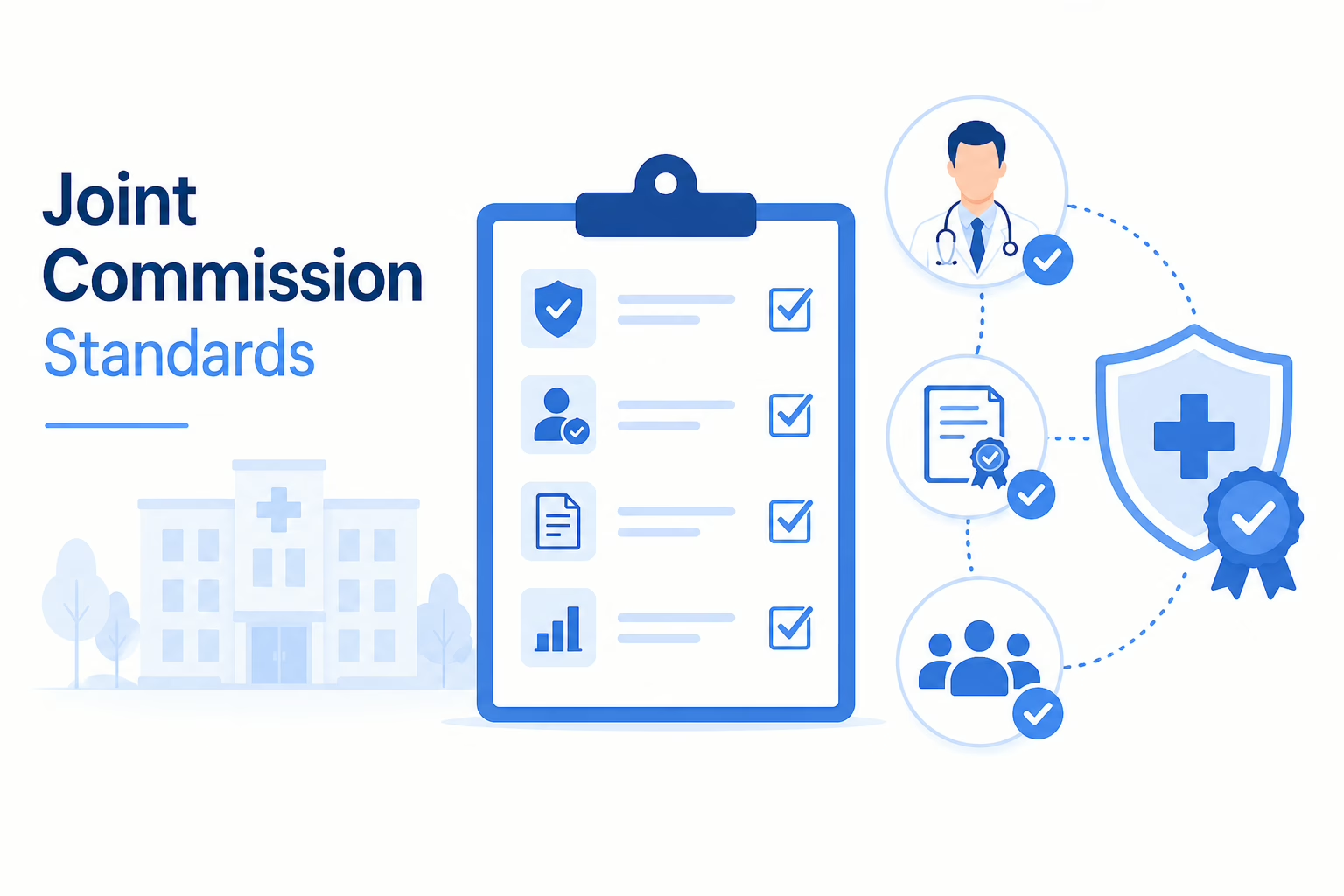
Joint Commission credentialing standards require applicable accredited organizations to use defined processes for verifying practitioner qualifications, confirming identity, evaluating required credentials, assessing current competence where privileges are granted, and maintaining reappointment or reprivileging processes. The exact requirements depend on the accreditation program, practitioner role, and healthcare setting.
Joint Commission credentialing requirements are often described too broadly.
They are not simply a checklist of licenses, degrees, and insurance documents.
The requirements vary depending on whether the organization is a hospital, Critical Access Hospital, ambulatory organization, office-based surgery program, behavioral health organization, or another accredited setting.
What Are Joint Commission Credentialing Standards?
Joint Commission credentialing standards establish requirements for how applicable accredited organizations verify and evaluate the qualifications of individuals who provide healthcare services.
Depending on the program, this can include:
- Identity verification
- Licensure verification
- Certification or registration verification
- Education and training review
- Experience review
- Current competence
- Clinical privileging
- Reappointment and reprivileging
- Credential file documentation
The applicable standard should always be read within the correct Joint Commission accreditation manual and chapter.
Do Joint Commission Credentialing Standards Apply to Every Medical Practice?
No.
Joint Commission standards apply to organizations participating in the applicable accreditation program.
An ordinary physician practice that is not participating in a Joint Commission accreditation program should not assume that every Joint Commission credentialing standard applies to it.
Other requirements may instead come from:
- State law
- Payer contracts
- Medicare or Medicaid
- Hospital bylaws
- Other accrediting organizations
- Employer policies
What Is Primary Source Verification Under Joint Commission Standards?
Joint Commission defines primary source verification as confirmation of a practitioner’s reported qualification through the original source or an approved agent of that source.
Methods may include:
- Secure electronic verification
- Direct correspondence
- Documented telephone verification
- A qualifying credentials verification organization
The accredited organization is responsible for ensuring that the verification is completed and appropriately documented.
Which Credentials Require Primary Source Verification?
Joint Commission currently requires primary source verification of a license, certification, or registration when that credential is required by law or regulation for the individual to practice the profession.
The verification should confirm that the credential is current and valid.
Depending on the program and practitioner, additional qualifications may also require verification under separate standards.
Is a Copy of a License Enough?
No.
Simply placing a copy of a professional license in the credentialing file does not demonstrate that the organization completed primary source verification.
The organization should be able to document information such as:
- What was verified
- Source used
- Date of verification
- Person or process completing the verification
- Result of the verification
Does Education Always Need Primary Source Verification?
No.
Joint Commission requirements differ according to the applicable standard and setting.
For some staff qualification requirements, education and experience must be verified and documented when they are required by the role, but the organization may determine the verification method.
In medical staff credentialing and privileging, additional verification may be appropriate when education or training is relevant to determining whether a practitioner is qualified for requested privileges.
The organization should therefore avoid a blanket rule that every educational credential must always be verified directly with the school.
What Is a Credentials Verification Organization?
A Credentials Verification Organization, or CVO, performs credential verification services for healthcare organizations.
Joint Commission allows organizations to use qualifying CVOs or equivalent sources when those sources meet applicable requirements.
Using a CVO does not eliminate the accredited organization’s responsibility to ensure that credentialing requirements are satisfied.
Does Joint Commission Require Practitioner Identity Verification?
Yes, for applicable credentialing and privileging processes.
Joint Commission currently permits identity verification using:
- A current organizational photo identification card
- A valid government-issued photo ID such as a driver’s license or passport
- Qualifying Identity Assurance Level 2 credentials
The verification may occur during the application process or when the practitioner enters the organization.
Does the Organization Need to Keep a Copy of the Photo ID?
No.
Joint Commission specifically states that retaining a copy of the photo ID is not required or recommended solely for identity verification because of identity-theft concerns.
The credentialing file should instead document that verification occurred.
Can Practitioner Identity Be Verified Remotely?
Yes, in applicable circumstances.
Joint Commission allows identity verification through an audio-video telecommunications link.
For telehealth practitioners who never physically enter the patient-site organization, identity verification can be completed at the distant site using the organization’s defined process.
What Is the Difference Between Credentialing and Privileging?
| Credentialing | Privileging |
|---|---|
| Evaluates and verifies professional qualifications | Determines which clinical activities the practitioner may perform |
| Includes review of licenses, training, experience, and other qualifications | Focuses on competence for specific procedures or services |
| Answers whether the practitioner is professionally qualified | Answers what the practitioner may do within the organization |
See our credentialing vs privileging vs enrollment guide for a broader comparison.
What Does Joint Commission Require for Clinical Privileges?
For applicable hospital and Critical Access Hospital programs, privileging decisions should evaluate whether the practitioner’s education, training, and current competence support the privileges requested.
This applies whether privileges are listed individually or organized into a core or bundled privilege model.
What Are Core or Bundled Privileges?
A core or bundled privileging model groups related clinical activities into a defined privilege set.
Joint Commission does not prohibit this approach.
However, the organization should clearly define what is included in the bundle and evaluate whether the practitioner has appropriate education, training, and current competence for each included activity.
What Is Current Competence?
Current competence concerns whether the practitioner can presently perform the requested clinical activity safely and appropriately.
Evidence may include:
- Recent experience
- Clinical performance
- Procedure history
- Peer information
- Training
- Other organization-defined evidence
The appropriate evidence depends on the privilege and organizational criteria.
How Often Does Joint Commission Require Reappointment and Reprivileging?
Current Joint Commission guidance states that reappointment and reprivileging are due no later than every three years from the previous appointment or reappointment date.
If applicable law or regulation requires a shorter period, the shorter timeframe applies.
Organizations should not continue using an older two-year assumption without checking their current accreditation and regulatory requirements.
Does the Governing Body Approval Date Have to Match the Reappointment Date?
No.
Joint Commission guidance states that governing body approval may occur before the upcoming effective period.
The important point is that approval occurs before the current appointment or privilege period expires.
Is Reappointment the Same as Payer Recredentialing?
No.
These are separate processes.
| Process | Purpose |
|---|---|
| Medical staff reappointment | Periodic review of medical staff appointment |
| Reprivileging | Periodic review of clinical privileges |
| Payer recredentialing | Periodic health plan review of provider qualifications |
| Medicare revalidation | CMS provider enrollment maintenance process |
These cycles should be tracked separately.
Does Joint Commission Credentialing Control Payer Enrollment?
No.
Joint Commission accreditation and payer enrollment are separate.
A practitioner may satisfy an organization’s credentialing requirements and still need separate:
- Commercial payer credentialing
- Payer enrollment
- Group affiliation
- Medicare enrollment
- Medicaid enrollment
- Network activation
Does Joint Commission Credentialing Affect Claim Payment?
Not automatically.
Claims payment depends on factors such as:
- Payer enrollment
- Network status
- Coverage
- Authorization
- Coding
- Medical necessity
- Effective dates
An organization’s Joint Commission accreditation status should not be treated as a universal billing-status indicator.
What Should Be in a Credentialing File?
The exact contents depend on practitioner type, accreditation program, organization, and applicable requirements.
A file may include:
- Application
- Identity verification documentation
- Licensure verification
- Certification or registration verification
- Education and training information
- Experience
- Current competence information
- Privilege requests where applicable
- Committee or medical staff review documentation
- Approval information
- Reappointment or reprivileging dates
See our provider credentialing documents guide for a broader administrative checklist.
How Should Primary Source Verification Be Documented?
Joint Commission states that organizations are responsible for defining how PSV completion will be documented.
The record should make clear:
- Date verification occurred
- Who completed it
- What was verified
- Verification result
Electronic credentialing systems can help maintain this audit trail.
Can Credentialing Software Make an Organization Joint Commission Compliant?
No.
Technology can support:
- Credential tracking
- Expiration alerts
- Document storage
- Verification records
- Privilege tracking
- Reappointment dates
- Audit trails
But software does not replace organizational policies, credentialing decisions, medical staff review, competence assessment, or governing body responsibilities.
Common Joint Commission Credentialing Mistakes
Treating Every Accreditation Standard as a Credentialing Standard
Credentialing is one part of the broader accreditation framework.
Keeping Only a Copy of the License
A copy does not replace required primary source verification.
Assuming Every Degree Requires Primary Source Verification
The applicable standard and organizational need determine the verification requirement.
Confusing Credentialing With Privileging
Qualification review and clinical authorization are separate.
Using Outdated Reappointment Cycles
Current Joint Commission guidance allows up to three years unless law or regulation requires a shorter period.
Failing to Document Identity Verification
The organization should document that the applicant’s identity was verified using an acceptable method.
Keeping Unnecessary Copies of Photo IDs
Joint Commission specifically states that keeping a copy is not required or recommended solely for identity verification.
Assuming Accreditation Replaces Payer Enrollment
Payer credentialing and enrollment remain separate processes.
Joint Commission Credentialing Checklist
| Area | What to Confirm |
|---|---|
| Program | Correct Joint Commission accreditation program and standards identified |
| Identity | Applicant identity verified and documented |
| License | Required license verified through an acceptable primary source |
| Certification or registration | Verified where required by law, regulation, or applicable standard |
| Education and training | Reviewed and verified according to applicable requirements |
| Experience | Relevant experience evaluated |
| Current competence | Evaluated where applicable to requested privileges |
| Privileges | Specific or bundled privileges clearly defined |
| PSV evidence | Date, source, verifier, and result documented |
| Reappointment | Next applicable appointment review date tracked |
| Reprivileging | Privilege renewal due date tracked separately |
Frequently Asked Questions
What are Joint Commission credentialing standards?
They are requirements used within applicable Joint Commission accreditation programs to verify and evaluate practitioner qualifications, identity, licensure, credentials, competence, and privileges.
Does Joint Commission require primary source verification?
Yes. Joint Commission requires PSV for licenses, certifications, or registrations required by law or regulation to practice the profession, with additional requirements depending on the program and practitioner.
Is a photocopy of a license enough?
No. A copy of a license does not demonstrate that the accredited organization completed required primary source verification.
Does Joint Commission require education to always be primary-source verified?
No. Requirements vary by the applicable standard, practitioner, job responsibilities, and credentialing or privileging context.
Does Joint Commission require identity verification?
Yes, in applicable credentialing and privileging programs. Acceptable methods can include organizational or government-issued photo identification and qualifying IAL2 credentials.
Should the organization keep a copy of the provider’s driver’s license?
Not solely for Joint Commission identity verification. Joint Commission states that retaining the copy is not required or recommended for this purpose.
How often does Joint Commission require reappointment?
Current guidance states that reappointment and reprivileging are due no later than every three years, unless law or regulation requires a shorter period.
Is payer credentialing the same as Joint Commission credentialing?
No. Payer credentialing determines qualifications for participation with a health plan, while Joint Commission requirements apply within the scope of the accredited healthcare organization.
Does Joint Commission accreditation mean a provider is in-network?
No. Network participation, payer enrollment, contracting, group affiliation, and effective dates are separate.
Use the Correct Joint Commission Standard for the Correct Setting
The most important principle is that there is no single universal Joint Commission credentialing checklist for every healthcare organization.
Organizations should first determine:
- Which accreditation program applies
- Which practitioners fall under the relevant standards
- Which credentials require verification
- What evidence of current competence is needed
- Whether clinical privileges are involved
- When reappointment or reprivileging is due
From there, a structured credentialing system can help maintain the required provider information and documentation.
eClinicAssist supports healthcare organizations with provider credentialing administration, document tracking, credential expiration monitoring, primary source verification coordination, recredentialing workflows, payer enrollment, and related provider-data management.
eClinicAssist does not grant Joint Commission accreditation, make privileging decisions, evaluate clinical competence, interpret standards on behalf of The Joint Commission, or guarantee accreditation outcomes.
Contact eClinicAssist to discuss credentialing and provider-data workflow support for your organization.
This article provides general administrative information and is not official Joint Commission, legal, accreditation, clinical, privileging, or payer-specific advice. Standards differ by accreditation program and may change. Organizations should verify current requirements using the applicable Joint Commission accreditation manual, Standards FAQs, law, regulation, and organizational bylaws.