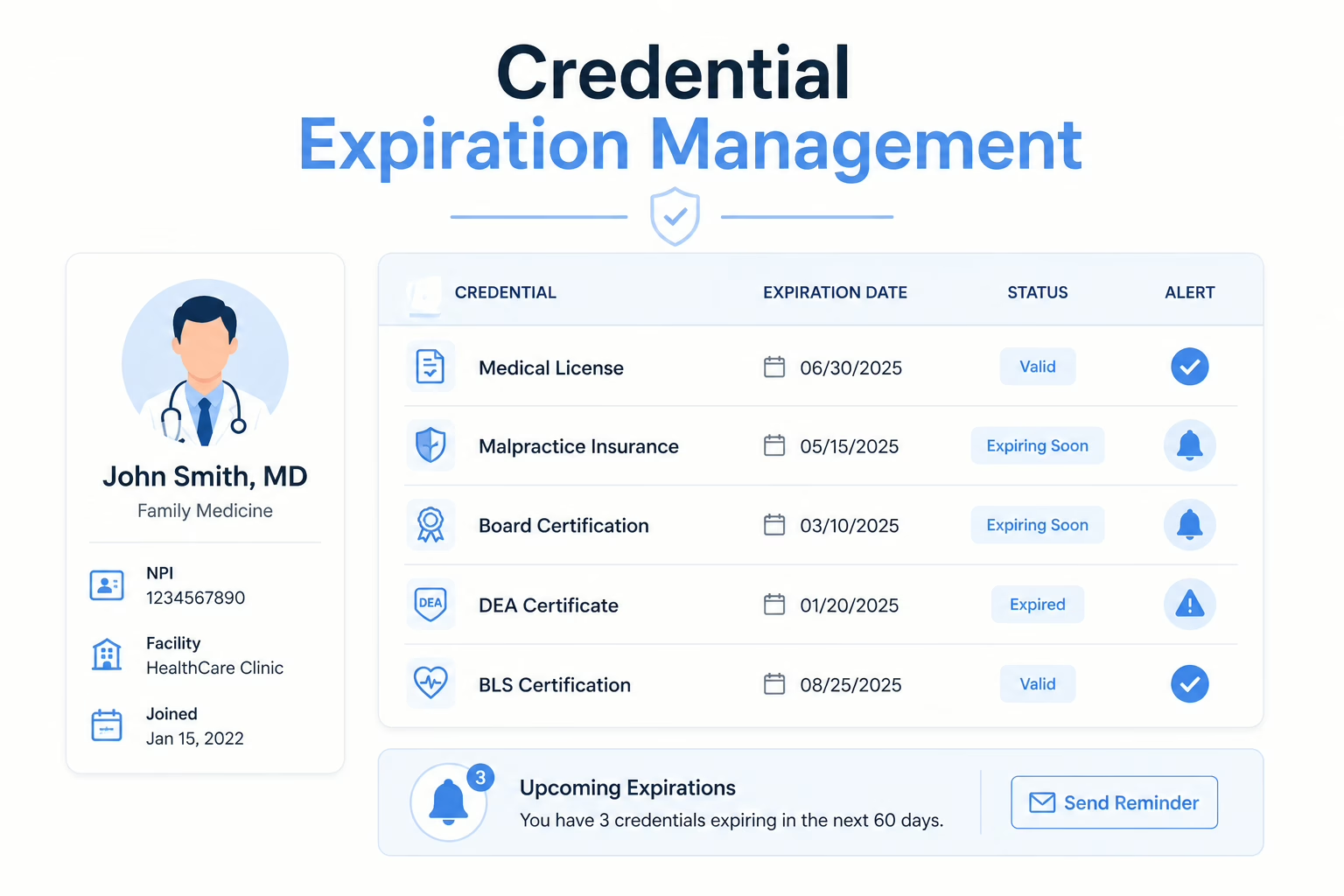
Credential expiration management is the process of tracking provider licenses, registrations, certifications, professional liability coverage, CAQH information, and other time-sensitive credentials before they lapse. Not every expiration has the same consequence. Practices should classify credentials by operational risk, assign an owner, track renewal dependencies, and verify the updated credential before closing the task.
A provider file may contain dozens of documents and data points, but only some of them have expiration dates.
Even among those that expire, the consequences are very different.
An expired state professional license can affect legal authority to practice.
An expired DEA registration can affect controlled-substance prescribing authority.
An expired professional liability policy may affect a payer or facility if coverage is required.
An expired CAQH attestation may interfere with credentialing workflows but does not automatically terminate the provider’s license or payer relationship.
This is why credential expiration management should be based on risk, not just reminders.
What Is Credential Expiration Management?
Credential expiration management is the ongoing process of identifying time-sensitive provider qualifications and administrative records, monitoring their renewal dates, obtaining updates, verifying the renewed information, and communicating changes to systems or organizations that need them.
Common examples include:
- Professional licenses
- APRN or other advanced-practice authorizations
- Board certifications
- National certifications
- DEA registrations
- State controlled-substance registrations
- Professional liability insurance
- CAQH attestations
- Other payer or facility-specific qualifications
Why Should Credentials Not All Be Treated the Same?
Because each credential represents something different.
| Credential | What It Generally Represents | Potential Impact of Expiration |
|---|---|---|
| State professional license | Legal authority to practice the profession | May affect ability to legally practice |
| DEA registration | Federal authority related to controlled substances | May affect controlled-substance activities |
| Board certification | Specialty certification | Depends on employer, payer, privilege, or specialty requirements |
| Professional liability coverage | Insurance or applicable liability arrangement | Depends on payer, employer, hospital, contract, or state requirements |
| CAQH attestation | Provider confirmation that CAQH data remains current | May interfere with payer credentialing or recredentialing workflows |
Which Credential Expirations Are Highest Risk?
The highest-risk items are generally those that directly affect the provider’s legal authority or ability to perform a regulated activity.
Examples may include:
- State professional license
- Required APRN authorization
- State controlled-substance authority
- DEA registration when controlled-substance activities are part of the provider’s role
The exact consequence depends on the profession and jurisdiction.
What Happens if a Medical License Expires?
A professional license is different from an ordinary credentialing document.
State licensing boards grant legal authority to practice a regulated profession.
For physicians, FSMB notes that practitioners must periodically renew their state licenses to maintain active status.
A practice should not allow a provider to continue practicing based solely on an old certificate when the licensing authority shows the license is no longer active.
Should Practices Verify License Renewal at the Primary Source?
Yes, when primary source verification is required or appropriate.
A newly uploaded license document may show what the provider received, but the practice should verify the credential through the applicable licensing authority or other acceptable verification source when required.
See our primary source verification guide for the difference between collecting a credential and verifying it.
What Happens if DEA Registration Expires?
DEA registration is tied to controlled-substance activities.
It should not be treated as a universal medical license.
When DEA registration is required for the provider’s role, an expired or inactive registration can affect the provider’s authority to prescribe, administer, dispense, or otherwise handle controlled substances within the scope of federal and state law.
It does not automatically mean:
- The professional license expired
- The provider cannot provide any healthcare services
- Every payer enrollment is terminated
- Every claim becomes nonpayable
The practice should separately evaluate state authority, DEA status, the services being performed, and payer or facility requirements.
Does Every Provider Need a DEA Registration?
No.
DEA registration is relevant to practitioners who handle controlled substances and have the required underlying professional and state authority.
Do not create a universal DEA expiration task for providers whose roles do not require DEA registration.
What Happens if Board Certification Expires?
Board certification and professional licensure are separate.
An expired board certification does not automatically mean the provider has lost legal authority to practice.
However, it may matter to:
- Payer credentialing criteria
- Hospital or facility privileges
- Employer requirements
- Medical staff bylaws
- Specialty-specific arrangements
The practice should identify which relationships actually require current board certification.
What Happens if Professional Liability Insurance Expires?
The consequence depends on whether current coverage is required.
Requirements may come from:
- Payers
- Hospitals
- Employers
- Contracts
- State law
- Other healthcare organizations
An expired professional liability document should trigger review, but it should not automatically be interpreted as a universal payer termination or claim-denial event.
What Happens if CAQH Expires?
CAQH Provider Data Portal attestation status is separate from a professional license or certification.
If the provider does not complete the required re-attestation cycle, the profile can move to an expired status.
This may affect organizations using CAQH for:
- Initial credentialing
- Recredentialing
- Provider data maintenance
- Directory workflows
It does not automatically terminate the provider’s professional license or every payer contract.
See our CAQH profile expiration guide for the detailed maintenance process.
Build a Master Credential Inventory
Credential expiration management starts with knowing what actually needs to be monitored.
For each provider, build a master inventory that records:
- Credential type
- Credential number
- Issuing authority
- State where applicable
- Issue date
- Expiration date
- Renewal requirements
- Verification source
- Owner
- Status
Use a Provider-Credential Matrix
| Provider | Credential | Expiration | Risk | Owner | Status |
|---|---|---|---|---|---|
| Provider A | Texas Medical License | Upcoming | Critical | Credentialing Team | Renewal submitted |
| Provider A | DEA Registration | Current | High | Provider | Monitor |
| Provider B | Board Certification | Upcoming | Relationship-specific | Provider | Renewal documentation pending |
A risk field helps staff distinguish a license expiration from a lower-impact administrative document.
Create Credential Risk Levels
A multi-provider practice can classify credentials into operational risk levels.
Critical
Credentials whose lapse may affect legal authority to perform the provider’s role.
Examples may include:
- Required professional license
- Required state prescribing authority
High
Credentials whose lapse can materially affect specific clinical activities or important organizational relationships.
Examples can include:
- DEA registration where controlled-substance activity is required
- Required liability coverage
- Required specialty certification
Administrative
Items where expiration is primarily an administrative or credentialing workflow issue.
Examples can include:
- CAQH attestation
- Certain payer-specific documentation
The classification should reflect the provider’s actual role and requirements.
Should Every Credential Use 90, 60, and 30-Day Reminders?
No universal rule requires those exact intervals.
They can be useful internal reminders, but different credentials require different lead times.
For example:
- A state license renewal may require continuing education or additional documentation.
- A professional liability policy may not generate a new certificate until close to renewal.
- A board certification renewal may require a longer preparation cycle.
- CAQH follows its own attestation cycle.
Reminder schedules should therefore be based on the real renewal process.
Use Renewal Lead Time, Not Just Expiration Date
Tracking only the expiration date is too late.
Add a second field:
Action Start Date
This is the date the renewal process should begin.
For example:
| Credential | Expiration | Action Start | Next Step |
|---|---|---|---|
| Professional license | December 31 | Based on board renewal opening | Confirm renewal requirements |
| Professional liability | June 30 | Based on carrier renewal process | Request renewed certificate |
| Board certification | Specialty-specific | Based on certification requirements | Confirm renewal pathway |
Assign an Owner to Every Credential
Practices should define who is responsible for:
- Monitoring the date
- Notifying the provider
- Beginning the renewal process
- Obtaining the updated document
- Verifying the renewed credential
- Updating payer or administrative systems when required
Responsibility may be shared, but ownership should still be clear.
Do Not Mark a Renewal Complete When the Provider Says “Done”
The task should remain open until the renewed credential can be verified.
A reliable workflow is:
- Renewal initiated.
- Provider confirms submission.
- Renewal approved.
- Updated credential obtained.
- Primary source or authoritative status verified where appropriate.
- Internal record updated.
- External systems updated where required.
What Systems May Need Updating After Renewal?
Depending on the credential, updates may be needed in:
- Internal credentialing system
- CAQH
- Payer portals
- Hospital or facility files
- Medicare enrollment records where reportable
- Medicaid systems
- Employer records
Do not assume updating one system automatically updates the others.
How Does Medicare Handle License Changes?
Medicare enrollment maintenance is separate from ordinary credential expiration tracking.
CMS requires enrolled providers and suppliers to maintain accurate enrollment information.
For physicians and non-physician practitioners, certain final adverse legal actions, including suspension or revocation of a federal or state license, generally must be reported within 30 days.
Other Medicare enrollment changes generally have separate reporting deadlines.
Failure to maintain eligibility or report required events can lead to administrative action.
Does an Expired License Automatically Mean Medicare Claims Deny?
The issue is more serious than a simple internal credentialing delay, but the exact Medicare consequence depends on the provider’s enrollment status and CMS or MAC action.
CMS guidance distinguishes between license problems, Medicare deactivation, revocation, and claims billed during periods when the provider was not appropriately licensed.
Practices should verify the provider’s actual license status and Medicare enrollment status rather than relying on a generic assumption.
Should Credential Expiration Be Tracked Separately From Recredentialing?
Yes.
A credential can expire even when payer recredentialing is not due.
Likewise, a payer can initiate recredentialing while all provider documents remain current.
These are separate workflows:
- Credential expiration management: tracks individual time-sensitive qualifications and documents.
- Recredentialing: tracks periodic payer or organization review of provider qualifications.
See our healthcare recredentialing guide for the broader periodic review process.
Use an Expiration Exception Queue
Instead of reviewing every provider file every day, create an exception queue showing only items that require action.
Useful categories include:
- Action window opened
- Expiring soon
- Provider response required
- Renewal submitted
- Verification pending
- Expired
- External system update needed
What Should Happen When a Credential Actually Expires?
Do not use the same response for every credential.
Immediately determine:
- What credential expired?
- Is it required for legal practice?
- Is it required for a specific clinical activity?
- Does a payer require it?
- Does a facility require it?
- Has the renewal already been approved but the system not updated?
- Does billing or scheduling need to be notified?
The operational response should be based on the actual consequence.
When Should Billing Be Notified?
Billing should be notified when expiration changes or may change the provider’s payer participation, enrollment, billing privileges, or authority relevant to the service being billed.
Credentialing should communicate:
- Provider
- Affected credential
- Effective date
- Payer or program affected
- Known billing restriction
- Resolution status
A generic message such as “license expired” is not enough for billing to determine what to do.
Credential Expiration Management Checklist
| Area | What to Confirm |
|---|---|
| Inventory | All expiring credentials identified |
| Expiration date | Current date recorded from a reliable source |
| Risk level | Legal, clinical, payer, or administrative impact classified |
| Action start | Renewal preparation date established |
| Owner | Responsible staff member or provider identified |
| Renewal | Submission and approval status tracked |
| Verification | Renewed credential verified where required |
| Systems | CAQH, payer, facility, or government records updated where applicable |
| Escalation | Expired or unresolved credentials placed in exception queue |
Frequently Asked Questions
What is credential expiration management?
Credential expiration management is the process of tracking provider credentials before they expire, coordinating renewal, verifying updated information, and updating systems that depend on the credential.
Does every expired credential stop a provider from practicing?
No. The consequence depends on the credential. An expired professional license can affect legal practice authority, while an expired administrative credential may have a different effect.
Does an expired DEA registration mean the provider cannot see patients?
Not automatically. DEA registration concerns controlled-substance authority. The provider’s broader ability to practice depends on professional licensure, scope of practice, services performed, and other requirements.
Does an expired DEA registration automatically stop all billing?
No. It can affect controlled-substance activities and may affect particular organizational or payer requirements, but it is not a universal billing credential.
Does expired board certification mean the provider loses their license?
No. Board certification and professional licensure are separate. However, current board certification may be required by certain employers, payers, hospitals, or privileges.
Does expired malpractice insurance automatically cause claim denials?
No. The effect depends on whether current coverage is required and whether the payer or organization changes the provider’s participation status.
Should every credential have 90, 60, and 30-day reminders?
Not necessarily. Reminder schedules should reflect the actual renewal process and risk associated with the credential.
Should CAQH expiration be tracked with licenses?
It can appear on the same dashboard, but CAQH attestation should be identified separately because it is not a professional license.
Is credential expiration management the same as recredentialing?
No. Expiration management tracks individual credentials and documents. Recredentialing is a periodic review performed by a payer or healthcare organization.
Track the Consequence, Not Just the Date
A mature credential expiration system should answer more than:
When does this credential expire?
It should also answer:
- What does this credential authorize?
- Who requires it?
- What happens if it expires?
- When should renewal begin?
- Who owns the task?
- How will renewal be verified?
- Which systems must be updated?
That approach allows practices to focus first on credentials with real clinical, legal, or payer consequences instead of treating every expiration as identical.
eClinicAssist supports healthcare organizations with provider-document management, credential expiration tracking, renewal reminders, CAQH administration, credentialing workflows, payer enrollment, recredentialing tracking, and related provider-data management.
eClinicAssist does not issue professional licenses, DEA registrations, certifications, or insurance policies, determine legal authority to practice, or guarantee payer participation or reimbursement.
Contact eClinicAssist to discuss credential tracking and provider credentialing support for your organization.
This article provides general administrative information and is not legal, licensing, prescribing, credentialing, insurance, Medicare, or payer-specific advice. Expiration consequences vary by credential, provider type, state, payer, employer, facility, and government program. Verify requirements with the applicable licensing authority, DEA, payer, CMS, facility, certification board, or other responsible organization.