
Staying informed about healthcare regulations requires a structured monitoring system built around authoritative sources. Practices should track CMS, HHS, OCR, OIG, state licensing boards, Medicaid agencies, payers, and other regulators relevant to their services. Regulatory alerts should then be reviewed, assigned to an owner, translated into operational changes when necessary, and documented.
Healthcare regulations change constantly, but that does not mean practice managers need to monitor every government website every day.
The better approach is to build a regulatory monitoring system.
That system should answer four questions:
- Which rules actually apply to our organization?
- Which authoritative sources should we monitor?
- Who is responsible for reviewing each update?
- What operational change, if any, does the update require?
This creates a much more reliable compliance process than reacting to social media posts, vendor emails, or regulatory rumors.
Why Is Staying Informed About Healthcare Regulations Important?
Healthcare practices operate under overlapping federal, state, payer, professional, and sometimes accreditation requirements.
Changes can affect:
- Patient privacy
- Cybersecurity
- Medicare billing
- Telehealth
- Provider licensing
- Credentialing
- Medicare and Medicaid enrollment
- Laboratory testing
- Quality reporting
- Claims submission
Not every change affects every practice.
The goal is therefore not to collect as many regulatory alerts as possible. The goal is to identify the changes that materially affect your organization and act on them correctly.
Where Should Healthcare Practices Get Regulatory Updates?
Primary sources should come before summaries, consultants, social media, or vendor marketing.
| Area | Primary Sources to Monitor |
|---|---|
| Medicare | CMS, Medicare Administrative Contractors, Medicare Learning Network |
| HIPAA | HHS Office for Civil Rights |
| Exclusions | HHS Office of Inspector General |
| Telehealth | CMS, HHS Telehealth, state professional licensing boards |
| Medicaid | State Medicaid agency, applicable managed care organizations |
| Professional licensing | Applicable state licensing board |
| Laboratory testing | CMS CLIA program and applicable state agencies |
| NPDB | HRSA National Practitioner Data Bank |
| Drug and device regulation | U.S. Food and Drug Administration |
Industry associations and professional publications can help explain changes, but they should not replace the underlying rule or agency guidance when a decision depends on the actual requirement.
Strategy 1: Build a Regulatory Source List
Create a list of the agencies and organizations that actually regulate or administer your practice’s activities.
A primary care office may need to monitor a different combination of sources than:
- An urgent care center
- A clinical laboratory
- A telehealth organization
- A behavioral health practice
- A Medicare supplier
- A multi-state medical group
For each source, record:
- Agency or organization
- Topic monitored
- Official webpage or newsletter
- Internal owner
- Review frequency
Strategy 2: Subscribe to Official Regulatory Alerts
Practices should reduce manual searching by subscribing to reliable government updates.
Useful sources can include:
- CMS email updates
- Medicare Learning Network communications
- MAC newsletters
- HHS OCR announcements
- OIG updates
- State Medicaid bulletins
- State licensing board notices
- FDA safety and regulatory communications where applicable
Assign a responsible person to review each source rather than sending every update to a shared inbox that nobody owns.
Strategy 3: Separate Proposed Rules From Final Rules
This is especially important for CMS.
A proposed rule tells practices what an agency is considering.
A final rule establishes the policy that will take effect, subject to its stated effective and implementation dates.
Practices should label regulatory updates as:
- Proposed
- Final
- Effective
- Delayed
- Rescinded
- Guidance
Do not change billing or clinical workflows based solely on a proposal unless there is another reason to prepare in advance.
Strategy 4: Track Effective Dates, Not Just Publication Dates
A regulation may be published months before it takes effect.
For every important change, track:
- Publication date
- Effective date
- Compliance date
- Who is affected
- Required operational change
- Responsible department
This prevents teams from implementing changes too early or discovering them after the compliance deadline.
Strategy 5: Use a Compliance Calendar
A centralized compliance calendar can track recurring obligations that are predictable.
Examples include:
- Professional license expirations
- DEA expirations where applicable
- Professional liability renewals
- Medicare revalidation due dates
- Payer recredentialing
- CLIA certificate dates where applicable
- Policy reviews
- Required staff training
Do not assume that every item follows an annual schedule.
Each requirement should use its actual renewal or reporting cycle.
Strategy 6: Use Technology for Tracking, Not Legal Interpretation
Compliance and credentialing software can be useful for:
- Deadline reminders
- Provider-document tracking
- Task assignment
- Policy review dates
- Audit trails
- Regulatory update logs
- Workflow escalation
Technology should not automatically change policies simply because a new regulation or guidance document appears.
An update may:
- Not apply to the organization
- Be only a proposed rule
- Have a future effective date
- Require legal or operational interpretation
- Affect only certain provider types or services
Human review remains essential.
Strategy 7: Screen the OIG Exclusion List Appropriately
The OIG List of Excluded Individuals and Entities, or LEIE, identifies individuals and entities excluded from participation in federally funded healthcare programs.
OIG recommends checking the LEIE before employing or contracting with an individual or entity and periodically thereafter.
OIG updates the LEIE monthly and states that monthly screening best minimizes potential overpayment and civil monetary penalty exposure.
That is different from saying federal law requires every practice to perform an automated daily LEIE search.
Should Practices Screen the OIG LEIE Every Day?
No universal federal requirement mandates daily LEIE screening.
OIG’s guidance specifically notes that providers may determine screening frequency, while monthly screening aligns with the LEIE’s monthly update cycle and best reduces potential exposure.
Other payer, state, contractual, or organizational requirements may impose additional expectations.
Strategy 8: Use the NPDB Only When Authorized
The National Practitioner Data Bank is not a general public exclusion database.
Access depends on the type of organization and the legal purpose of the query.
Hospitals have specific mandatory query obligations, while other eligible healthcare organizations may have different query rights.
NPDB Continuous Query is the official service for eligible organizations that want ongoing monitoring of enrolled practitioners.
It should not be described as a daily automated screening requirement.
See our NPDB credentialing compliance guide for the detailed rules.
Strategy 9: Maintain an Ongoing HIPAA Risk Analysis Process
The HIPAA Security Rule requires regulated entities to perform an accurate and thorough assessment of risks and vulnerabilities affecting electronic protected health information.
However, HHS does not prescribe one universal frequency such as “once every year.”
HHS states that risk analysis should be an ongoing process.
A new or updated analysis may be particularly important after:
- Introducing new technology
- Changing information systems
- Experiencing a security incident
- Changing ownership or operations
- Identifying new threats or vulnerabilities
- Making significant workflow changes involving ePHI
The risk analysis must also be documented.
Are HIPAA Penalties Still $100 to $50,000 Per Violation?
No. That commonly repeated range is outdated.
HIPAA civil monetary penalties use multiple tiers based on the circumstances and degree of culpability.
The amounts are also subject to federal inflation adjustments and calendar-year caps.
OCR considers the facts of each matter and may resolve noncompliance through:
- Voluntary compliance
- Corrective action
- Resolution agreements
- Civil monetary penalties when appropriate
Practices should refer to current HHS and OCR guidance rather than placing a static penalty number into policies that quickly becomes outdated.
Strategy 10: Monitor Medicare Rules Every Year
The Medicare Physician Fee Schedule is updated annually.
CMS uses the rulemaking process to update areas such as:
- Payment policies
- Relative values
- Telehealth services
- Supervision policies
- Quality Payment Program requirements
- Other Medicare Part B policies
Practices should monitor both the final rule for the current year and the proposed rule for the following year.
What Changed in the 2026 Medicare Physician Fee Schedule?
The CY 2026 Medicare Physician Fee Schedule took effect January 1, 2026.
Among other policies, CMS:
- Updated Medicare Physician Fee Schedule payment policies and rates
- Changed the process used to evaluate additions to the Medicare Telehealth Services List
- Permanently removed certain telehealth frequency limitations
- Made virtual direct supervision permanent for applicable services using real-time audio-video technology
These examples demonstrate why annual Medicare rule monitoring is more reliable than using an old compliance checklist from a previous year.
See our Medicare compliance 2026 guide for a Medicare-specific review.
Strategy 11: Monitor Telehealth Separately From General Medicare Rules
Telehealth involves multiple regulatory layers.
A practice may need to evaluate:
- Medicare coverage
- Commercial payer policy
- State Medicaid policy
- Professional licensure
- Patient location
- Prescribing rules
- Privacy requirements
Federal Medicare policy should not be confused with state professional licensing requirements.
What Is the Medicare Telehealth Status in 2026?
As of October 2026, many Medicare telehealth flexibilities have been extended through December 31, 2027.
Current federal guidance states that during this period:
- Medicare beneficiaries may receive many non-behavioral telehealth services in their homes.
- Geographic originating-site restrictions remain waived for covered non-behavioral telehealth services.
- Eligible Medicare practitioners may continue furnishing telehealth under the extended authorities.
- Certain audio-only flexibilities continue.
Practices should check current CMS coverage rules and the Medicare Telehealth Services List rather than relying on predictions about a return to pre-pandemic policy.
State licensing rules remain separate.
See our telehealth licensure requirements guide when providers treat patients across state lines.
Strategy 12: Monitor Medicare Enrollment and Revalidation
Medicare enrollment requirements change independently of annual claim-payment policy.
Practices should monitor:
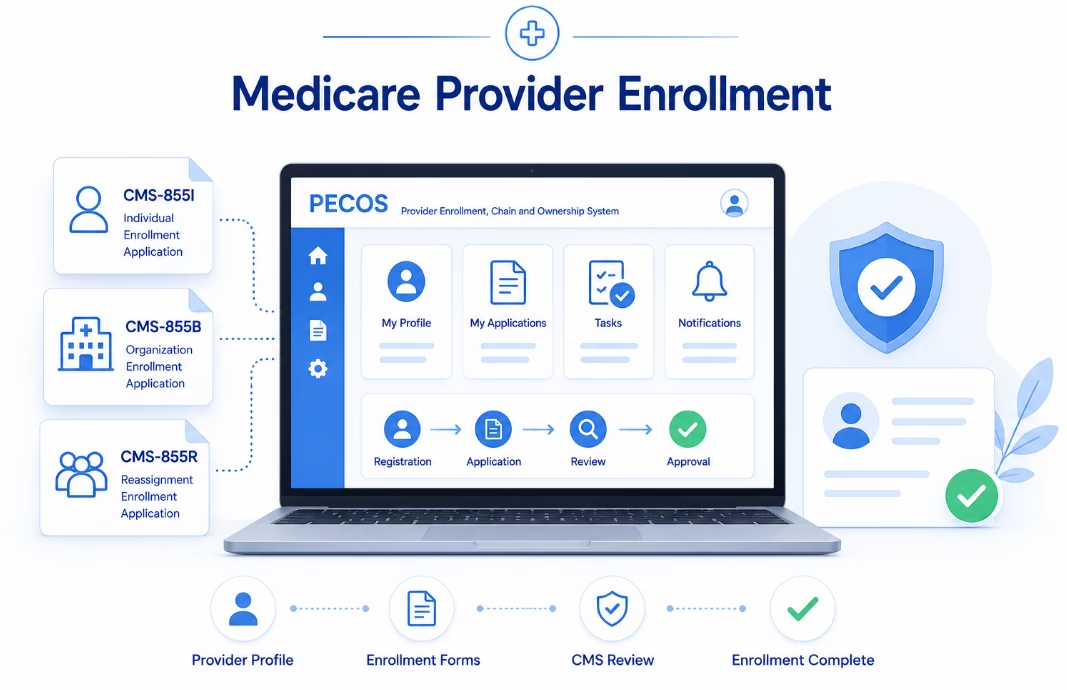
- PECOS enrollment records
- Practice locations
- Reassignment relationships
- Ownership information where applicable
- Reportable changes
- Revalidation due dates
Most Medicare providers and suppliers generally revalidate every five years, while DMEPOS suppliers generally revalidate every three years. CMS may also require off-cycle revalidation.
See our Medicare provider enrollment workflow guide for the complete process.
Strategy 13: Monitor CLIA Requirements if the Practice Performs Testing
Practices performing laboratory testing should maintain a separate CLIA compliance workflow.
The applicable requirements depend on factors such as:
- Tests performed
- Complexity classification
- Certificate type
- Personnel requirements
- Quality requirements
- State laboratory requirements where applicable
A CLIA waiver does not mean a practice is exempt from all CLIA requirements.
See our CLIA compliance 2026 guide for practices performing point-of-care or other laboratory testing.
Strategy 14: Use Risk-Based Internal Audits
There is no universal rule that every healthcare practice must perform a monthly internal compliance audit and an annual external audit.
Instead, an audit schedule should consider:
- Regulatory requirements
- Payer contracts
- Accreditation requirements
- Prior audit findings
- Billing volume
- Risk areas
- Recent regulatory changes
- New services or technology
Higher-risk areas may warrant more frequent review.
Strategy 15: Document What Changed and What You Did About It
Regulatory monitoring is incomplete if the organization cannot show what happened after an important update was identified.
A regulatory change log can record:
| Field | Example |
|---|---|
| Source | CMS |
| Topic | Telehealth billing |
| Publication date | Date agency released update |
| Effective date | Date new requirement begins |
| Affected department | Billing and clinical operations |
| Required action | Update billing workflow |
| Owner | Assigned compliance lead |
| Completion | Date change was implemented |
Documentation supports continuity, training, audit preparation, and organizational accountability.
Which Healthcare Regulations Should Practices Monitor in 2026?
| Area | What to Monitor | Primary Source |
|---|---|---|
| Medicare PFS | Payment policy, coding, telehealth, supervision, quality-program updates | CMS |
| Medicare enrollment | PECOS, revalidation, enrollment changes, reassignment | CMS and MAC |
| Telehealth | Medicare coverage plus state licensure and prescribing requirements | CMS, HHS, state boards |
| HIPAA | Privacy, Security, Breach Notification, OCR guidance and enforcement | HHS OCR |
| Exclusions | LEIE screening and exclusion updates | HHS OIG |
| Credentialing | Licenses, recredentialing, payer requirements, sanctions monitoring | Payers, licensing boards, applicable standards |
| CLIA | Certificate, testing, personnel, quality requirements | CMS |
| Medicaid | Enrollment, billing, managed care, state program requirements | State Medicaid agency |
How Often Should Regulatory Updates Be Reviewed?
There is no single review frequency appropriate for every source.
A practical approach is to classify information by urgency.
Continuous or event-driven monitoring
Use for:
- Security incidents
- Urgent payer alerts
- Licensing-board actions
- Immediate CMS billing changes
Monthly review
Useful for areas such as:
- OIG LEIE screening
- Upcoming credential expirations
- Regulatory update logs
Quarterly or periodic review
Useful for:
- Policy review
- Internal compliance trends
- Selected billing and documentation audits
Annual rule-cycle review
Useful for:
- Medicare Physician Fee Schedule
- Annual coding changes
- Quality-program updates
- Organizational compliance planning
The final frequency should reflect actual risk and applicable requirements.
Frequently Asked Questions
What is the best way to stay informed about healthcare regulations?
Start with authoritative government and regulatory sources, assign each topic to an internal owner, track effective dates, and document whether an operational change is required.
Should practices rely on social media for regulatory updates?
Social media can alert you to a potential development, but important decisions should be verified against the applicable government agency, payer, licensing board, or official rule.
Does HIPAA require a security risk analysis every year?
No. HHS requires an ongoing risk-analysis and risk-management process but does not prescribe one universal annual frequency. Organizations should reassess as their systems, operations, threats, and risks change.
Does OIG require daily exclusion screening?
No universal federal requirement mandates daily LEIE screening. OIG updates the LEIE monthly and states that monthly screening best minimizes potential exposure.
Should NPDB reports be checked daily?
No. NPDB access is limited to eligible organizations and permitted purposes. Eligible organizations needing ongoing monitoring may use the NPDB’s Continuous Query service.
Have Medicare telehealth rules returned to pre-pandemic limits?
No. As of October 2026, many Medicare telehealth flexibilities have been extended through December 31, 2027, although individual services and billing requirements still need to be verified.
How often do Medicare providers revalidate?
Most Medicare providers and suppliers generally revalidate every five years, while DMEPOS suppliers generally revalidate every three years. CMS can also require off-cycle revalidation.
Can compliance software automatically keep a practice compliant?
No. Software can track deadlines, alerts, documents, and assigned tasks, but regulatory interpretation, policy decisions, implementation, and oversight still require responsible human review.
Turn Regulatory Monitoring Into a Repeatable Workflow
Staying informed about healthcare regulations does not require chasing every headline.
It requires a repeatable process:
- Identify which regulatory sources apply.
- Subscribe to authoritative updates.
- Separate proposals from final requirements.
- Track effective dates.
- Assign responsibility.
- Determine operational impact.
- Implement required changes.
- Document completion.
- Review the process periodically.
eClinicAssist supports healthcare organizations with provider credentialing, payer enrollment, licensing and document tracking, Medicare and Medicaid enrollment administration, CAQH management, renewal reminders, task management, and related administrative workflows.
eClinicAssist does not provide legal advice, automatically determine which regulations apply to a practice, or guarantee regulatory compliance.
Contact eClinicAssist to discuss credentialing and provider-enrollment workflow support for your organization.
This article provides general educational and administrative information and is not legal, regulatory, billing, cybersecurity, clinical, or payer-specific advice. Healthcare requirements change frequently and vary by organization, service, payer, state, and program. Verify current requirements with the applicable government agency, payer, licensing authority, or qualified professional.