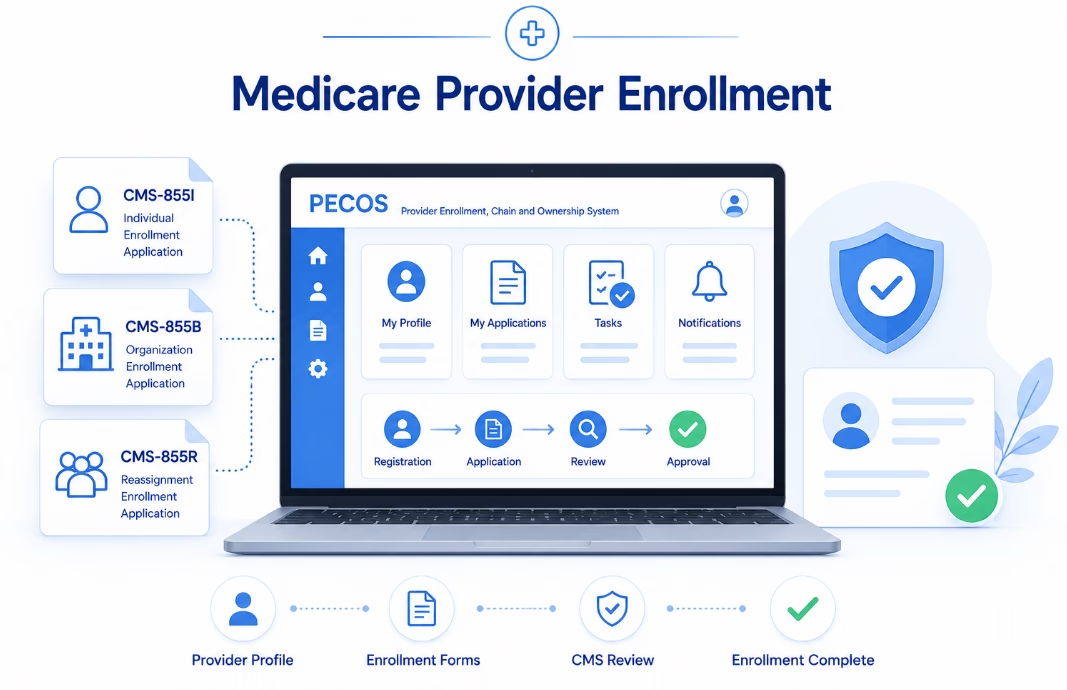

The Medicare Medicaid credentialing process is better understood as two separate government provider enrollment workflows. Medicare enrollment is managed through CMS, PECOS, and Medicare Administrative Contractors. Medicaid enrollment is administered by individual states under federal screening requirements. Medicaid managed care may add separate credentialing, contracting, affiliation, and network-participation requirements.
Healthcare practices often use the phrase “Medicare and Medicaid credentialing” to describe getting a provider ready to participate in government health programs.
Operationally, however, Medicare and Medicaid do not use one shared credentialing process. For patients covered by both programs, see our explanation of Medicare and Medicaid dual eligibility billing, which is separate from provider enrollment.
Practices should separate:
- Professional credentialing
- Medicare enrollment
- Medicaid enrollment
- Medicaid managed care participation
- Group affiliation
- Practice-location setup
- Reassignment
- Revalidation
This makes it much easier to see what has actually been completed and what still prevents the intended billing relationship from becoming active.
Is Medicare and Medicaid Credentialing Really Credentialing?
Not in the same sense as commercial health plan credentialing.
Professional credentialing generally evaluates a provider’s qualifications, such as:
- Licensure
- Education
- Training
- Certification
- Professional history
- Sanctions
Medicare and Medicaid primarily use provider enrollment and screening processes to establish providers and suppliers within their programs.
Those enrollment processes may verify many of the same qualifications, but the terminology and administrative structure are different.
Medicare vs Medicaid Enrollment at a Glance
| Area | Medicare | Medicaid |
|---|---|---|
| Primary administrator | CMS and Medicare Administrative Contractors | Individual state Medicaid agencies |
| Primary enrollment system | PECOS | State-specific enrollment system |
| Screening | CMS provider enrollment requirements | Federal risk-based screening plus state requirements |
| Managed care | Not the same structure as Medicaid MCO enrollment | May require additional MCO credentialing or contracting |
| Revalidation | Generally 5 years, 3 years for DMEPOS, plus possible off-cycle review | At least every 5 years under federal rules, with state variation |
Step 1: Confirm the Provider’s Legal and Professional Requirements
Before starting government enrollment, verify that the provider has the professional authority needed for the services they will furnish.
Depending on provider type, this may include:
- Active professional license
- National certification where applicable
- NPI
- DEA registration where applicable
- State controlled-substance authority where applicable
- Practice-location information
Not every provider needs every document.
See our provider credentialing documents guide for a broader provider-file checklist.
Step 2: Obtain the Correct NPI
Medicare and Medicaid enrollment commonly rely on the provider’s National Provider Identifier.
Individuals generally use a Type 1 NPI.
Organizations generally use a Type 2 NPI.
The NPI identifies the provider or organization but does not by itself establish:
- Medicare enrollment
- Medicaid enrollment
- Credentialing approval
- Network participation
- Payment eligibility
Step 3: Determine the Correct Medicare Enrollment Type
Medicare enrollment depends on the provider or supplier type.
Common enrollment categories include:
- Physicians
- Non-physician practitioners
- Group practices
- Clinics
- Institutional providers
- Suppliers
- Ordering and certifying practitioners
CMS uses different enrollment applications and requirements depending on the category.
Step 4: Submit Medicare Enrollment Through PECOS
PECOS is CMS’s online Medicare enrollment management system.
Providers and organizations can use PECOS to:
- Submit initial Medicare enrollment
- Review information already on file
- Upload supporting documents
- Sign and submit applications electronically
- Report enrollment changes
- Manage applicable reassignment relationships
- Complete revalidation
The applicable Medicare Administrative Contractor, or MAC, reviews the enrollment application.
See our Medicare provider enrollment workflow guide for the detailed PECOS process.
Step 5: Respond to Medicare Administrative Contractor Requests
After submission, the MAC may request additional information.
This can include clarification or documentation involving:
- Professional licenses
- Ownership
- Managing employees
- Practice locations
- Supporting documents
- Enrollment relationships
Practices should track the actual response deadline supplied by the MAC.
Step 6: Establish Medicare Reassignment Where Applicable
An individual practitioner’s Medicare enrollment is not the same as the practitioner’s relationship with a group practice.
Reassignment of benefits establishes the applicable relationship through which an eligible practitioner reassigns Medicare benefits to an enrolled organization.
Practices should separately confirm:
- Individual practitioner enrollment
- Organization enrollment
- Reassignment relationship
- Practice location
A provider being individually enrolled does not automatically mean the provider is correctly linked to a new group.
Step 7: Confirm the Medicare Effective Enrollment Relationship
Submission, approval, reassignment, and billing effective dates should not automatically be treated as the same date.
Before the billing team relies on the enrollment, verify the applicable:
- Provider enrollment status
- Organization enrollment status
- Reassignment
- Practice location
- Applicable effective date
Step 8: Start Medicaid Enrollment Separately
Medicaid enrollment is administered by individual states.
That means a provider participating in Medicaid in one state is not automatically enrolled in another state’s Medicaid program.
State enrollment may require:
- NPI
- Professional licensure
- Ownership and control disclosures
- Provider-type information
- Practice locations
- Screening
- Additional state-specific information
The actual requirements must be verified with the applicable state Medicaid agency.
How Does Medicaid Provider Screening Work?
Federal Medicaid rules require participating providers to be screened according to categorical risk level.
Screening applies during:
- Initial enrollment
- Reenrollment
- Revalidation
The screening level depends on the provider category.
Does Every Medicaid Provider Need Fingerprinting?
No.
Fingerprint-based criminal background checks apply to certain providers subject to high-risk screening requirements.
Depending on risk level, screening can also include:
- License verification
- Database checks
- Site visits
- Fingerprint-based criminal background checks
States may also impose additional screening methods permitted under federal rules.
Step 9: Complete Medicaid Ownership and Disclosure Requirements
Medicaid enrollment can require detailed ownership, control, managing employee, and related disclosures.
The exact information depends on:
- Provider type
- Organization structure
- State requirements
Organizational practices should collect this information before starting applications so ownership questions do not have to be reconstructed during enrollment.
Step 10: Address Medicaid Managed Care Separately
State Medicaid enrollment does not always complete participation with every Medicaid managed care organization.
Depending on the state and plan, the practice may also need:
- MCO network request
- Credentialing
- Contracting
- Provider enrollment
- Group affiliation
- Practice-location activation
- Effective-date confirmation
This is one of the most important distinctions in Medicaid participation.
Is Medicaid Credentialing the Same as Medicaid Enrollment?
No.
State Medicaid enrollment establishes the provider with the state program.
Credentialing may separately occur through a Medicaid managed care organization or another credentialing entity.
A provider can therefore be enrolled with the state Medicaid program while still waiting for participation with a specific Medicaid MCO.
Does Medicare Require a Commercial-Style Contract?
Traditional Medicare enrollment should not be described like commercial payer contracting.
Medicare participation and enrollment are governed by federal program rules rather than negotiated provider-network contracts with individually negotiated reimbursement rates.
This differs from commercial plans and many Medicaid managed care relationships.
Can Medicare or Medicaid Enrollment Begin While Commercial Credentialing Is Pending?
Often, yes.
Medicare, Medicaid, and commercial payer workflows are separate.
When the required information is available, practices can frequently manage them in parallel.
One payer’s pending credentialing review does not automatically prevent another program’s enrollment application from being prepared or submitted. For differences between insurer processes, see our payer credentialing requirements guide.
How Often Does Medicare Revalidation Occur?
CMS currently states that:
- Most Medicare providers and suppliers generally revalidate every five years.
- DMEPOS suppliers generally revalidate every three years.
- CMS may require off-cycle revalidation.
CMS publishes revalidation due dates in advance.
Practices remain responsible for monitoring those dates even if a notice is also sent by the enrollment contractor.
What Happens if Medicare Revalidation Is Missed?
CMS states that failing to revalidate on time can result in:
- A hold on Medicare reimbursement
- Deactivation of Medicare billing privileges
If billing privileges are deactivated, a complete Medicare enrollment application may be required for reactivation.
CMS also states that Medicare does not reimburse services furnished during the period of deactivation.
How Often Does Medicaid Revalidation Occur?
Federal Medicaid rules require states to revalidate provider enrollment at least every five years.
States may establish additional or more stringent screening requirements and may conduct off-cycle revalidation when warranted.
The actual state due date and process should therefore be tracked through the applicable Medicaid program.
Does Medicaid Revalidation Include Screening Again?
Yes.
Federal guidance states that the applicable provider screening requirements also apply during Medicaid revalidation.
That means the provider’s risk category can affect the revalidation process, including whether additional screening measures apply.
Step 11: Maintain Medicare Enrollment Information
Medicare enrollment records must remain current after approval.
CMS currently requires many physicians, non-physician practitioners, and related organizations to report certain changes within 30 days, including applicable changes involving:
- Ownership or control
- Practice location
- Final adverse legal actions
Many other changes generally must be reported within 90 days.
Different provider and supplier categories can have different reporting rules.
Step 12: Maintain Medicaid Enrollment Information
States establish procedures for maintaining Medicaid provider records.
Practices should monitor state requirements involving:
- Ownership changes
- Practice locations
- Licensure
- Group affiliations
- Revalidation
- Other reportable information
Do not assume Medicare change-reporting deadlines apply automatically to Medicaid.
Common Medicare and Medicaid Enrollment Mistakes
Calling everything credentialing
Medicare enrollment, Medicaid enrollment, commercial credentialing, and Medicaid MCO credentialing are separate processes.
Using CAQH as a Medicare requirement
CAQH is commonly used for commercial credentialing. It does not replace PECOS or Medicare enrollment.
Assuming Medicare enrollment links the provider to every group
Reassignment relationships should be confirmed separately.
Assuming state Medicaid enrollment activates every MCO
Managed care plans may require additional credentialing, contracting, or affiliation.
Assuming every Medicaid provider requires fingerprints
Screening requirements depend on provider category and risk level.
Applying one revalidation cycle to both programs
Medicare and Medicaid have separate revalidation rules and processes.
Treating approval as a billing effective date
The actual enrollment, affiliation, and effective date should be confirmed before relying on the payer relationship.
Medicare and Medicaid Enrollment Checklist
| Area | What to Confirm |
|---|---|
| Professional authority | Required license and provider qualifications are current |
| NPI | Correct Type 1 or Type 2 NPI established |
| Medicare | Correct PECOS enrollment submitted |
| MAC review | Requests and deadlines monitored |
| Medicare reassignment | Practitioner-to-group relationship confirmed where applicable |
| Medicaid | Correct state enrollment completed |
| Medicaid screening | Provider risk-category requirements satisfied |
| Medicaid MCO | Separate managed care participation confirmed where applicable |
| Effective date | Confirmed for the applicable billing relationship |
| Maintenance | Required Medicare and Medicaid changes tracked separately |
| Revalidation | Program-specific due dates monitored |
Frequently Asked Questions
What is the Medicare Medicaid credentialing process?
The phrase usually refers to getting providers approved to participate in Medicare and Medicaid, but the more accurate term is provider enrollment. Medicare uses CMS and PECOS, while Medicaid enrollment is administered by individual states.
Does Medicare use CAQH for credentialing?
No. Medicare enrollment is managed through CMS systems such as PECOS. CAQH is primarily associated with commercial payer credentialing workflows.
Does Medicaid use PECOS?
No. Medicaid provider enrollment is administered through state-specific enrollment processes.
Does every Medicaid provider undergo a background check?
Providers are subject to risk-based screening. Fingerprint-based criminal background checks apply to certain high-risk categories rather than every Medicaid provider.
Does Medicare require reassignment to a group?
An eligible practitioner who bills through an organization may need the appropriate reassignment relationship. Individual Medicare enrollment and reassignment should be tracked separately.
Does state Medicaid approval mean the provider is active with every Medicaid MCO?
No. Medicaid managed care organizations may require additional credentialing, contracting, enrollment, affiliation, or effective-date setup.
How often does Medicare revalidation occur?
Most Medicare providers and suppliers generally revalidate every five years, while DMEPOS suppliers generally revalidate every three years. CMS may also require off-cycle revalidation.
How often does Medicaid revalidation occur?
Federal Medicaid rules require provider revalidation at least every five years. States may use additional screening requirements or off-cycle revalidation.
Can Medicare and Medicaid applications be worked at the same time?
Often, yes. They are separate enrollment processes and can frequently proceed in parallel when the required provider and organization information is available.
Does approval guarantee reimbursement?
No. Payment still depends on factors such as covered services, eligibility, coding, medical necessity, billing rules, effective dates, claim submission, and other program requirements.
Manage Medicare and Medicaid as Separate Enrollment Workflows
The most reliable way to handle the Medicare Medicaid credentialing process is to stop treating it as one combined credentialing application.
Practices should separately track:
- Medicare individual enrollment
- Medicare organization enrollment
- Medicare reassignment
- Medicare practice locations
- State Medicaid enrollment
- Medicaid screening
- Medicaid managed care participation
- Program-specific effective dates
- Medicare and Medicaid revalidation
This structure makes it easier to identify exactly which requirement remains incomplete.
eClinicAssist supports healthcare organizations with Medicare enrollment administration, PECOS workflow tracking, state Medicaid enrollment administration, provider-document management, payer follow-up, commercial credentialing, CAQH management, group affiliation, and revalidation tracking.
eClinicAssist does not make Medicare or Medicaid enrollment decisions, determine screening outcomes, set effective dates, or guarantee reimbursement or program participation.
Contact eClinicAssist to discuss Medicare, Medicaid, credentialing, and payer enrollment support for your organization.
This article provides general administrative information and is not legal, billing, regulatory, Medicare, Medicaid, or payer-specific advice. Requirements vary by provider type, state, program, managed care organization, and enrollment circumstance. Verify current requirements with CMS, the applicable Medicare Administrative Contractor, state Medicaid agency, or managed care plan.